
If you’re wondering what does pressed mean slang, it usually means bothered, annoyed, upset, offended, or overly concerned about something. When someone asks, “Why are you so pressed?” they usually mean, “Why are you so bothered?”
You may see pressed in text messages, TikTok comments, Instagram posts, group chats, and everyday casual conversations. The word is often used when someone seems to be reacting strongly to a comment, opinion, joke, argument, or situation.
For example:
“Why are you so pressed about my opinion?”
Here, pressed means bothered or overly concerned.
The meaning can change slightly depending on the situation, so context and tone are important.
What Does Pressed Mean in Slang?
In modern slang, pressed describes someone who seems bothered, upset, annoyed, offended, or emotionally affected by something.
For example:
“He got pressed when I disagreed with him.”
This means that he seemed bothered or upset by the disagreement.
The word does not always mean someone is extremely angry. A person can be slightly annoyed, defensive, disappointed, or simply too concerned about an issue and still be described as pressed.
Quick Meaning
Pressed = bothered + upset + emotionally affected + reacting strongly
The exact meaning depends on the conversation.
What Does Pressed Mean in Simple Words?
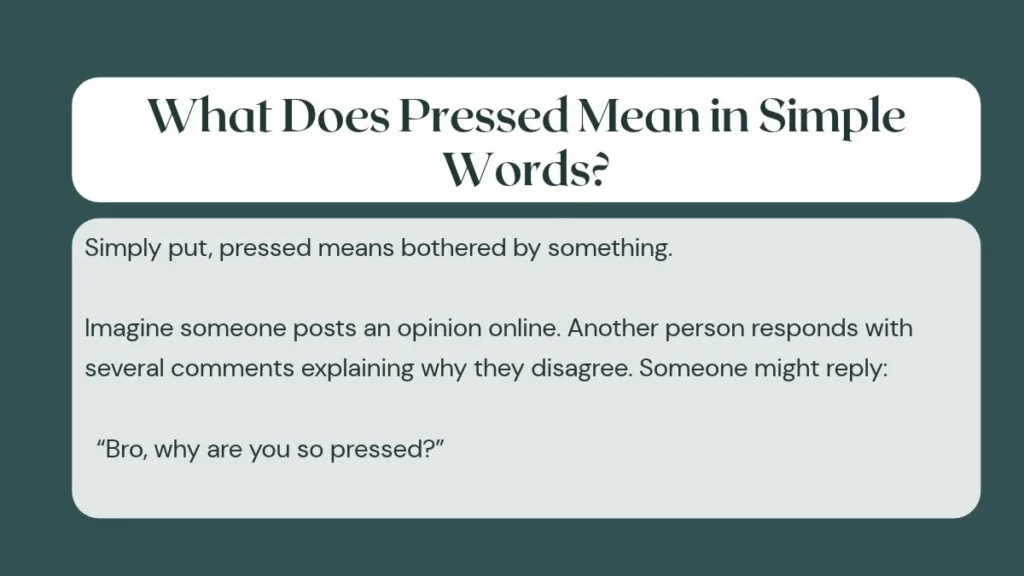
Simply put, pressed means bothered by something.
Imagine someone posts an opinion online. Another person responds with several comments explaining why they disagree. Someone might reply:
“Bro, why are you so pressed?”
The speaker is suggesting that the other person is taking the situation too seriously or allowing it to affect them.
The word can also be playful between friends:
“You lost one game and you’re this pressed?”
In this example, the speaker may simply be teasing their friend for caring so much about losing.
So, being pressed does not automatically mean being furious. It is a broader way of saying someone appears bothered or affected.
What Does Pressed Mean in Text?
In texting, pressed usually means bothered, annoyed, upset, or overly concerned.
You might see messages such as:
- “Why are you pressed?”
- “Don’t get pressed.”
- “He’s so pressed.”
- “She got pressed over nothing.”
- “Are you pressed?”
- “You sound pressed.”
- “I’m not pressed.”
For example:
“Why are you pressed?”
This usually means:
“Why are you so bothered?”
If someone says:
“I’m not pressed.”
They mean:
“I’m not bothered or upset.”
Tone matters a lot in text because there is no voice or facial expression to explain what the person means.
What Does Pressed Mean on TikTok and Instagram?
On TikTok, Instagram, and other social platforms, pressed is commonly used when someone appears bothered by a post, comment, opinion, joke, trend, or situation.
For example:
“You wrote three paragraphs about this. You’re pressed 😭”
The person is joking that the commenter seems to care too much about the subject.
Another example is:
“Why are you so pressed about what she posted?”
Here, pressed means bothered or overly concerned.
On social media, the word can sound funny and playful, but it can also be sarcastic or dismissive.
Pressed Meaning in Real-Life Conversations
Although pressed is especially common online, people also use it in casual conversations.
For example:
“He still seems pressed about what happened yesterday.”
This means he appears to still be bothered by the situation.
Someone might use the word when talking about:
- An argument
- Losing a game
- Criticism
- A joke
- Competition
- Rejection
- Social media comments
- An embarrassing moment
- Someone’s opinion
- A disagreement
The common idea is that the person appears emotionally affected by something.
Examples of Pressed in Sentences
Here are some natural examples of how people use pressed:
- Why are you so pressed about what I posted?
- He got pressed after losing the game.
- She seems pressed because nobody agreed with her.
- Don’t get pressed over a silly comment.
- Everyone was joking, but he looked genuinely pressed.
- Why does that comment have you so pressed?
- I’m not pressed about who wins.
- You seem pretty pressed about this situation.
- He was still pressed about the argument.
- Don’t be so pressed; I was only joking.
These examples show that pressed is usually connected to a person’s reaction rather than the actual event itself.
Different Meanings of Pressed by Context
The word pressed can have different meanings depending on where you see it.
| Context | Meaning | Example |
|---|---|---|
| Casual conversation | Bothered or upset | “Why are you pressed?” |
| Texting | Emotionally affected | “He’s pressed lol.” |
| TikTok | Bothered by content or an opinion | “You seem pressed.” |
| Annoyed or offended | “She got pressed over the post.” | |
| Formal writing | Usually not slang | Use “concerned” or “upset.” |
| Standard English | Physically pushed or applied with pressure | “She pressed the button.” |
This is why you should always look at the surrounding words before deciding what pressed means.
Is Pressed Slang or a Normal English Word?
Pressed is both a standard English word and an informal slang expression.
In standard English, pressed can mean something was pushed or squeezed.
For example:
“He pressed the button.”
But when someone says:
“Why are you so pressed?”
the word has a slang meaning. It means the person appears bothered or upset.
So, the sentence and context tell you which meaning is intended.
Where Did the Slang Word Pressed Come From?
The standard word press has long been associated with ideas such as pushing, squeezing, applying pressure, and forcing something down.
The modern slang sense appears to extend the idea of pressure into an emotional situation. Someone who is bothered by something can be described figuratively as being under pressure or affected by it.
Informal slang often develops gradually through everyday speech, music, online communities, and social media, so there is not always one simple moment when a slang meaning begins.
Today, pressed is widely recognized in casual American English and internet conversations.
Why Do People Say Pressed?
People use pressed because it is short and expressive.
Instead of saying:
“You seem unusually bothered by this situation.”
someone can simply say:
“You’re pressed.”
The word can also add attitude to a conversation. Depending on the speaker’s tone, it may sound:
- Playful
- Funny
- Teasing
- Sarcastic
- Dismissive
- Confrontational
This is one reason it appears so often in online conversations.
What Does Pressed Say About Someone’s Reaction?
When people call someone pressed, they are usually commenting on how that person appears to be reacting.
Someone may be called pressed because they:
- Keep arguing about an issue
- React strongly to criticism
- Cannot seem to let something go
- Take a joke personally
- Get upset after losing
- Spend a lot of time defending themselves
However, pressed is not a psychological diagnosis. Calling someone pressed does not prove what they are actually feeling.
A person may respond strongly because they are confused, stressed, tired, or simply trying to explain their point. The slang describes how a reaction appears to another person.
Is Pressed Positive, Negative, or Neutral?
In slang, pressed is usually negative or teasing, although it is not necessarily offensive.
For example:
“Why are you so pressed? 😂”
This could be playful between friends.
But:
“Stay pressed.”
usually has a more dismissive or provocative tone.
The meaning therefore depends heavily on the relationship between the speakers and the situation.
Is It Rude to Call Someone Pressed?
It can be.
Among close friends, calling someone pressed may be harmless teasing. During a serious disagreement, however, it can sound dismissive because it focuses on the person’s emotional reaction instead of their actual argument.
For example:
“Why are you so pressed?”
could be funny in a group chat but rude during a serious conversation.
If you want to sound more respectful, you could say:
- “Is something bothering you?”
- “Are you concerned about this?”
- “Would you like to explain your point?”
- “I understand that you disagree.”
These alternatives focus on the conversation rather than labeling someone’s reaction.
What Does “Stay Pressed” Mean?
“Stay pressed” is a sarcastic or dismissive slang expression.
It generally means:
“Keep being bothered.”
For example:
“You don’t like my opinion? Stay pressed.”
The phrase is usually more provocative than simply saying “Why are you pressed?”
It can be used jokingly between friends, but in an argument it may make the situation more heated.
What Does “Not Pressed” Mean?
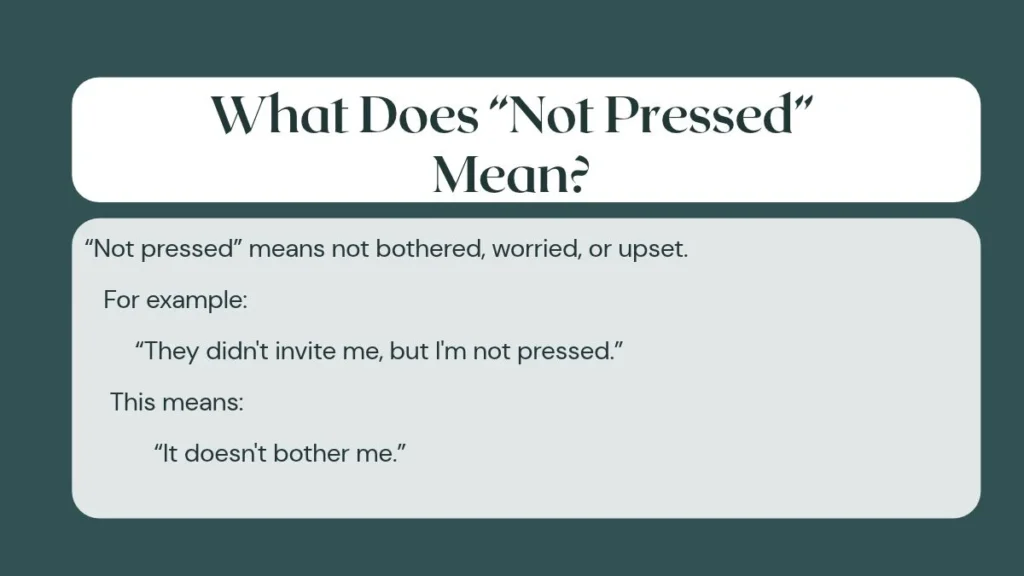
“Not pressed” means not bothered, worried, or upset.
For example:
“They didn’t invite me, but I’m not pressed.”
This means:
“It doesn’t bother me.”
Another example:
“I’m not pressed about the result.”
This means the speaker is not particularly concerned about the result.
Pressed vs. Similar Slang Words
Although several slang words can describe someone’s emotional reaction, they are not exactly the same.
| Word | Common Meaning | Difference |
|---|---|---|
| Pressed | Bothered or upset | Often suggests someone cares too much |
| Bothered | Annoyed or concerned | More neutral |
| Triggered | Strongly emotionally affected | Often suggests a stronger reaction |
| Salty | Bitter or annoyed | Often connected with losing or disappointment |
| Mad | Angry or upset | Broader and more common |
One important difference is that pressed often suggests that someone is more bothered by something than they need to be.
When Should You Use Pressed?
Use pressed when the conversation is casual and the people involved understand slang.
It can work well in:
- Text messages
- Group chats
- Social media comments
- Casual conversations
- Jokes between friends
- Informal online communities
Before using it, consider the situation and your relationship with the other person.
A slang word that sounds funny among friends may sound disrespectful in a serious conversation.
When Should You Avoid Using Pressed?
The slang meaning of pressed is usually not suitable for formal writing.
For example, instead of writing:
“My manager is pressed about the report.”
a professional sentence would be:
“My manager is concerned about the report.”
Similarly, in academic writing, words such as concerned, frustrated, upset, worried, or emotionally affected are usually clearer and more appropriate.
Be especially careful when speaking to:
- A teacher
- A supervisor
- A client
- Someone you do not know well
- Someone discussing a serious issue
- Someone who is already upset
What Does Pressed Mean in American English?
In American informal English, pressed can describe someone who appears bothered, annoyed, offended, or overly concerned.
It is especially common in internet conversations, memes, comment sections, and casual speech.
For example:
“Why are you so pressed?”
is a familiar informal way to ask why someone seems bothered.
People outside the United States may also use the expression because social media has spread American internet slang around the world.
However, not everyone will understand slang in exactly the same way. If clarity matters, bothered or upset is usually easier to understand.
Common Misconceptions About Pressed
One common mistake is assuming that pressed always means angry.
It does not.
Someone who is pressed might be:
- Annoyed
- Offended
- Defensive
- Embarrassed
- Disappointed
- Worried
- Overly concerned
For example:
“She was pressed about the dress code.”
This does not necessarily mean she was furious. It could simply mean that she was bothered or strongly concerned about it.
How to Respond When Someone Calls You Pressed
Your response depends on the situation.
Casual Responses
You could say:
- “I’m good. Not pressed.”
- “Nah, I’m just saying.”
- “I’m not bothered.”
- “Relax, I’m fine.”
Funny Responses
If the conversation is clearly playful, you might say:
- “Apparently I’m pressed 😂”
- “You caught me caring for five seconds.”
- “I’m recovering from the drama 😂”
Calm Responses
If the conversation is becoming serious, you could say:
- “I’m not upset. I simply disagree.”
- “I’m just explaining my point.”
- “I’d rather focus on the issue.”
- “Let’s talk about what actually happened.”
A calm response can help keep a disagreement from becoming more heated.
A Simple Way to Understand Pressed
When you see pressed, ask yourself what the word is describing.
Is it describing an object being pushed?
Then it probably has its standard English meaning.
“She pressed the button.”
Is it describing a person’s reaction?
Then it probably means bothered or upset.
“Why are you so pressed?”
Is it being used in a TikTok, Instagram, or text conversation?
The slang meaning is likely.
Is it being used in a formal document?
It may have its standard meaning, or another word such as concerned or upset may be more appropriate.
This simple check makes the meaning much easier to understand.
Frequently Asked Questions About Pressed Slang
What does “pressed” mean in slang?
In slang, pressed usually means bothered, upset, annoyed, offended, or overly concerned about something. “Why are you pressed?” usually means “Why are you so bothered?”
What does “pressed” mean in text?
In text messages, pressed usually means that someone seems bothered or emotionally affected by something.
What does “pressed” mean on TikTok?
On TikTok, pressed commonly describes someone who appears bothered by a video, comment, opinion, trend, or situation. It is often used jokingly or sarcastically.
Is pressed the same as angry?
Not exactly. Pressed can include anger, but it can also mean annoyed, offended, defensive, embarrassed, disappointed, or overly concerned.
What does “why are you so pressed?” mean?
It usually means “Why are you so bothered?” or “Why is this affecting you so much?”
What does “I’m not pressed” mean?
It means “I’m not bothered”, “I’m not upset,” or “I don’t really care about it.”
Is calling someone pressed rude?
It can be. Among friends it may be playful, but during a serious disagreement it can sound dismissive or insulting.
What does “stay pressed” mean?
“Stay pressed” is usually a sarcastic or dismissive way of saying “Keep being bothered.” Depending on the situation, it can be playful or confrontational.
What is the opposite of pressed?
Common opposites include unbothered, calm, relaxed, unconcerned, indifferent, and not worried.
Key Takeaways
- Pressed is common informal slang for being bothered, annoyed, upset, offended, or overly concerned.
- “Why are you so pressed?” usually means “Why are you so bothered?”
- The expression is common in texting, TikTok, Instagram, memes, and casual American English.
- Pressed does not always mean angry.
- The word can sound playful, teasing, sarcastic, dismissive, or confrontational.
- “Stay pressed” is generally more provocative than simply saying “pressed.”
- Context and tone are important when understanding or using the word.
- In professional and academic writing, clearer words such as concerned, upset, or frustrated are usually better.
Conclusion
So, what does pressed mean slang? In most casual conversations and online posts, pressed means bothered, upset, annoyed, offended, or overly concerned about something.
If someone says, “Why are you so pressed?”, they are usually asking why you seem so bothered or why the situation appears to affect you so much.
You may see the word on TikTok, Instagram, in text messages, or during casual conversations. Its tone can range from playful teasing to a dismissive response, so the relationship between the speakers and the situation matter.
The easiest way to remember it is:
Pressed = bothered or emotionally affected by something.
Once you understand the context, this common slang expression becomes much easier to recognize.

James Walker is a passionate writer, dream analyst, and content creator who specializes in uncovering the deeper meanings behind everyday experiences, symbols, and dreams. As a featured author on meaniings.com, he is dedicated to helping readers understand hidden messages within their subconscious and guiding them toward clarity, purpose, and self-discovery.
With a strong interest in psychology, spirituality, and real-life storytelling, James blends research with relatable insights to create engaging and easy-to-understand content. His writing focuses on dream meanings, symbolism, emotional awareness, and personal growth—making complex ideas simple for readers from all backgrounds.
James Walker began his writing journey with a desire to share meaningful stories and life lessons inspired by real experiences. Like many inspirational writers, he believes that every dream and life situation carries a message worth exploring. His work aims to educate, inspire, and empower readers to better understand themselves and the world around them.
Over time, his thoughtful approach and engaging style have helped him build a loyal readership. He continues to contribute valuable content that aligns with the mission of meaniings.com—to provide accurate, insightful, and helpful interpretations.
Notable Works by James Walker:
Growing Up with Jessica: A True Story (inspirational real-life journey)
Dream Symbols and Their Hidden Meanings
The Power of Dreams: Understanding Your Inner Mind