
If you are wondering what does btw mean, it usually means “by the way.” People use BTW in texts, chats, emails, comments, and social media when they want to add an extra thought, change the subject slightly, or mention something they just remembered.
What Does BTW Mean? (Quick Answer)
BTW can mean:
- By the way — the standard meaning in texting and online conversations.
- Incidentally — used to introduce an additional or side point.
- As an aside — used when adding information that is not the main topic.
- BTW can have other meanings in specialized fields, but “by the way” is by far the most common meaning in everyday communication.
Merriam-Webster lists BTW as an abbreviation for “by the way,” while Oxford explains that “by the way” introduces a comment or question that is not directly related to the current topic.
What Does BTW Mean?
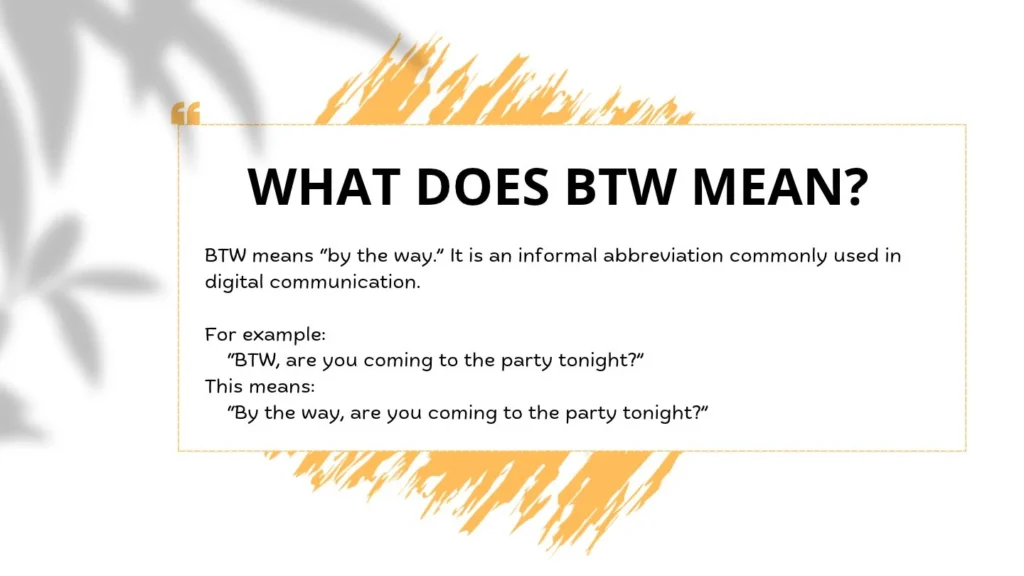
BTW means “by the way.” It is an informal abbreviation commonly used in digital communication.
For example:
“BTW, are you coming to the party tonight?”
This means:
“By the way, are you coming to the party tonight?”
The abbreviation allows people to communicate the same idea more quickly. It is especially common in text messages, direct messages, online comments, forums, and casual emails.
The important thing to understand is that BTW does not normally change the meaning of the sentence that follows it. Instead, it signals that the writer is adding a side comment or bringing up another thought.
Key Takeaway
BTW = by the way.
It is generally informal, neutral, and conversational, rather than rude or offensive.
Full Meaning in Simple Words
In simple English, “by the way” means “I have something else to mention.”
Imagine that two friends are talking about dinner:
“I’m ordering pizza tonight. BTW, your package arrived at my house.”
The package has nothing to do with the pizza. The speaker uses BTW to introduce this additional piece of information.
You can think of BTW as a small conversational bridge. It tells the reader:
“This isn’t the main topic, but I want to tell you something else.”
The phrase can introduce a question, reminder, observation, update, or completely new subject.
What Does BTW Mean in Text?
In texting, BTW means “by the way.” It is often used to add information without starting a completely separate conversation.
For example:
“I’ll meet you at 7. BTW, bring your jacket.”
Here, the main message is about meeting at 7. The second sentence is an additional reminder.
Another example:
“Did you finish the assignment? BTW, the teacher moved the deadline.”
The writer uses BTW to introduce a related update.
Is BTW Slang?
BTW is informal internet shorthand, but it is not really slang in the same sense as words such as “lit,” “sus,” or “no cap.”
It is better described as an abbreviation or initialism used in informal digital communication.
Merriam-Webster has discussed BTW alongside other common online abbreviations such as TBH, FYI, and IMO, noting that computer-based communication helped spread many of these shortened forms.
What Does BTW Mean on Social Media?
On social media platforms such as TikTok, Instagram, Facebook, X, Reddit, and Snapchat, BTW still means “by the way.”
The meaning does not usually change from platform to platform.
People may use it to:
- Add a random thought
- Introduce another topic
- Give someone a reminder
- Add a funny observation
- Mention an extra detail
- Shift the conversation
- Share information they almost forgot
WhatsApp Chat Example
Alex: “Are we still meeting at 6?”
Sam: “Yep! BTW, can you bring the tickets?”
Here, BTW introduces an extra request.
Instagram DM Example
Mia: “Your vacation photos look amazing!”
Emma: “Thank you! BTW, I posted the rest on my story.”
The second sentence gives additional information.
TikTok Comment Example
User 1: “This recipe looks so good.”
User 2: “BTW, I tried it yesterday and it actually works!”
The commenter uses BTW to add a personal observation.
Real-Life Meaning and Usage
Although BTW is strongly associated with texting and social media, its underlying phrase, “by the way,” is also common in everyday spoken English.
Someone might say:
“By the way, I saw your brother yesterday.”
The spoken phrase and the written abbreviation have the same basic purpose.
The difference is mainly the communication setting. BTW is much more natural in casual writing than in formal speech or formal documents.
Real-Life Situations Where BTW Is Used
You might see BTW in many everyday situations.
Adding a Reminder
“BTW, don’t forget to call Mom.”
Changing the Subject
“That movie was great. BTW, have you seen the new restaurant downtown?”
Adding a Small Detail
“I finished the report. BTW, I saved a copy in the shared folder.”
Sharing Something You Just Remembered
“BTW, your keys are still on my desk.”
Making a Casual Comment
“BTW, your new haircut looks great.”
In each example, the phrase introduces information that is secondary to the main conversation.
Examples of BTW in Sentences
Here are several natural examples:
- “BTW, what time does the movie start?”
- “I’ll call you later. BTW, thanks for helping me yesterday.”
- “BTW, your package arrived this morning.”
- “We need to finish the project today. BTW, the client changed the deadline.”
- “BTW, did you remember to bring your charger?”
- “That restaurant is closed on Mondays, BTW.”
- “BTW, I really liked your presentation.”
- “I’m heading home now. BTW, do you need anything from the store?”
Notice that BTW can appear at the beginning, middle, or end of a sentence.
Different Contexts of BTW
The meaning stays basically the same, but the appropriateness changes depending on the setting.
| Context | Is BTW Appropriate? | Example |
| Texting friends | Yes | “BTW, what are you doing later?” |
| Instagram DMs | Yes | “BTW, I loved that photo.” |
| TikTok comments | Yes | “BTW, this is hilarious.” |
| Casual email | Usually | “BTW, I attached the file.” |
| Workplace chat | Sometimes | “BTW, the meeting starts at 10.” |
| Academic paper | No | Use “incidentally” or rewrite the sentence |
| Formal business letter | Usually no | Write “by the way” or use a clearer sentence |
| Legal/official writing | No | Use precise formal language |
A useful rule is simple: the more formal the audience, the less useful BTW becomes.
Origin and History of the Term
The phrase “by the way” is much older than the internet. It has long been used in English to introduce an additional thought or a side point.
Modern abbreviations such as BTW became especially useful with electronic communication because people wanted shorter ways to express familiar phrases.
Merriam-Webster notes that abbreviations used in informal digital communication became widespread alongside computer-mediated communication, including early online communities.
Today, BTW is recognized by major dictionaries as an abbreviation for “by the way.” Collins also identifies it as a written abbreviation commonly used in email and other informal communication.
Why Do People Use BTW?
People use BTW mainly because it is short, familiar, and efficient.
Instead of typing:
“By the way, I wanted to ask you something.”
Someone can simply write:
“BTW, I wanted to ask you something.”
Common reasons include:
- Saving typing time
- Keeping messages casual
- Adding an extra thought
- Making a subject change feel natural
- Matching the style of online conversations
- Avoiding unnecessary formality
There is also a social function. BTW can make a new topic feel less abrupt because it signals that the upcoming information is an aside.
Emotional & Psychological Meaning Behind BTW
BTW does not have a fixed emotional meaning. It is generally neutral.
However, the surrounding words can change how it feels.
Compare:
“BTW, I love your new haircut!”
with:
“BTW, we need to talk about your behavior.”
The first sounds friendly. The second may sound serious or even worrying.
This means you should not interpret BTW itself as positive, negative, angry, or sarcastic. Look at the complete sentence and the relationship between the people communicating.
Tone Explanation: Formal, Informal, Slang, or Offensive?
BTW is informal.
It is commonly associated with casual digital communication, but it is not inherently slang, rude, vulgar, or offensive.
Tone at a Glance
- Formal: No
- Informal: Yes
- Casual: Yes
- Internet shorthand: Yes
- Slang: Not technically, although it is sometimes casually described as slang
- Rude: No
- Offensive: No
- Positive: Depends on the surrounding message
- Negative: Depends on the surrounding message
- Neutral: Usually
Is It Rude to Say BTW?
No, BTW is not normally rude.
Using BTW in a casual conversation is completely ordinary.
However, context matters. If someone uses it to introduce criticism, the criticism may feel rude even though BTW itself is neutral.
For example:
“BTW, you never listen to anyone.”
The problem is the criticism, not the abbreviation.
In a professional setting, BTW can also seem too casual rather than rude. Writing “By the way” or simply stating the information directly may sound more polished.
Is BTW Positive, Negative, or Neutral?
BTW is neutral.
It does not express happiness, anger, approval, or disapproval by itself.
Its emotional tone comes from what follows it.
For example:
- “BTW, you did a great job!” → positive
- “BTW, the meeting was canceled.” → neutral
- “BTW, you still owe me $20.” → potentially uncomfortable or negative
The surrounding context determines the tone.
When to Use BTW
BTW works best when you are communicating casually.
Use it when:
- Talking with friends
- Messaging family
- Sending casual DMs
- Commenting online
- Chatting in gaming communities
- Writing informal messages
- Adding a small reminder
- Introducing a side topic
A Simple Decision Guide
Are you writing to a friend?
↓
Yes → BTW is usually fine.
Are you writing a casual online comment?
↓
Yes → BTW is usually fine.
Are you writing to your manager or client?
↓
Maybe → consider “by the way” or a clearer sentence.
Are you writing an academic, legal, or official document?
↓
No → avoid BTW.
When NOT to Use BTW
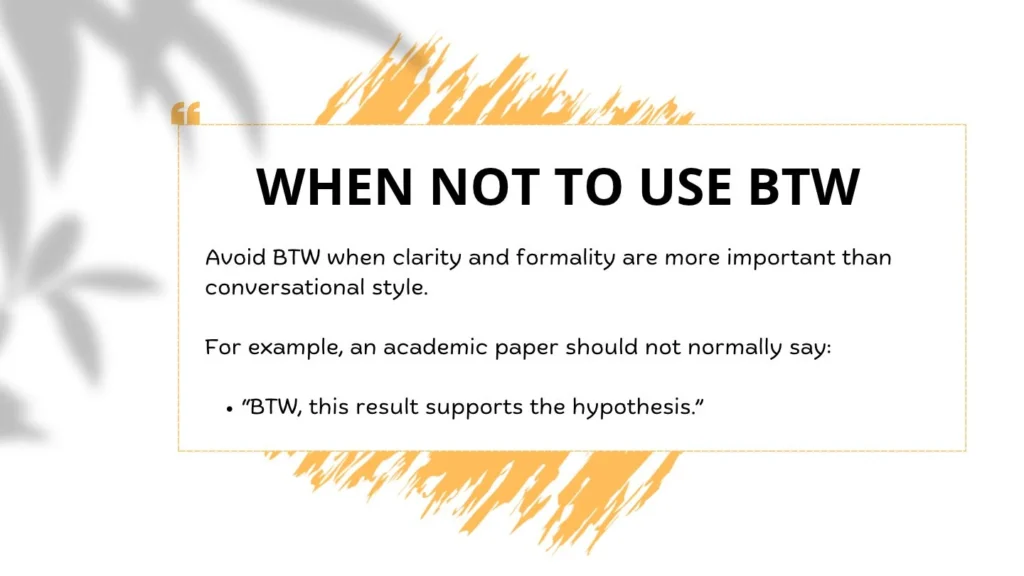
Avoid BTW when clarity and formality are more important than conversational style.
For example, an academic paper should not normally say:
“BTW, this result supports the hypothesis.”
A better version would be:
“This result also supports the hypothesis.”
Likewise, a formal business email may sound more professional if you write:
“I also wanted to mention that the deadline has changed.”
instead of:
“BTW, the deadline changed.”
Situations Where You Should Avoid Using This Abbreviation
Avoid BTW in:
- Academic essays
- Research papers
- Legal documents
- Formal applications
- Official reports
- Important business correspondence
- Professional documents for unfamiliar audiences
The main issue is not that BTW is wrong. It is that abbreviations can make formal writing look overly casual or less polished.
BTW Compared With Similar Terms
| Term | Meaning | Usage | Key Difference |
| BTW | By the way | Casual texting and online chat | Adds an aside or side thought |
| FYI | For your information | Work, email, messaging | Gives information the reader may need to know |
| TBH | To be honest | Casual online communication | Signals honesty or a personal opinion |
| IMO | In my opinion | Texting, comments, forums | Introduces someone’s personal view |
| Incidentally | By the way / as an aside | Formal or written English | More formal than BTW |
BTW and FYI are sometimes confused. They are not exact replacements. BTW usually introduces an additional thought, while FYI generally signals information being provided for the reader’s awareness.
Oxford describes “by the way” as an informal expression for introducing a comment or question that is not directly connected to the main topic.
5–10 Variations and Related Forms
Here are common forms and related expressions:
- BTW — the standard abbreviation.
- btw — lowercase version, very common in texting.
- By the way — the complete phrase.
- By-the-way — sometimes used when the phrase functions adjectivally, although this is not the normal texting form.
- Incidentally — a more formal alternative.
- As an aside — another way to introduce secondary information.
- In passing — suggests mentioning something briefly.
- By the by — an older expression with a similar meaning.
- Apropos — a more formal word used when something is relevant to the current discussion.
- On another note — a modern conversational alternative for changing topics.
These expressions are related, but they are not always interchangeable. The best choice depends on your audience and the exact relationship between your ideas.
How to Respond to BTW
There is no special response required when someone says BTW. Simply respond to the information or question that follows it.
Casual Replies
“Oh yeah, I forgot about that!”
“Sure, I can do that.”
“Haha, good point.”
“Oh, BTW, thanks for reminding me!”
Funny Replies
“The legendary BTW has arrived 😂”
“And now for the important side quest…”
“BTW? You can’t just drop that information and leave!”
Professional or Mature Replies
“Thanks for letting me know.”
“Good point. I’ll take care of it.”
“Thanks for the update. I’ll review it.”
“Understood. I appreciate the reminder.”
The best response depends on the actual information being shared, not the abbreviation itself.
USA and Western Usage
In the United States, BTW is widely understood in casual digital communication.
A person may use it in a text such as:
“BTW, are we still on for Friday?”
or in a social media conversation:
“BTW, where did you buy that?”
The phrase feels natural because English speakers already use “by the way” in ordinary conversation. The abbreviation simply shortens it for writing.
Global and Internet Usage Differences
BTW is not limited to American English. It is widely recognized in internet communication across many English-speaking communities and among people who use English online as a second language.
The exact level of familiarity can vary by age, platform, country, and audience. If you are communicating with someone who may not know common English internet abbreviations, writing “by the way” is clearer.
This is one reason context matters in global communication: an abbreviation that feels obvious to one online community may be unfamiliar to another.
Common Misconceptions About BTW
Does BTW mean “between”?
No. BTW normally means “by the way.”
“Between” is sometimes abbreviated as btwn, not BTW. Merriam-Webster lists “btwn” as an abbreviation for “between.”
Does BTW mean something romantic?
No. BTW has no standard romantic meaning.
If someone writes:
“BTW, I miss you.”
the romantic or emotional meaning comes from “I miss you,” not from BTW.
Is BTW only for teenagers?
No. It is an internet abbreviation used by people of different ages. Its suitability depends more on the communication setting than on age.
Does BTW always introduce a completely unrelated topic?
No. The added thought can be closely related to the existing conversation.
For example:
“The meeting starts at 10. BTW, don’t forget your notes.”
The second sentence is related to the meeting.
Expert Tip: Focus on the Function, Not Just the Abbreviation
A useful way to understand BTW is to focus on what the speaker is doing in the conversation.
When someone writes BTW, ask:
Are they adding information?
→ Read the next phrase.
Are they changing the topic?
→ Treat it as a conversational transition.
Are they giving a reminder?
→ Respond to the reminder.
Are they making a joke or criticism?
→ Judge the tone from the entire message.
This prevents a common mistake: assuming that the abbreviation itself carries an emotional meaning.
FAQs About BTW
What does BTW mean in texting?
BTW means “by the way” in texting. It is used to introduce an extra thought, question, reminder, or piece of information.
What does BTW mean in slang?
BTW is often described casually as internet slang, but more precisely, it is an informal abbreviation or initialism for “by the way.” It is not a slang word with a separate definition.
What does BTW mean on Instagram?
On Instagram, BTW means “by the way.” People may use it in comments, captions, or DMs to add another thought or change the subject.
What does BTW mean on TikTok?
On TikTok, BTW also means “by the way.” For example, someone might comment, “BTW, this song is stuck in my head,” to add an extra observation.
Is BTW rude?
No. BTW is normally neutral and casual. A message containing BTW can sound rude if the rest of the message is rude, but the abbreviation itself is not offensive.
What is the difference between BTW and FYI?
BTW means “by the way” and usually introduces a side thought or additional topic. FYI means “for your information” and usually signals information that the reader should know.
Should I use BTW in a professional email?
It depends on the workplace and relationship. In a very casual workplace, it may be acceptable, but in formal business communication, writing “by the way” or stating the information directly is usually safer.
Key Takeaways
- BTW means “by the way.”
- It is mainly used in texts, chats, DMs, comments, and informal emails.
- It introduces an additional thought, reminder, question, or side topic.
- BTW is informal but not offensive.
- It is generally neutral in tone.
- BTW is different from FYI, TBH, and IMO, even though all are common online abbreviations.
- For academic and highly formal writing, it is better to use the full phrase or rewrite the sentence.
- The meaning of BTW is usually straightforward; the surrounding words determine the emotional tone.
References
- Merriam-Webster, “BTW” — identifies BTW as an abbreviation for “by the way.”
- Oxford Learner’s Dictionaries, “by the way” — explains its informal use for introducing a comment or question that is not directly related to the current topic.
- Cambridge Dictionary, “by the way” — describes the phrase as a way to introduce something that does not directly relate to the current discussion.
- Merriam-Webster, “Tbh: To Be Honest” — discusses BTW and other abbreviations used in informal digital communication.
- Collins Dictionary, “BTW” — identifies BTW as the written abbreviation for “by the way,” especially in informal written communication.
Conclusion
So, what does btw mean? In everyday texting and online communication, it means “by the way.” It is a short, informal way to introduce an extra thought, reminder, question, or side comment.
You may see BTW in WhatsApp messages, Instagram DMs, TikTok comments, online forums, casual emails, and everyday chats. It is not normally rude, offensive, or slang in the strong sense. It is simply a widely understood abbreviation that makes casual writing quicker.
The main rule is simple: use BTW when the setting is casual, and use “by the way” or a more direct sentence when the setting is formal.

James Walker is a passionate writer, dream analyst, and content creator who specializes in uncovering the deeper meanings behind everyday experiences, symbols, and dreams. As a featured author on meaniings.com, he is dedicated to helping readers understand hidden messages within their subconscious and guiding them toward clarity, purpose, and self-discovery.
With a strong interest in psychology, spirituality, and real-life storytelling, James blends research with relatable insights to create engaging and easy-to-understand content. His writing focuses on dream meanings, symbolism, emotional awareness, and personal growth—making complex ideas simple for readers from all backgrounds.
James Walker began his writing journey with a desire to share meaningful stories and life lessons inspired by real experiences. Like many inspirational writers, he believes that every dream and life situation carries a message worth exploring. His work aims to educate, inspire, and empower readers to better understand themselves and the world around them.
Over time, his thoughtful approach and engaging style have helped him build a loyal readership. He continues to contribute valuable content that aligns with the mission of meaniings.com—to provide accurate, insightful, and helpful interpretations.
Notable Works by James Walker:
Growing Up with Jessica: A True Story (inspirational real-life journey)
Dream Symbols and Their Hidden Meanings
The Power of Dreams: Understanding Your Inner Mind