

If you are wondering what does ghosting mean in dating, it usually means someone suddenly stops communicating with you without explaining why. They may stop answering texts, calls, or social media messages and disappear from the connection without saying goodbye.
Ghosting can happen after one date, several dates, or even after people have known each other for a long time. However, taking a long time to reply does not automatically mean ghosting. The main idea is an unexplained and ongoing stop in communication.
In this guide, you will learn what ghosting means in dating, texting, social media, and everyday conversations. You will also see simple examples, related dating terms, and respectful ways to respond.
What Does Ghosting Mean in Dating?
Ghosting in dating means suddenly ending communication with someone without clearly explaining that you want to end the connection.
The person may stop replying to texts, ignore calls, leave messages unanswered, or become unavailable online.
In simple terms, ghosting can mean:
- Suddenly stopping communication: Someone no longer answers your texts, calls, or messages.
- Ending a dating connection without an explanation: Instead of saying they are no longer interested, they disappear.
- Ignoring attempts to reconnect: The person continues not to respond when you reach out.
- Disappearing from a connection: Ghosting often happens through texting, dating apps, and social media.
Researchers generally describe ghosting as a one-sided end to communication, often through digital technology, without a clear explanation.
Quick Meaning
Ghosting = suddenly disappearing from someone’s life and stopping communication without explaining why.
For example, if you have been talking to someone every day, they suddenly stop replying, and they never explain what happened, you might say:
“I think they ghosted me.”
Full Meaning in Simple Words
Imagine you have been texting someone for several weeks. You have gone on a couple of dates, everything seems normal, and you are making plans to meet again.
Then suddenly, they stop responding.
You send a message.
Nothing.
A few days later, you send another message.
Still nothing.
You call, but they do not answer.
If this becomes a clear and lasting pattern with no explanation, people commonly call it ghosting.
Ghosting is different from simply being busy. Everyone can miss a message, need some space, or have a difficult day. What makes ghosting different is the combination of ongoing silence, withdrawal, and no clear explanation.
The behavior can also happen suddenly or gradually. Either way, the main idea is that one person stops the connection without clearly communicating that decision.
What Does Ghosting Mean in Text?
In text messages, ghosting means someone stops responding even though you previously had an active conversation or connection.
For example:
You: “Hey, are we still on for Friday?”
Them: No response.
You wait.
You: “Just checking if everything is okay.”
Them: No response.
If the person continues ignoring your messages without an explanation, you might describe the situation as being ghosted.
However, one unanswered message is not automatically ghosting. A person could be working, traveling, dealing with a family matter, or simply taking a break from their phone.
The pattern matters more than one missed reply.
What Does Ghosting Mean on Social Media?
On TikTok, Instagram, Snapchat, Facebook, dating apps, and similar platforms, ghosting usually means suddenly stopping direct communication with someone.
It might involve:
- Not answering Instagram DMs
- Leaving Snapchat messages unanswered
- Stopping replies on TikTok
- Ignoring dating-app messages
- Refusing calls after previously communicating regularly
- Suddenly ending regular online communication
Social media can make ghosting confusing because someone may appear active while still not answering your messages.
For instance, you might notice that someone posted an Instagram Story but did not answer your message from a few days earlier. That alone does not prove they are ghosting you. Still, repeated unexplained silence can be a stronger sign.
WhatsApp Chat Example
Alex: “Had a great time tonight! Want to meet Saturday?”
Jordan: “Yeah, definitely.”
Two days later:
Alex: “What time works for you Saturday?”
Jordan: No response.
Alex sends another message the next day.
Alex: “Everything okay?”
Still no response.
If Jordan continues to disappear without explanation, Alex might say:
“I think Jordan ghosted me.”
Instagram DM Example
Mia: “I really enjoyed talking with you yesterday.”
Chris: “Same! Let’s talk again soon.”
A few days later:
Mia: “Want to meet this weekend?”
Chris: Seen.
Mia: “No worries if you’re busy. Just let me know.”
Chris never responds again.
If the silence continues without an explanation, Mia may describe the situation as ghosting.
TikTok Example
Suppose two people meet through TikTok and begin messaging privately.
One person says:
“We should definitely hang out sometime!”
They continue chatting for several weeks. Suddenly, one person stops replying completely and never explains why.
A friend might say:
“Looks like you got ghosted.”
Here, ghosted means the person stopped communicating instead of directly saying they no longer wanted to continue the connection.
Real-Life Meaning and Usage
In everyday conversations, ghosting is mainly used when talking about dating, relationships, friendships, and online communication.
You might hear:
- “He ghosted me after our third date.”
- “She stopped replying, so I think I got ghosted.”
- “I don’t want to ghost him, so I’ll tell him I’m not interested.”
- “We talked for a month and then she disappeared.”
- “Getting ghosted can be confusing because you don’t know what happened.”
The word can be used in several forms.
Noun: “Ghosting is frustrating.”
Verb: “She ghosted me.”
Past tense: “I got ghosted.”
Person: “He is the person who ghosted me.”
Real-Life Situations Where Ghosting Happens
Ghosting can happen at different stages of a connection.
After One Date
Someone may go on one date and then stop responding to future messages or invitations.
During the Talking Stage
Two people may communicate every day for weeks before one person suddenly disappears.
After Several Dates
Ghosting can happen even after people have developed a stronger connection.
In an Established Relationship
Although the term is more often associated with early dating, someone may also use “ghosting” when a person suddenly stops communicating during a more established relationship.
On Dating Apps
A match may have an active conversation and then disappear without explanation. This is one reason ghosting is strongly connected with online dating.
Examples of Ghosting in Sentences
Here are some natural examples:
- “I think the guy I was dating ghosted me after our third date.”
- “She stopped answering all my texts, so I thought I was being ghosted.”
- “Ghosting someone is different from telling them you are no longer interested.”
- “He didn’t ghost me; he explained that he wanted to stop dating.”
- “I thought she had ghosted me, but she later explained that she had a family emergency.”
- “Dating apps can make it easier for people to disappear without a conversation.”
- “I would rather receive an honest answer than be ghosted.”
Different Contexts of Ghosting
Casual Dating
In casual dating, ghosting may describe someone disappearing after a few conversations or dates.
Serious Relationships
Ghosting can be more difficult to understand when people have been together for a long time because there is usually more history between them.
Online Dating
Dating apps make digital communication a major part of many connections. Therefore, terms such as ghosting, breadcrumbing, orbiting, and benching are often used in online dating discussions.
Friendship
The term can also describe a friend suddenly cutting off communication. Ghosting has been studied in friendships as well as romantic relationships.
Professional Context
“Ghosting” is also used outside dating. For example, someone may say a company “ghosted” them after a job interview.
In that situation, the word simply means that communication stopped without an explanation.
Origin and History of the Term
The modern dating meaning of ghosting is relatively recent, but the idea behind the word is older.
The word uses the image of a ghost suddenly disappearing. As digital communication became more common, people began using “ghost” to describe someone who suddenly disappeared from a conversation or relationship.
Online communication helped the term become much more popular. Texting, social media, instant messaging, and dating apps all made it easier for people to communicate without meeting face to face.
As a result, ghosting became a common word for an unexplained end to communication.
Why Do People Ghost?
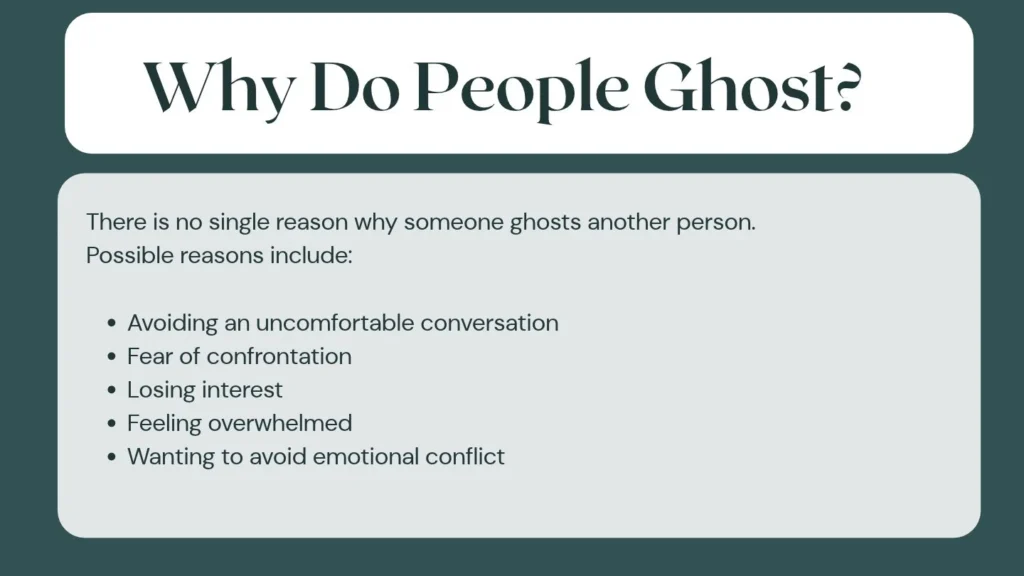
There is no single reason why someone ghosts another person.
Possible reasons include:
- Avoiding an uncomfortable conversation
- Fear of confrontation
- Losing interest
- Feeling overwhelmed
- Wanting to avoid emotional conflict
- Not knowing how to end a connection
- Feeling unsafe continuing contact
- Believing the connection was casual
- Having poor communication habits
However, you cannot know someone’s exact reason simply from their silence.
For example, one person may disappear because they do not know how to reject someone directly. Another person may stop responding because they feel uncomfortable or unsafe.
Therefore, it is better to avoid guessing the person’s motivation.
Emotional Meaning Behind Ghosting
Being ghosted can feel confusing because there is no clear ending.
With direct rejection, someone might say:
“I’m not interested in continuing this connection.”
That message may be difficult to hear, but it is clear.
Ghosting removes that explanation. As a result, the person left behind may wonder:
- “Did I do something wrong?”
- “Why did they disappear?”
- “Should I send another message?”
- “Did something happen?”
- “Were they ever interested?”
Research suggests that ghosting can create a form of unclear rejection because the person may not know why communication ended.
However, everyone responds differently. The experience can depend on the type of connection, personal expectations, and the circumstances surrounding the silence.
An Important Point
Being ghosted does not automatically mean you did something wrong.
You may never know the other person’s exact reason. It is usually better to avoid creating a story about what happened based only on silence.
Tone: Formal, Informal, or Slang?
Ghosting is informal language.
It is common in:
- Text conversations
- Dating discussions
- Social media
- Online articles
- Relationship discussions
- Casual conversations
The word is not generally offensive. However, calling someone a “ghoster” can sound critical because it describes their behavior in a negative way.
In a formal workplace document, a phrase such as “communication stopped without explanation” may sound more professional than “ghosted.”
Is It Rude to Say “Ghosting”?
The word itself is not rude.
However, the way you use it can sound accusing.
Compare:
Neutral:
“I think we may have lost touch.”
Direct:
“I feel like you ghosted me.”
More critical:
“You are such a terrible ghoster.”
If you want a calm conversation, describing what happened is often more useful than attacking the person’s character.
Is Ghosting Positive, Negative, or Neutral?
The term is generally negative or critical because it describes unexplained withdrawal from communication.
Still, there are situations where someone may stop responding for a valid reason. For example, a person may end contact because they feel unsafe, are being harassed, or need to protect their personal boundaries.
That is an important distinction.
Not every disappearance is automatically ghosting.
When to Use the Word “Ghosting”
You can use the term when:
- Someone has clearly stopped communicating.
- There was an established connection.
- The silence continues.
- There is no clear explanation.
- The behavior appears to be ending the connection.
- You are discussing dating or online communication.
When Not to Use It
Do not immediately call something ghosting when:
- Someone has not replied for a few hours.
- The person told you they are busy.
- They are dealing with an emergency.
- You have only sent one message.
- The person clearly said they need space.
- Communication has simply become less frequent on both sides.
A delayed response is not necessarily ghosting.
Serious Situations and Personal Boundaries
Sometimes someone may stop communicating because they feel uncomfortable or unsafe.
In those situations, they may not owe the other person a detailed explanation.
For example, if someone is receiving unwanted messages or feels threatened, ending communication and blocking contact can be a reasonable way to protect their boundaries.
Because of this, it is important not to treat every sudden loss of contact as a simple dating problem.
Ghosting vs. Similar Dating Terms
| Term | Meaning | Main Difference |
|---|---|---|
| Ghosting | Suddenly ending communication without explanation | The person disappears from communication |
| Rejection | Clearly telling someone you are not interested | The person gives a direct answer |
| Breadcrumbing | Giving small amounts of attention without clear commitment | Communication continues, but meaningful progress may not happen |
| Orbiting | Remaining visible online without meaningful direct communication | The person may watch Stories or like posts while avoiding direct contact |
| Benching | Keeping someone as an option while exploring other connections | Communication may continue, but commitment stays low |
These terms are related, but they describe different communication patterns.
Common Forms of Ghosting
Here are some terms you may see online:
Ghost
To ghost someone means to suddenly stop communicating with them.
Ghosted
If someone says “I got ghosted,” they mean another person suddenly stopped communicating with them.
Ghosting
Ghosting is the behavior itself.
Ghoster
A ghoster is the person who does the ghosting.
Getting Ghosted
This phrase describes the experience of being ignored or left without an explanation.
Soft Ghosting
Soft ghosting is an informal internet term for a less direct form of withdrawal. For example, someone might react to a message without actually replying.
Hard Ghosting
Hard ghosting is an informal phrase for completely disappearing or blocking communication.
Mutual Ghosting
Mutual ghosting describes a situation where both people gradually stop communicating.
Some of these terms are mainly internet slang rather than formal academic terms.
How to Respond If Someone Ghosts You
If you think someone is ghosting you, you do not need to keep sending messages.
Send One Clear Message
If you want to make sure there was no misunderstanding, you can send one respectful message.
For example:
“Hey, I haven’t heard from you lately. If you don’t want to continue talking, that’s okay. I just prefer clear communication.”
After that, give the person space.
Do Not Keep Chasing a Reply
If someone continues not to respond, repeated messages may not give you the answer you want.
Instead, accept that their lack of response is information about their willingness to communicate.
Focus on What You Know
You may not know why the person disappeared.
Rather than guessing, focus on the facts:
The communication stopped.
There was no clear explanation.
You cannot control whether they respond.
That can help you avoid unnecessary overthinking.
A Simple Decision Guide
They have not replied yet
↓
Wait and consider their normal communication habits.
They continue not to respond
↓
If needed, send one clear and respectful follow-up.
They keep disappearing without explanation
↓
Stop repeatedly contacting them.
They return later without addressing what happened
↓
Decide whether their communication style works for you.
The goal is not to force someone to respond. It is to communicate respectfully and protect your own time and boundaries.
USA and Western Usage
In the United States and other English-speaking communities, ghosting is widely understood as modern dating and relationship slang.
It is often used when discussing:
- Dating apps
- Texting
- Social media
- Casual dating
- Relationships
- Friendships
The word can also be used outside relationships.
For example:
“The recruiter ghosted me.”
This means the recruiter stopped responding after previously communicating with the person.
Global and Internet Usage
Because the term spread through online communication, ghosting is now widely recognized in many internet communities.
However, people do not always use the word in exactly the same way.
Some people may call a situation ghosting after a few unanswered messages. Others may use the term only when someone disappears after a meaningful connection.
There is no universal rule such as “three days without a reply means ghosting.”
Instead, consider the communication history and the situation.
What Does Ghosting Mean in Text?
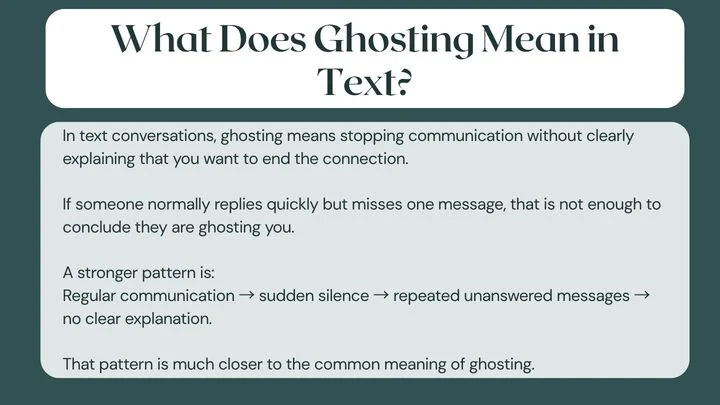
In text conversations, ghosting means stopping communication without clearly explaining that you want to end the connection.
If someone normally replies quickly but misses one message, that is not enough to conclude they are ghosting you.
A stronger pattern is:
Regular communication → sudden silence → repeated unanswered messages → no clear explanation.
That pattern is much closer to the common meaning of ghosting.
What Does Ghosting Mean on TikTok or Instagram?
On TikTok or Instagram, ghosting usually means someone stops responding to your DMs or other direct communication.
Seeing someone post a Story while they have not replied does not automatically prove that they are ghosting you.
Social-media activity can provide context, but it cannot tell you why someone has not responded.
Common Misconceptions About Ghosting
“Ghosting Always Means They Hate You”
Not necessarily.
Someone may ghost because they lost interest, feel uncomfortable with confrontation, feel overwhelmed, or have another personal reason.
“One Late Reply Is Ghosting”
No.
A delayed response by itself is not enough to call something ghosting.
“Ghosting Is Always Abuse”
No.
Ghosting describes a communication behavior. Its seriousness depends on the relationship and circumstances.
“You Must Get Closure From the Other Person”
Not always.
Sometimes you may never receive an explanation. You can still accept what happened and decide how you want to move forward.
“Ghosting Only Happens in Dating”
No.
People also use the term for friendships, job applications, business communication, and other situations.
Frequently Asked Questions
What does ghosting mean in dating?
Ghosting means suddenly ending communication with someone you were dating or getting to know without explaining why. The person may stop responding to texts, calls, or direct messages.
What does it mean when someone ghosts you?
It generally means the person has stopped communicating and may be ending the connection without directly saying so. However, silence alone does not reveal their exact reason.
Is ghosting the same as rejection?
No.
Rejection usually involves a clear statement that someone is not interested. Ghosting involves unexplained withdrawal and ongoing silence.
How long before it is considered ghosting?
There is no universal number of hours or days.
One missed message is not necessarily ghosting. Repeated and unexplained silence after an established connection is a stronger example.
Is ghosting rude?
It can be viewed as rude or inconsiderate because it leaves the other person without a clear explanation. However, someone may have personal or safety reasons for ending contact without further discussion.
Why do people ghost instead of saying goodbye?
Different people may ghost for different reasons. They may want to avoid confrontation, feel uncomfortable rejecting someone directly, lose interest, or feel overwhelmed.
What should I do if someone ghosts me?
If you need clarity, you can send one respectful follow-up. If the person still does not respond, avoid repeatedly contacting them and focus on moving forward.
Can ghosting happen after one date?
Yes.
Someone may stop responding after one date. However, a single missed message does not automatically mean ghosting.
Can friends ghost each other?
Yes.
The term can describe a friend suddenly stopping communication without an explanation.
What is the opposite of ghosting?
There is no exact opposite term, but clear communication is the opposite behavior. Instead of disappearing, a person directly explains that they want to end or change the connection.
Conclusion
So, what does ghosting mean in dating? It means suddenly stopping communication with someone without clearly explaining that you want to end the connection. The term is commonly used for texting, dating apps, social media, and relationships.
The key difference between ghosting and simply being busy is the pattern of ongoing, unexplained silence. One late reply or missed message does not automatically mean someone is ghosting you.
If someone disappears, you may never know their exact reason. Instead of guessing, focus on what you can control. You can communicate clearly, give the person space, and avoid repeatedly chasing a response.
Understanding the term can help you recognize the difference between normal delays, a change in communication, and a clear pattern of disappearing without explanation.

James Walker is a passionate writer, dream analyst, and content creator who specializes in uncovering the deeper meanings behind everyday experiences, symbols, and dreams. As a featured author on meaniings.com, he is dedicated to helping readers understand hidden messages within their subconscious and guiding them toward clarity, purpose, and self-discovery.
With a strong interest in psychology, spirituality, and real-life storytelling, James blends research with relatable insights to create engaging and easy-to-understand content. His writing focuses on dream meanings, symbolism, emotional awareness, and personal growth—making complex ideas simple for readers from all backgrounds.
James Walker began his writing journey with a desire to share meaningful stories and life lessons inspired by real experiences. Like many inspirational writers, he believes that every dream and life situation carries a message worth exploring. His work aims to educate, inspire, and empower readers to better understand themselves and the world around them.
Over time, his thoughtful approach and engaging style have helped him build a loyal readership. He continues to contribute valuable content that aligns with the mission of meaniings.com—to provide accurate, insightful, and helpful interpretations.
Notable Works by James Walker:
Growing Up with Jessica: A True Story (inspirational real-life journey)
Dream Symbols and Their Hidden Meanings
The Power of Dreams: Understanding Your Inner Mind