
If you are wondering what does gringo mean, the word generally refers to a foreigner in a Spanish-speaking or Latin American context, especially someone from the United States or another English-speaking country. Depending on the country, speaker, and tone, gringo can be neutral, casual, humorous, or insulting.
The important point is that gringo does not have one identical meaning everywhere. In some Latin American countries it commonly means an American, while in other contexts it can simply mean a foreigner or someone who does not speak Spanish.
Quick Answer: What Does Gringo Mean?
- Gringo commonly means a foreigner, especially an American or English-speaking person.
- In some Latin American countries, it specifically means someone from the United States.
- The word can be casual or descriptive, but it can also sound disparaging or offensive depending on context.
- The feminine form is gringa, while the plural is gringos.
Key Takeaway
When someone calls a person a “gringo,” they are usually pointing out that the person is foreign, particularly from the United States or another English-speaking country. The tone and local culture determine whether the word sounds friendly, neutral, teasing, or negative.
What Does Gringo Mean?
The simplest definition of gringo is a foreigner, especially an English-speaking foreigner or American in Latin American usage.
Merriam-Webster describes the term as a foreigner in Spain or Latin America, particularly someone of English or American origin, while also noting a broader meaning of a non-Hispanic person.
The Royal Spanish Academy gives the word a wider range of meanings. In Spanish, gringo can refer to a foreigner, especially an English speaker, and in several Latin American countries it can specifically mean an American. The dictionary also notes that it can sometimes be used in a derogatory sense.
So, the exact meaning depends heavily on where the word is being used.
Full Meaning in Simple Words
In simple English, think of gringo as a word for “foreigner,” often with a focus on Americans or English speakers.
For example:
“The beach was full of gringos.”
Depending on the country and speaker, this could mean:
“The beach was full of American or foreign tourists.”
It does not automatically mean something hateful. However, because the term can carry a negative tone, you should pay attention to how it is being used.
A friendly speaker might use it jokingly about a tourist. Another person might use it to emphasize that someone is an outsider.
What Does Gringo Mean in Text?
In text messages, gringo usually keeps its ordinary cultural meaning. Someone may use it to describe an American, English speaker, or foreign visitor.
For example:
“My cousin married a gringo from Texas.”
Here, the speaker probably means an American man.
Another example:
“There were so many gringos at the resort.”
This could simply mean there were many foreign or American tourists.
Text messages often remove facial expressions and voice tone, so it can be harder to know whether the word is being used affectionately or negatively.
Is “Gringo” Slang in Text?
Yes, gringo can function as informal slang, particularly in conversations involving Latin American culture or Spanish-speaking communities. However, it is not internet slang in the same way as terms such as “LOL” or “BRB.”
It is an established Spanish and Latin American term that also appears in English-language conversations.
What Does Gringo Mean on Social Media?
On TikTok, Instagram, X, Facebook, Reddit, and other platforms, gringo is often used when discussing Americans, tourists, travel, immigration, Spanish-speaking culture, or cultural differences.
Social media can make the word appear more casual than it would in formal writing.
For example, a travel video might have a comment such as:
“The gringos are loving this beach!”
That could be playful.
But a comment such as:
“Those gringos don’t understand our culture.”
has a more negative or exclusionary tone.
WhatsApp Chat Example
Person A: “Who are the tourists staying at the hotel?”
Person B: “Mostly gringos from the U.S.”
Here, gringos means American or foreign tourists.
Instagram DM Example
Person A: “Is your new neighbor American?”
Person B: “Yeah, he’s a gringo from California.”
The word is being used informally to identify the person’s nationality or foreign background.
TikTok Comment Example
Comment: “The gringos finally discovered this hidden beach 😂”
This could be humorous or teasing rather than seriously offensive. The laughing emoji changes the tone, but it does not guarantee that everyone will find the comment acceptable.
Real-Life Meaning and Usage
In everyday conversation, gringo is most often connected with nationality, language, or foreign identity.
Its meaning changes by region. The Royal Spanish Academy lists several regional uses, including “foreigner,” “American,” “English person” in Uruguay, and even “Russian” in another Uruguayan usage. It also records a meaning related to unintelligible language.
That variety explains why translating gringo simply as “American” can sometimes be inaccurate.
Real-Life Situations Where This Term Is Used
You may hear or see the word when people are discussing:
- American tourists
- English-speaking visitors
- Foreign residents
- Travelers in Latin America
- Cultural differences
- Spanish-speaking communities
- Immigration or nationality
- Foreign accents or language
- Tourism and travel
A traveler in Mexico, for example, might be called a gringo because they are American. In another country, the word may be applied more broadly to foreigners.
Examples of Gringo in Sentences
Here are realistic examples showing different tones:
- “He’s a gringo who moved to Mexico a few years ago.”
- “The restaurant was popular with gringos visiting the city.”
- “My friend jokingly called me a gringo because my Spanish was terrible.”
- “She married a gringo from the United States.”
- “The tour guide explained some local customs to the gringos.”
- “Don’t assume every gringo is American; the word can have a broader meaning.”
- “The word sounded friendly in that conversation, but it can be offensive in other situations.”
The last two examples show why context matters more than the word alone.
Different Contexts of Gringo
Casual Conversation
In casual speech, gringo may be used as a quick way to refer to a foreigner or American.
Academic Writing
In academic writing, it is better to explain the term rather than use it casually. For example, a paper about language and identity might say that gringo is a regional term for foreigners, especially Americans or English speakers.
Online Conversations
Online, the word may appear in jokes, memes, travel discussions, political debates, and cultural conversations.
Travel Situations
Tourists may encounter the term while traveling in Latin America. Whether it feels friendly or insulting depends on the speaker, location, and situation.
Origin and History of the Term
The history of gringo is more complicated than many popular internet explanations suggest.
Merriam-Webster traces the word to Spanish and gives its etymology as an alteration of griego, meaning “Greek,” which historically could be associated with something foreign or unfamiliar. It records the English word as being established in the 19th century.
The Online Etymology Dictionary gives additional historical detail. It notes that gringo was already used in Spanish before its English use and appeared in Spain in references to foreigners and foreign speech. It also reports that an 18th-century Spanish dictionary connected the word with foreigners who had a noticeable accent, particularly Irish people.
What About the “Green Grow” Story?
You may have heard that gringo came from American or Irish soldiers singing “Green Grow the Rushes” or a similar song.
That story is popular, but it is not supported by the historical evidence cited by major etymological sources. The Online Etymology Dictionary specifically describes that explanation as lacking factual basis.
This is a useful reminder that a popular explanation is not necessarily the real origin of a word.
Why Do People Use This Word?
People use gringo for several reasons.
First, it is a convenient informal label for a foreigner or American. Second, it can highlight cultural or linguistic differences. Third, speakers may use it humorously when talking about tourists or outsiders.
The word can also carry social meaning. Calling someone a gringo may emphasize an “insider versus outsider” distinction.
That is why the same word can sound harmless in one conversation and insulting in another.
Emotional and Psychological Meaning Behind the Word
The word itself does not reveal the speaker’s feelings. Context does.
A speaker might use gringo with:
- Humor
- Affection
- Curiosity
- Mild teasing
- Cultural identification
- Frustration
- Disapproval
- Hostility
For example, a person might jokingly call a close American friend a gringo. In another situation, someone might use the term to stereotype foreigners.
The safest approach is to judge the whole sentence, relationship, setting, and tone, rather than assuming that every use has the same emotional meaning.
Tone Explanation: Formal, Informal, Slang, or Offensive?
Gringo is informal. It is not normally the best choice for formal business, academic, or professional communication.
Cambridge labels the English-language term “informal” and “disapproving,” and its American English entry notes that the word is usually considered offensive.
That does not mean every native speaker will consider it an insult. Regional usage varies.
Tone Guide
| Tone | How it may sound |
| Friendly | Playful or familiar |
| Casual | Informal description of a foreigner |
| Teasing | Light joke about nationality or language |
| Neutral | Simple reference to an American or foreigner |
| Negative | Outsider-focused or dismissive |
| Offensive | Used as a derogatory label |
Is It Rude to Say “Gringo”?
It can be.
There is no universal rule that every use of gringo is automatically offensive. However, reputable dictionaries warn that the term can be disparaging or offensive.
If you are speaking to someone you do not know, using American, U.S. visitor, foreigner, or the person’s nationality is usually safer.
A major clue is whether the word is being used to describe someone neutrally or to reduce them to their foreign identity.
Is Gringo Positive, Negative, or Neutral?
Gringo can be neutral, negative, or occasionally playful.
There is no single emotional value attached to it in every Spanish-speaking community.
The RAE specifically notes that the word is sometimes used in a derogatory sense.
A useful rule is:
Friendly context → possibly playful or neutral
Neutral description → possibly simply “foreigner”
Insulting context → potentially offensive
When to Use Gringo
You can discuss the word itself in an educational, linguistic, or cultural context.
It may also appear naturally in informal conversations where the people involved understand the regional meaning and are comfortable with it.
For example:
“What does gringo mean in this country?”
That is a perfectly reasonable language question.
When NOT to Use Gringo
Avoid using the term casually for strangers when you are unsure how they will interpret it.
It is especially wise to avoid it in:
- Job interviews
- Formal business meetings
- Customer-service situations
- Academic writing without explanation
- Professional emails
- Sensitive discussions about nationality or immigration
Use a more precise term instead.
Situations Where You Should Avoid Using This Word
If you are describing someone, ask yourself:
Am I identifying their nationality, or am I labeling them as an outsider?
If the second answer is closer to the truth, choose more neutral language.
This simple test can prevent unnecessary offense.
Gringo Compared With Similar Terms
| Term | Meaning | Usage | Key Difference |
| Gringo | Foreigner, especially American or English-speaking person | Informal | Regional and potentially disparaging |
| Foreigner | Person from another country | General | More neutral in English |
| American | Usually a person from the United States in U.S. English | General | Specifies U.S. identity |
| Yankee | Historically a Northerner; sometimes an American generally | Informal/regional | Meaning varies greatly by location |
| Tourist | Person traveling temporarily | General | Describes travel status, not nationality |
The key difference is that gringo carries more cultural and regional meaning than a straightforward term such as “foreigner.”
Variations and Related Forms
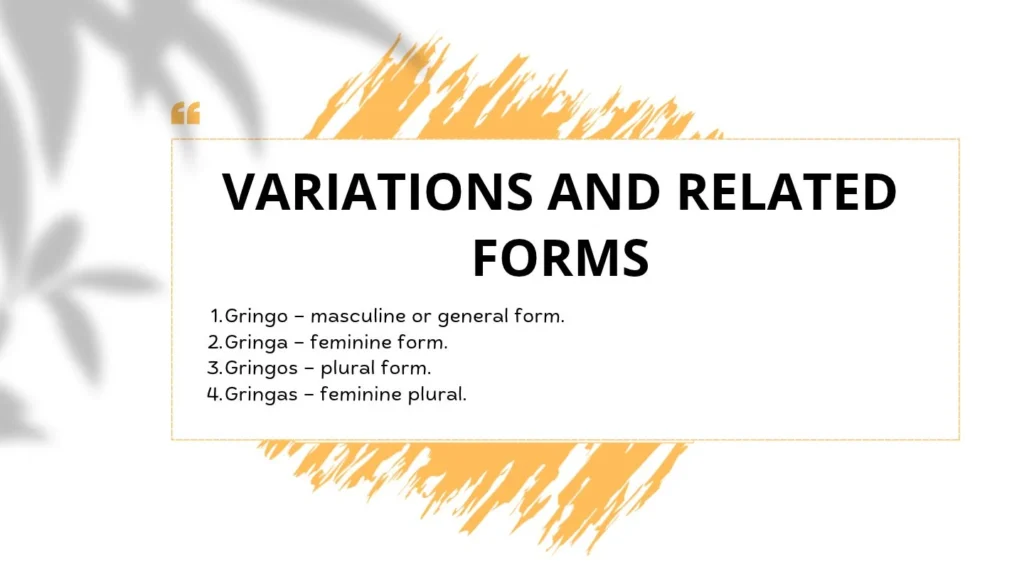
Here are common forms and related uses:
- Gringo — masculine or general form.
- Gringa — feminine form.
- Gringos — plural form.
- Gringas — feminine plural.
- Gringo tourist — an American or foreign tourist.
- Gringo accent — an accent perceived as belonging to an English-speaking foreigner.
- Gringo culture — informal reference to U.S. or foreign cultural habits.
- Gringo price — an informal expression sometimes used for a price charged to foreigners; the meaning depends strongly on local context.
- Gringo slang — a broad phrase referring to informal uses of the word.
- Gringa in some regional contexts — a foreign woman, often specifically an American woman.
Not all of these expressions have the same level of acceptance. Regional usage matters.
How to Respond When Someone Calls You Gringo
Your response can depend on the speaker’s tone.
Casual Replies
- “Yep, that’s me!”
- “Guilty. I’m visiting from the U.S.”
- “Haha, I guess I stand out.”
Funny Replies
- “My terrible Spanish gave me away.”
- “Caught me!”
- “Do I at least get a tourist discount?”
Professional or Mature Replies
If the word bothers you, stay calm:
“Do you mean American?”
Or:
“I understand what you mean, but I prefer being called American.”
This approach keeps the conversation respectful without unnecessarily escalating it.
Cultural Usage in the USA and Worldwide
USA / Western Usage
In the United States, gringo is usually encountered through Spanish, Latin American culture, travel, media, or conversations about cultural identity.
Many Americans know it as a word meaning “American” when used by people in Latin America.
Global and Internet Usage
The broader Spanish meaning can be different. The RAE records regional meanings that include foreigner, American, English person, Russian, and a person who is blond and fair-skinned in certain countries.
That means an internet user should not assume that gringo always means “U.S. citizen.”
A Simple Decision Guide: Should You Use “Gringo”?
Are you asking about the word itself?
↓
Yes → It is fine to discuss and explain it.
Are you speaking casually with someone who uses the term comfortably?
↓
Yes → It may be acceptable, depending on the relationship and region.
Are you speaking formally or to someone you don’t know?
↓
Yes → Choose “American,” “U.S. citizen,” “tourist,” or “foreigner” instead.
Are you using it to insult or stereotype someone?
↓
Avoid it.
This is the easiest way to understand the practical difference between knowing a word and knowing when to use it.
Common Misconceptions About Gringo
One common mistake is believing that gringo always means “American.” It does not. Regional Spanish dictionaries show that its meaning can extend to foreigners more generally.
Another misconception is that the word is always an insult. Cambridge warns that it is often considered offensive, but actual usage varies by context and region.
Finally, the popular “Green Grow” origin story should not be treated as established fact. Historical sources point to a much older Spanish usage.
FAQs About Gringo
What does gringo mean in slang?
In informal usage, gringo usually means a foreigner, especially an American or English-speaking person. In some places, it specifically refers to someone from the United States.
Does gringo mean American?
Sometimes. In several Latin American countries, gringo is used specifically for a person from the United States. However, the word can also mean a foreigner more generally.
Is gringo a bad word?
It can be. Major dictionaries describe it as potentially disparaging or offensive, but the tone varies by region and context.
What is the female version of gringo?
The feminine form is gringa. The plural forms are gringos and gringas, depending on the people being described.
What does gringo mean in text?
In text messages, it normally means a foreigner, American, or English-speaking person. Whether it sounds friendly or insulting depends on the conversation.
Is gringo Spanish or English?
The word comes from Spanish and is widely used in Spanish-speaking Latin America. It has also entered English, especially in discussions about Latin American culture.
Where did the word gringo come from?
Its exact etymology is debated. Merriam-Webster connects it with Spanish gringo and ultimately griego (“Greek”), while historical sources show that the word was already used in Spain for foreigners and foreign speech before its later English usage.
References
- Merriam-Webster, “Gringo” — definition, usage, and word history. Merriam-Webster: Gringo
- Cambridge Dictionary, “Gringo” — English meaning, usage label, and American English note. Cambridge Dictionary: Gringo
- Real Academia Española (RAE), “gringo, gringa” — Spanish definitions and regional meanings. RAE: Gringo, Gringa
- Online Etymology Dictionary, “Gringo” — historical development and etymological discussion. Etymonline: Gringo
Conclusion
So, what does gringo mean? In simple terms, it is an informal Spanish and Latin American term for a foreigner, especially an American or English-speaking person. In some countries, it specifically means someone from the United States.
The word is not automatically an insult, but it can be disparaging or offensive depending on the speaker, country, relationship, and tone. If you are unsure, using a more precise term such as “American,” “tourist,” or “foreigner” is usually the safer choice.
Understanding gringo is therefore about more than memorizing a definition. The real meaning comes from regional usage, cultural context, and the intention behind the word..

James Walker is a passionate writer, dream analyst, and content creator who specializes in uncovering the deeper meanings behind everyday experiences, symbols, and dreams. As a featured author on meaniings.com, he is dedicated to helping readers understand hidden messages within their subconscious and guiding them toward clarity, purpose, and self-discovery.
With a strong interest in psychology, spirituality, and real-life storytelling, James blends research with relatable insights to create engaging and easy-to-understand content. His writing focuses on dream meanings, symbolism, emotional awareness, and personal growth—making complex ideas simple for readers from all backgrounds.
James Walker began his writing journey with a desire to share meaningful stories and life lessons inspired by real experiences. Like many inspirational writers, he believes that every dream and life situation carries a message worth exploring. His work aims to educate, inspire, and empower readers to better understand themselves and the world around them.
Over time, his thoughtful approach and engaging style have helped him build a loyal readership. He continues to contribute valuable content that aligns with the mission of meaniings.com—to provide accurate, insightful, and helpful interpretations.
Notable Works by James Walker:
Growing Up with Jessica: A True Story (inspirational real-life journey)
Dream Symbols and Their Hidden Meanings
The Power of Dreams: Understanding Your Inner Mind