
If you are wondering what does median mean, the word usually refers to the middle value in an ordered group of numbers. In statistics, the median is the point where half of the values are below it and half are above it. The word can also mean something located in the middle, such as the median strip on a divided highway.
What Does Median Mean? (Quick Answer)
The word median can have several related meanings:
- In statistics: The middle value in a set of numbers after the values are arranged in order.
- In everyday language: Something located in the middle or between two sides.
- In mathematics: A line drawn from a triangle’s vertex to the midpoint of the opposite side.
- In roads: The strip of land or pavement separating opposite directions of traffic.
The most common meaning today is the statistical meaning, especially when you see phrases such as “median income,” “median age,” “median salary,” or “median home price.”
What Does Median Mean?
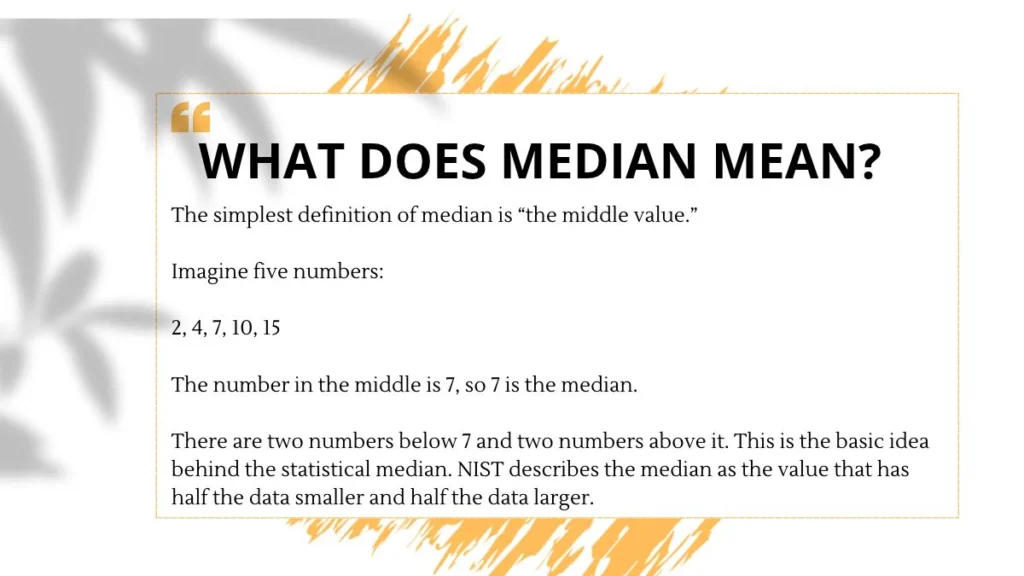
The simplest definition of median is “the middle value.”
Imagine five numbers:
2, 4, 7, 10, 15
The number in the middle is 7, so 7 is the median.
There are two numbers below 7 and two numbers above it. This is the basic idea behind the statistical median. NIST describes the median as the value that has half the data smaller and half the data larger.
The important point is that you normally need to put the numbers in order first. If the numbers are not arranged from smallest to largest, it can be easy to choose the wrong value.
What Happens When There Is an Even Number of Values?
If there are an even number of values, there is no single number directly in the middle. Instead, you find the two middle values and calculate their average.
For example:
2, 4, 8, 10
The two middle numbers are 4 and 8.
(4 + 8) ÷ 2 = 6
So, the median is 6. This is also the standard statistical method described by NIST.
Full Meaning in Simple Words
In simple words, median means the middle point.
When talking about numbers, it identifies the value that divides an ordered group into two parts. When talking about location or position, it can simply mean something that is in the middle.
For example, if a report says the median household income is $70,000, it does not mean every household earns $70,000. It means the income value sits at the midpoint of the distribution: roughly half of the households are below that value and half are above it.
This is why median is useful when describing large groups. It gives readers a sense of the center without necessarily being pulled strongly by unusually high or low values.
What Does Median Mean in Text?
If you see median in a text message, email, school assignment, news article, or report, its meaning depends on the context.
In most written communication, it is likely to have its standard mathematical or general meaning. For example:
“The median salary for the position is $75,000.”
Here, median refers to the middle salary value in an ordered group.
It is not normally texting slang. Unlike words such as “LOL,” “TBH,” or “BRB,” median does not have a widely recognized special meaning in casual texting.
What Does Median Mean in Slang?
There is no common mainstream slang meaning of median in American English. If someone uses the word casually, they are usually talking about a middle point, a statistic, or something physically located between two sides.
Context still matters, especially on social media, where people sometimes create jokes or use technical words creatively.
What Does Median Mean on Social Media?
On TikTok, Instagram, Reddit, Facebook, or other platforms, median usually keeps its normal meaning.
You might see it in posts about:
- Income
- Age
- Test scores
- Housing prices
- Sports statistics
- Data analysis
- Schoolwork
- Poll results
- Population statistics
For example, a TikTok creator might say:
“The median age of the people in this group is 28.”
That means 28 is the middle point of the ordered age data.
Someone might also use the word humorously:
“The median response to this question was completely unexpected.”
The underlying meaning remains the same. Social media does not normally give median a separate slang definition.
WhatsApp Chat Example
Alex: “What was the median score on the test?”
Sam: “It was 82.”
Alex: “So half the students scored below 82 and half above it?”
Sam: “Basically, yes.”
Instagram DM Example
Mia: “The post says the median rent is $2,000.”
Jordan: “Does that mean most people pay exactly $2,000?”
Mia: “No. It means $2,000 is the middle point of the listed rents.”
TikTok Comment Example
Comment: “What does median income mean?”
Reply: “It’s the income at the middle of the distribution, with about half of the values below and half above.”
These examples show that the word is mainly informational rather than slang.
Real-Life Meaning and Usage
You will often encounter median when people discuss statistics or compare groups.
Common phrases include:
- Median income
- Median salary
- Median age
- Median home price
- Median household income
- Median score
- Median rent
- Median price
- Median value
- Median number
For example, a real estate report may discuss the median home price in a city. A school may report a median test score. A government report may use median income to describe the center of an income distribution.
The word is especially useful when a few extremely high or low numbers could make a simple average less representative.
Real-Life Situations Where This Term Is Used
Housing
Suppose five homes sell for:
$200,000, $225,000, $250,000, $275,000, $1,000,000
The median price is $250,000.
The $1 million home is much higher than the others, but it does not move the median in the same way it can affect the arithmetic mean.
Education
A school might report a median test score of 78. This tells you where the middle of the ordered scores falls.
Employment
A company or government agency may discuss median wages or median salaries. This can help describe the midpoint of earnings in a group.
Demographics
Researchers may report the median age of a population. This gives a midpoint for the ages in that population.
NIST identifies median as one of the common ways to describe the central location of a set of data.
Examples of Median in Sentences
Here are several natural examples:
- “The median score on the exam was 84.”
- “The median home price in the neighborhood increased.”
- “Her salary is higher than the median for the industry.”
- “The median age of the group was 31.”
- “Find the median of these five numbers.”
- “The median household income was used for the comparison.”
- “The median price gives a better picture of the typical home in this area.”
- “The highway median separates traffic traveling in opposite directions.”
Notice that the word can refer either to a statistical middle value or a physical middle area, depending on the sentence.
Different Contexts of Median
Academic Context
In school, median is most often used in mathematics and statistics. Students learn it alongside mean, mode, range, and sometimes standard deviation.
Business Context
Businesses may use median salary, median customer spending, or median sales price when analyzing data.
News Context
News reports frequently use terms such as median income, median age, and median home price when describing populations or markets.
Casual Context
In everyday conversation, people may use median when discussing a middle value, but “middle” or “average” may sound more natural when exact statistical meaning is not important.
Road and Transportation Context
In American English, a median can also refer to the area separating opposing lanes of traffic on a divided road.
Origin and History of the Term
The word median has a long history connected to the idea of being in the middle.
Merriam-Webster traces the word to Latin medianus, meaning “in the middle” or “central,” from medius, meaning “middle.” The word entered English in several senses, including anatomical uses, before developing its statistical meaning. Merriam-Webster records a statistical noun sense dating to the 19th century.
This history explains why the word has several meanings today. Whether you are talking about statistics, anatomy, geometry, or roads, the central idea is middle position.
Why Do People Use This Word?
People use median because it gives a precise way to describe the center of a group.
In statistics, it can be especially useful when the data contains unusually large or small values. A few extreme observations can change the mean considerably, while the median is based on the ordered position of the data.
For example, consider:
30, 32, 35, 36, 500
The median is 35.
The arithmetic mean is much higher because of the 500.
That difference is important. Neither statistic is automatically “better.” The right measure depends on the question being asked and the shape of the data.
Emotional & Psychological Meaning Behind This Word
Median does not have a standard emotional or psychological meaning.
It is mainly a neutral mathematical, statistical, geometric, or descriptive term.
However, context can give a sentence an emotional tone. For example:
“Her income is below the median.”
The word itself is neutral, but the speaker may be discussing financial stress.
Likewise:
“His test score was above the median.”
This may sound positive because the surrounding situation gives the statement meaning.
So, the emotional message comes from the context, not from the word median itself.
Tone Explanation: Formal, Informal, Slang, or Offensive?
Median is generally neutral and somewhat formal.
- Formal: Yes, especially in reports and academic writing.
- Informal: It can be used casually when discussing numbers.
- Slang: No common slang meaning.
- Rude: No.
- Offensive: No.
- Professional: Yes.
- Academic: Very common.
It is perfectly normal to use the term in school, business, research, journalism, and everyday discussions about data.
Is It Rude to Say Median?
No. Median is not a rude or offensive word.
If someone says, “The median income in this area is $60,000,” they are simply describing a statistical measurement.
However, a statistic can be used in a rude or insensitive way. For example, using someone’s income data to insult them could be inappropriate. That problem would come from the person’s behavior and wording, not from the word median.
Is Median Positive, Negative, or Neutral?
The word median is neutral.
It does not automatically describe something as good or bad.
For example:
- “The median score was 95.” → potentially positive context
- “The median score was 55.” → potentially negative context
- “The median age was 40.” → neutral information
The number and situation determine the emotional meaning.
When to Use Median
Use median when you are discussing a middle value in an ordered data set or something positioned in the middle.
It is appropriate when:
- Explaining statistics
- Discussing income or salaries
- Comparing home prices
- Describing test results
- Reporting demographic information
- Discussing numerical data
- Explaining a middle position
- Talking about a road median
- Describing a geometric median
A Simple Decision Guide
Are you talking about a set of numbers?
↓ Yes
Do you need the middle value?
↓ Yes
Arrange the numbers from lowest to highest → find the middle → use the median.
If you are talking about a physical middle area, such as the center section of a divided highway, median may also be the correct word.
When NOT to Use Median
Do not automatically use median whenever you mean “average.”
The mean and median are different measurements.
For example, if you add all numbers together and divide by how many numbers there are, you are calculating the mean, not necessarily the median.
This is one of the most common mistakes people make.
Situations Where You Should Avoid Using This Word
Avoid using median if your audience may not understand statistical terminology and the exact distinction is not important.
For example, in a very casual conversation, saying:
“The median number of people attending was five.”
may sound more technical than necessary.
You could say:
“About five people attended.”
However, when accuracy matters, such as in a report or research paper, using the correct statistical term is better.
Median vs. Similar Terms
| Term | Meaning | Usage | Key Difference |
| Median | Middle value in ordered data | Statistics, reports, math | Based on position in the ordered data |
| Mean | Sum divided by number of values | Math and statistics | Uses every value in the calculation |
| Mode | Most frequently occurring value | Statistics | Based on frequency |
| Average | Often means the arithmetic mean in everyday use | Casual and academic contexts | Broader everyday term; may refer to mean |
| Middle | Central position | Everyday language | General word, not necessarily a statistical measure |
NIST distinguishes the mean, median, and mode as different measures used to describe the location or center of data.
5–10 Meanings and Variations of Median
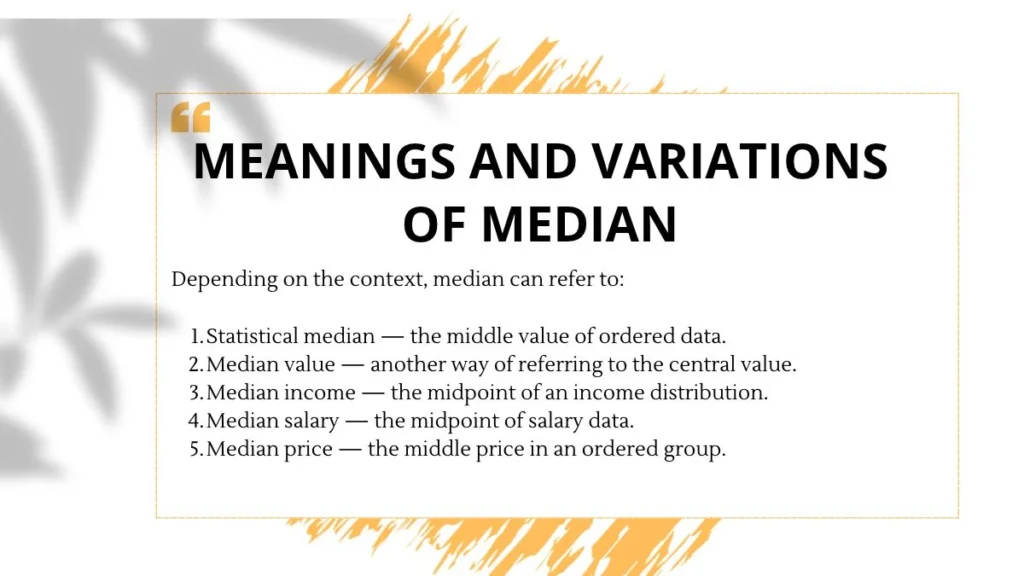
Depending on the context, median can refer to:
- Statistical median — the middle value of ordered data.
- Median value — another way of referring to the central value.
- Median income — the midpoint of an income distribution.
- Median salary — the midpoint of salary data.
- Median price — the middle price in an ordered group.
- Median age — the midpoint of ages in a population.
- Geometric median — a geometric concept involving a central point.
- Triangle median — a line connecting a triangle’s vertex to the midpoint of the opposite side.
- Road median — the strip separating opposing traffic.
- Median position — a general reference to something occupying the middle.
These are related by the same basic concept: central position.
How to Respond When Someone Uses “Median”
Because median is not slang, your response should depend on the context.
Casual Replies
- “So basically, it’s the middle value?”
- “Got it. You mean the midpoint.”
- “Okay, that makes sense.”
Funny Replies
- “So the numbers had a middle child?”
- “Basically, the number sitting in the center.”
- “The data picked its favorite middle number.”
Professional or Mature Replies
- “Thanks for clarifying. Does that refer to the median rather than the mean?”
- “Can you share the range of values as well?”
- “That helps put the data into context.”
USA / Western Usage
In the United States, median is common in statistics, business, education, housing, economics, and transportation.
Americans frequently hear expressions such as median household income, median home price, and highway median.
The word is also familiar in schools because students commonly learn median as one of the basic measures of central tendency.
Global and Internet Usage Differences
The statistical meaning of median is broadly understood internationally because mathematics and statistics use standardized terminology.
The physical meaning can vary slightly by regional vocabulary. In American English, median is commonly used for the central strip separating opposing traffic lanes. In other varieties of English, terms such as “central reservation” may be more common.
Online, the word generally retains its standard meaning. There is no major universal internet slang meaning that replaces its mathematical definition.
Common Misconceptions About Median
Median Always Equals the Mean
False.
A data set can have a median of 35 and a mean of 120 if an unusually large value is included.
Median Means the Most Common Number
False.
The mode is the value that occurs most often.
You Can Find the Median Without Ordering the Numbers
Usually, no. You should arrange the values before identifying the middle position.
Median Always Has to Be One of the Original Values
Not necessarily.
With an even number of observations, the median is commonly calculated as the average of the two middle values. Therefore, the resulting median may not appear in the original data set.
Expert Tip: Median Does Not Mean “Typical” in Every Situation
People often use median as a quick way to describe what is “typical,” but it is better to think of it specifically as a middle-position measure.
For example, knowing the median household income tells you where the midpoint of the income distribution lies. It does not tell you everything about inequality, the spread of incomes, or the most common income.
For deeper analysis, researchers may also consider the mean, mode, range, percentiles, distribution, and other statistical measures.
What Does Median Mean in Statistics?
In statistics, the median is a measure of central tendency. It identifies the point that separates an ordered data set into two halves.
For an odd number of observations, there is one middle value.
For an even number of observations, the two central values are averaged.
The median is also associated with the 50th percentile in many statistical contexts.
This makes it useful for describing data such as wages, property prices, ages, and test scores.
FAQs About Median
What does median mean in simple terms?
Median means the middle value in an ordered group of numbers. If there are two middle values, you normally average them to find the median.
What is the difference between median and average?
In everyday language, average often means the arithmetic mean. The mean is calculated by adding the values and dividing by the number of values. The median is found by locating the middle of the ordered data.
What does median mean in salary?
Median salary means the salary at the midpoint of an ordered group of salaries. About half of the salaries are below that value and about half are above it.
What does median mean in math?
In statistics, it means the middle value of ordered data. In geometry, a median can also be a line from a triangle’s vertex to the midpoint of the opposite side.
What does median mean in text messages?
There is no common texting slang meaning for median. It normally has its standard meaning related to the middle of a data set or something positioned in the middle.
Is median the same as mode?
No. The median is the middle value, while the mode is the value that appears most frequently.
Why is median useful?
Median can provide a useful picture of the center of data, particularly when unusually high or low values are present. It helps show the midpoint without requiring every value to contribute equally to the calculation.
Key Takeaways
- Median usually means the middle value.
- In statistics, arrange the data first and identify its center.
- With an even number of values, average the two middle numbers.
- Median is different from mean, mode, and average.
- It is commonly used for income, salaries, home prices, ages, and test scores.
- Median is also used for a road’s center strip and in geometry.
- The word is neutral, not slang, and not offensive.
- Its basic idea comes from the concept of being in the middle.
References
- Merriam-Webster, “Median” — definition, word history, and usage.
- National Institute of Standards and Technology (NIST), Engineering Statistics Handbook — Measures of Location — statistical explanation of mean, median, and related measures.
- NIST Computer Security Resource Center, Median Glossary Entry — statistical definition.
- National Cancer Institute, NCI Dictionary of Cancer Terms — Median — concise statistical definition.
- NCBI Bookshelf, StatPearls — Median — explanation of median, mean, and calculation examples.
Conclusion
So, what does median mean? In most cases, it means the middle value of an ordered set of numbers. It can also describe something positioned in the middle, such as a road median or a geometric line in a triangle.
The easiest way to remember it is: median = middle. Just remember that median is not automatically the same as mean or average. Understanding that small difference can help you read statistics, news reports, salary information, housing data, and school assignments much more accurately.

Daniel Carter is a passionate writer and creative storyteller dedicated to exploring the deeper meanings of life, dreams, and human experiences. With a strong interest in symbolism, spirituality, and personal growth, Daniel brings clarity to complex ideas, making them easy to understand for readers from all walks of life.
As a featured author on meaniings.com, Daniel Carter focuses on delivering insightful, well-researched, and engaging content that helps readers uncover hidden meanings behind dreams, emotions, and everyday situations. His writing style combines thoughtful analysis with a relatable voice, making his work both informative and inspiring.
Daniel’s approach is rooted in curiosity and a desire to guide readers toward self-awareness and understanding. He believes that every dream and experience carries a message—one that can lead to personal transformation when interpreted correctly.
Over time, Daniel has built a reputation for creating meaningful content that resonates with a global audience, especially those interested in dream interpretation and spiritual insight.
Books by Daniel Carter:
- The Hidden Language of Dreams
- Signs, Symbols, and Their Meanings
- Unlocking the Power of Your Subconscious Mind