
If you’re wondering what does mid mean slang, the word usually means average, mediocre, or not very impressive. On TikTok, Instagram, Reddit, gaming platforms, and other social media sites, calling something “mid” usually means it is okay but not good enough to be considered great.
People can use “mid” to describe almost anything, including food, music, movies, video games, fashion, products, sports performances, or personal experiences. Depending on the situation and tone, it can sound mildly critical, dismissive, or playful.
In this guide, you’ll learn what mid means in slang, how people use it in texts and social media, what it means in different situations, and when you should or should not use the word.
Quick Answer: What Does “Mid” Mean in Slang?
In modern slang, mid usually means:
- Average or mediocre — something is neither terrible nor excellent.
- Overhyped or disappointing — something does not live up to expectations.
- Not worth the hype — a casual way to criticize something.
- Just okay — something that is acceptable but not especially impressive.
Example: “That new movie was mid.”
This means the person thought the movie was okay or mediocre but not good enough to deserve much praise.
What Does Mid Mean?
The slang mid is an informal way to describe something that feels ordinary, average, or disappointing. It is commonly used in online conversations and casual speech.
For example, if someone visits a highly recommended restaurant and says, “Honestly, it was mid,” they mean the food was acceptable but did not impress them.
The important thing to remember is that mid usually does not mean completely terrible. It often describes something somewhere between good and bad.
Think of it like this:
Amazing → Good → Mid → Bad
The exact meaning depends on the speaker, the subject, and the context.
Mid Meaning in Simple Words
The easiest definition is:
Mid = average, mediocre, or less impressive than expected.
People often use the word when they believe something has received more praise or attention than it deserves.
What Does Mid Mean in Text?
When someone uses mid in text, they normally mean that something is average, mediocre, or disappointing.
For example:
Person A: “Did you watch the new superhero movie?”
Person B: “Yeah. Mid tbh.”
Here, tbh means “to be honest,” while mid means the person did not think the movie was particularly impressive.
Another example:
“That restaurant everyone talks about is mid.”
The speaker is saying that the restaurant is acceptable but does not live up to its reputation.
In a text message, “mid” can replace longer phrases such as:
- “It was just okay.”
- “It wasn’t that good.”
- “It was pretty average.”
- “I expected more.”
- “It isn’t worth the hype.”
What Does “Mid” Mean in a Text Message?
In a text message, mid usually gives something an average or mildly negative review.
The words around it can show how strong the opinion is:
- “Kinda mid” = mildly unimpressive.
- “So mid” = clearly unimpressive.
- “Absolutely mid” = strongly dismissive.
- “Mid at best” = no better than average.
What Does Mid Mean on Social Media?
On TikTok, Instagram, X, Reddit, YouTube, and other online platforms, mid is commonly used as a quick reaction to content.
Someone might comment “mid” under:
- A new song
- A movie trailer
- A celebrity outfit
- A video game
- A restaurant review
- A viral product
- A sports performance
- A popular TV show
- A social media trend
The word is popular online because it communicates an opinion in only three letters.
WhatsApp Chat Example
Alex: “I finally tried that burger place you recommended.”
Sam: “How was it?”
Alex: “Honestly? Mid 😂”
Meaning: Alex thought the burger was okay but not impressive.
Instagram DM Example
Jamie: “Did you like the new album?”
Chris: “Not really. It’s kinda mid.”
Meaning: Chris thinks the album is average or disappointing.
TikTok Comment Example
Creator: “Best fast-food fries ever 🔥”
Comment: “Mid tbh.”
Meaning: The commenter disagrees and thinks the fries are only average.
What Does Mid Mean in Real Life?
Although “mid” is strongly associated with internet slang, people also use it in everyday casual conversations.
For example:
“How was the concert?”
“It was mid. The opening act was better.”
The word works best when people are casually judging or rating something.
Common subjects include:
- Entertainment
- Food
- Fashion
- Sports
- Gaming
- Products
- Events
- Social media trends
- Personal experiences
Examples of Mid in Different Situations
Mid Meaning for Food
“Everyone said this pizza was amazing, but it was mid.”
The speaker expected something excellent but found it average.
Mid Meaning for Movies and TV
“The first movie was great, but the sequel was mid.”
The speaker thinks the sequel did not meet the quality of the first movie.
Mid Meaning for Music
“That new single is mid.”
The listener does not think the song is especially memorable or impressive.
Mid Meaning for Gaming
“The graphics look good, but the gameplay is mid.”
The speaker likes the graphics but thinks the actual gameplay is only average.
Mid Meaning for Fashion
“That outfit is mid compared with her usual looks.”
The speaker thinks the outfit is acceptable but not particularly impressive.
Mid Meaning for Sports
“He had a mid performance tonight.”
The player performed around an ordinary level rather than standing out.
Examples of “Mid” in Sentences
Here are some natural examples:
- “The movie looked amazing in the trailer, but it was mid.”
- “I tried their famous coffee, and honestly, it was mid.”
- “Everyone loves that song, but I think it’s mid.”
- “The game isn’t bad, but the story is pretty mid.”
- “That new restaurant is seriously mid for the price.”
- “The first season was great, but season two was mid.”
- “I expected the concert to be incredible, but it was kind of mid.”
You will often see “mid” combined with words such as kinda, pretty, really, so, actually, and honestly.
Is Mid a Positive or Negative Word?
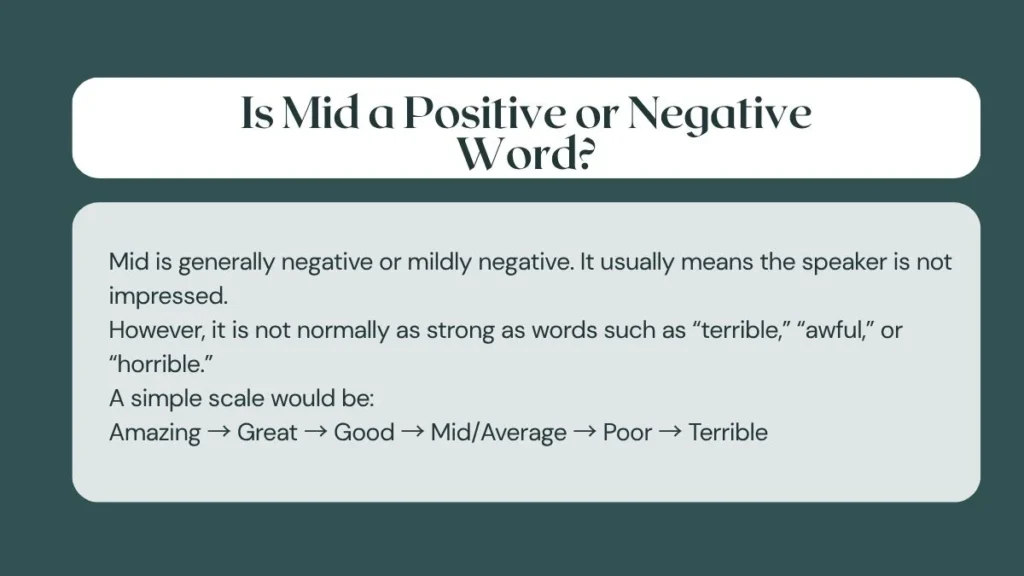
Mid is generally negative or mildly negative. It usually means the speaker is not impressed.
However, it is not normally as strong as words such as “terrible,” “awful,” or “horrible.”
A simple scale would be:
Amazing → Great → Good → Mid/Average → Poor → Terrible
For example:
- “Kinda mid” sounds relatively mild.
- “That was mid” gives a straightforward negative opinion.
- “Absolutely mid” sounds much more dismissive.
The meaning can also change with tone. Friends may sometimes use “mid” jokingly when they actually have a stronger or more complicated opinion.
Is Mid an Insult?
It can be, depending on how you use it.
Saying:
“That movie was mid.”
is usually just a casual opinion.
But saying:
“Your artwork is mid.”
directly to an artist may sound rude because you are judging someone’s personal work.
A useful rule is:
Criticizing an object is usually safer than criticizing a person.
For example:
- “The movie was mid.” → Casual opinion.
- “Your acting was mid.” → More personal.
- “Your presentation was average.” → More professional.
- “The presentation could be stronger in a few areas.” → More constructive.
Is Mid a Bad Word?
No. “Mid” is not generally considered profanity. It is informal slang.
However, the word can still sound dismissive or rude depending on the situation.
It is usually fine in casual conversations with friends, but it may not be appropriate for professional or academic communication.
Is Mid Formal or Informal?
“Mid” is primarily informal slang.
| Situation | Is “mid” suitable? |
|---|---|
| Talking with friends | Yes |
| Text messages | Yes |
| Social media | Yes |
| Gaming chats | Yes |
| Casual conversations | Yes |
| Professional report | Usually no |
| Academic essay | Usually no |
| Formal business communication | Usually no |
In formal writing, clearer alternatives include average, mediocre, ordinary, underwhelming, and unremarkable.
When Should You Use “Mid”?
You can use “mid” when:
- Talking casually with friends
- Commenting on social media
- Discussing movies, music, food, or games
- Participating in online communities
- Making a playful criticism
- Giving an informal opinion
For example:
“The new game isn’t bad, but it’s pretty mid.”
That sounds natural in casual conversation.
When Should You Avoid Using “Mid”?
Avoid the word when:
- Writing an academic paper
- Speaking in a formal business meeting
- Writing a professional report
- Giving serious workplace feedback
- Communicating with someone who may not understand internet slang
- Discussing a sensitive personal subject
Instead of:
“Your work is mid.”
you could say:
“The work is solid, but there are a few areas that could be improved.”
This communicates your opinion without sounding unnecessarily dismissive.
“Mid” Compared With Similar Words
| Term | Meaning | Main Difference |
|---|---|---|
| Mid | Average or unimpressive | Informal and slangy |
| Average | Ordinary or typical | More neutral |
| Mediocre | Only moderately good | Usually more clearly negative |
| Underwhelming | Less impressive than expected | Focuses on disappointment |
| Unremarkable | Not especially noticeable | More formal and neutral |
| Basic | Ordinary or lacking originality | Often focuses on style or originality |
The closest everyday synonym is usually average, but “mid” often carries more attitude.
8 Common Variations of “Mid”
The word can appear in several forms.
1. Mid
Simply means average or mediocre.
2. Kinda Mid
Means somewhat average or unimpressive.
3. Pretty Mid
Suggests something is noticeably unimpressive.
4. So Mid
Emphasizes that the speaker is not impressed.
5. Mid AF
Means extremely mid. This is very informal and includes profanity shorthand.
6. Mid-Tier
Describes something around the middle in quality or ranking.
7. Mid-Grade
Can describe average or moderate quality, although its meaning depends on the context.
8. Mid at Best
Emphasizes that something is no better than average.
These expressions are not always interchangeable. For example, mid-tier can sometimes be a neutral ranking rather than an insult.
Why Do People Say “Mid”?
People use “mid” because it is short, flexible, and expressive.
Instead of saying:
“I don’t think this product is particularly impressive compared with what people claim.”
someone can simply say:
“It’s mid.”
That makes the word useful in fast-moving online conversations.
It can also communicate that the speaker disagrees with the hype surrounding something.
What Does “Mid” Say About the Hype?
Calling something “mid” can sometimes mean:
- “I don’t agree with the hype.”
- “I’ve seen better.”
- “You expected too much.”
- “This isn’t worth the attention.”
- “I’m not impressed.”
That is why “mid” can sometimes sound more dismissive than simply saying average.
The Tone Behind “Mid”
“Mid” does not have one fixed emotional meaning.
Depending on context, it can express:
- Low enthusiasm
- Disappointment
- Indifference
- Skepticism
- Mild criticism
- Playful teasing
For example:
“That was mid.”
may simply mean:
“I wasn’t impressed.”
But friends might also use the same phrase jokingly when they disagree about a movie, song, game, or meal.
Context and tone matter.
Is It Rude to Say “Mid”?
It depends on what you are describing and who you are talking to.
Saying:
“That movie was mid.”
is usually harmless.
But saying:
“Your presentation was mid.”
may sound disrespectful, especially if someone spent a lot of time preparing it.
If you want to give useful feedback, be specific instead.
Less helpful:
“Your presentation was mid.”
More helpful:
“The presentation had good information, but the opening could be stronger and the slides could be easier to follow.”
Specific feedback gives the other person something they can actually improve.
How to Respond When Someone Says “Mid”
Your response can depend on the situation.
Casual Replies
- “Fair enough 😂”
- “You didn’t like it?”
- “I thought it was pretty good.”
- “Honestly, I agree.”
- “What would you rate it?”
Funny Replies
- “Mid? That’s fighting words 😂”
- “Okay, critic 😂”
- “Bro gave it a rating with one word.”
- “So we’re choosing violence today?”
Mature Replies
If someone calls your work “mid,” you can ask:
- “What specifically felt average to you?”
- “What would you improve?”
- “What would make it stronger?”
- “Can you give me a specific example?”
This can turn a vague opinion into useful feedback.
Mid in American and Western Internet Slang
In the United States and wider English-speaking internet culture, “mid” is strongly associated with casual online communication.
It appears in:
- Social media comments
- Group chats
- Gaming communities
- Entertainment discussions
- Sports conversations
- Product discussions
- Everyday casual speech
For example:
“That restaurant is mid for $30 a plate.”
The speaker is not only saying the food is average. They are also suggesting that the quality does not justify the price.
Does Everyone Understand “Mid”?
Not necessarily.
Because social media spreads slang across countries, many English-speaking internet users recognize the word. However, understanding can vary by age, country, and online community.
A frequent social media user may immediately understand:
“That show is mid.”
Someone who rarely uses internet slang may simply understand “mid” as meaning “middle.”
That is why context remains important.
Origin and History of “Mid”
The modern slang use of mid developed from the broader idea of something being in the middle or average.
The slang became increasingly visible across internet communities during the 2010s and early 2020s. The word has also appeared in other subcultures with more specific meanings, so its history is broader than one single internet trend.
Today, the most common online use is much wider. People can call almost anything “mid” when they think it is ordinary, disappointing, or overhyped.
This is a good example of how slang changes over time. A word can develop additional meanings as different communities adopt and reshape it.
Common Misconceptions About “Mid”
“Mid” Always Means Bad
Not exactly. It usually means average or unimpressive, rather than completely terrible.
“Mid” Is Always an Insult
No. Friends may use it jokingly when talking about movies, music, food, games, or trends.
“Mid” Is Appropriate Everywhere
No. It is informal slang and may not fit professional or academic communication.
“Mid” Is an Objective Rating
No. Calling something “mid” is usually someone’s personal opinion. One person’s mid movie can be another person’s favorite movie.
FAQs About Mid Slang
What does mid mean in slang?
Mid means average, mediocre, or not especially impressive. It is often used online to criticize something that people believe is overhyped.
What does mid mean in text?
In text messages, mid usually means something is just okay or disappointing.
For example:
“That show was mid.”
This means the person did not think the show was very good.
What does mid mean on TikTok?
On TikTok, “mid” is commonly used in comments to say that a video, song, trend, product, or performance is average or overhyped.
Is calling something mid an insult?
It can be mildly insulting, especially when said directly to someone about their work or abilities. However, it is generally less harsh than calling something terrible or worthless.
Is mid a bad word?
No. “Mid” is not generally considered profanity. It is informal slang that can sound dismissive depending on the context.
What is another word for mid?
Depending on the situation, alternatives include average, mediocre, ordinary, underwhelming, unremarkable, and okay.
Why do people say mid?
People say “mid” because it is a quick way to express that something is average, disappointing, or not worth the hype. It is especially useful in short online comments.
Can I use mid in a professional email?
It is better to avoid it in professional emails. Words such as average, underwhelming, or specific constructive feedback will sound clearer and more professional.
Can mid be used as a compliment?
Usually, no. “Mid” normally suggests that something is only average or not impressive. However, friends may use it jokingly, so tone and context matter.
Does mid mean boring?
Sometimes it can suggest that something is boring or uninteresting, but mid more broadly means average or unimpressive. The exact meaning depends on the context.
Key Takeaways
- Mid usually means average, mediocre, or unimpressive.
- It is common on TikTok, Instagram, Reddit, gaming platforms, and in text messages.
- It usually expresses a mildly negative opinion.
- “Mid” does not necessarily mean something is terrible.
- Friends may use it playfully, but it can sound rude when directed at someone’s personal work.
- In professional or academic writing, use clearer words such as average, mediocre, or underwhelming.
- The exact meaning depends on context and tone.
Conclusion
So, what does mid mean slang? In simple terms, mid means average, mediocre, or not as impressive as expected.
It is a popular informal expression used to describe everything from movies and music to food, video games, fashion, sports performances, and internet trends. When someone says, “That was mid,” they usually mean, “It was okay, but I wasn’t impressed.”
The word is short and easy to use, which is one reason it has become popular in online conversations. However, it is still slang, so it may not be appropriate for professional or academic situations.
Now that you know what mid means, you can understand it when you see it in a text, TikTok comment, Instagram post, gaming chat, or everyday conversation.

Daniel Carter is a passionate writer and creative storyteller dedicated to exploring the deeper meanings of life, dreams, and human experiences. With a strong interest in symbolism, spirituality, and personal growth, Daniel brings clarity to complex ideas, making them easy to understand for readers from all walks of life.
As a featured author on meaniings.com, Daniel Carter focuses on delivering insightful, well-researched, and engaging content that helps readers uncover hidden meanings behind dreams, emotions, and everyday situations. His writing style combines thoughtful analysis with a relatable voice, making his work both informative and inspiring.
Daniel’s approach is rooted in curiosity and a desire to guide readers toward self-awareness and understanding. He believes that every dream and experience carries a message—one that can lead to personal transformation when interpreted correctly.
Over time, Daniel has built a reputation for creating meaningful content that resonates with a global audience, especially those interested in dream interpretation and spiritual insight.
Books by Daniel Carter:
- The Hidden Language of Dreams
- Signs, Symbols, and Their Meanings
- Unlocking the Power of Your Subconscious Mind