
Quick answer: OPS stands for On-base Plus Slugging. It’s a baseball statistic that adds together a hitter’s on-base percentage (OBP) and slugging percentage (SLG) into one number that shows how good a batter is at both reaching base and hitting for power. OPS combines on-base percentage and slugging percentage to show how good a player is at both batting and getting on base. Most fans and analysts consider an OPS above .800 a sign of a very good hitter, and anything over 1.000 puts a player in elite, MVP-caliber territory.
If you’ve seen “OPS” pop up on a scoreboard, a fantasy baseball app, or an ESPN stat line and wondered what it actually measures, you’re not alone — it’s one of the most-searched baseball stat terms in the U.S. This guide breaks down exactly what OPS means, how it’s calculated, why coaches and scouts care about it, and how it compares to older stats like batting average.
OPS can refer to a few different things depending on context:
- Baseball statistic (most common meaning): On-base Plus Slugging, a hitting stat that combines OBP and SLG
- OPS+ (a related but different stat): OPS adjusted for ballpark and league, where 100 is league average
- Pitching context: “OPS against,” which measures how well a pitcher limits opposing hitters
- Outside baseball: In texting or business contexts, “ops” can mean “operations” (as in an ops team) or be shorthand for “oops” — but this has nothing to do with the baseball stat
What Does OPS Mean? (Clear, Simple Definition)
In baseball, OPS is a single number that tells you how much offensive value a hitter creates. Think of it as two important skills squeezed into one stat:
- Getting on base (via hits, walks, or being hit by a pitch)
- Hitting for power (extra-base hits like doubles, triples, and home runs)
Instead of tracking those two skills separately, OPS adds them together so coaches, scouts, and fans can judge a hitter’s overall offensive impact at a glance.
Full Meaning in Simple Words
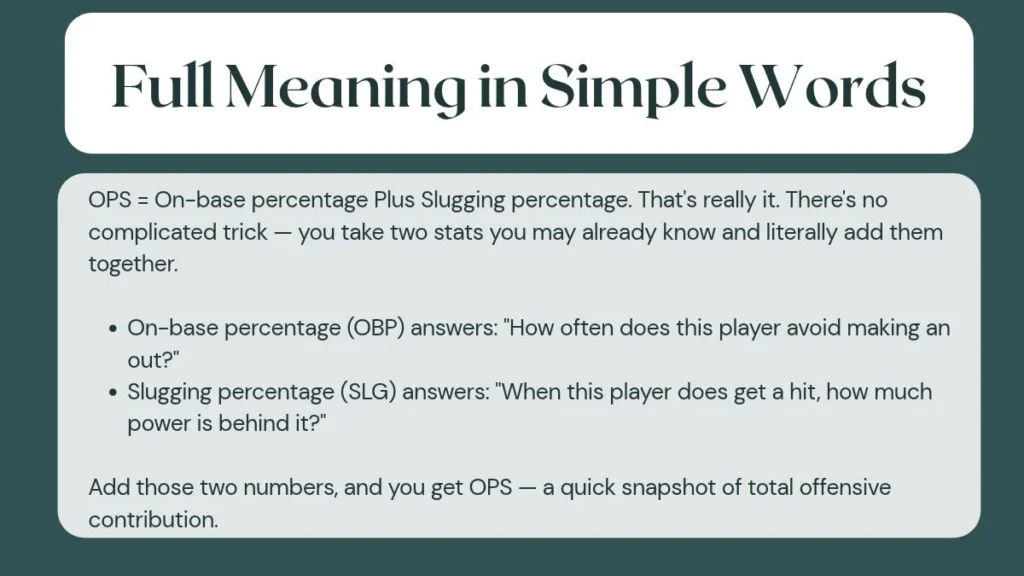
OPS = On-base percentage Plus Slugging percentage. That’s really it. There’s no complicated trick — you take two stats you may already know and literally add them together.
- On-base percentage (OBP) answers: “How often does this player avoid making an out?”
- Slugging percentage (SLG) answers: “When this player does get a hit, how much power is behind it?”
Add those two numbers, and you get OPS — a quick snapshot of total offensive contribution.
What Does OPS Mean in a Box Score or Text?
When you see “OPS: .850” on a stat sheet, group chat, or fantasy baseball app, it means that player’s combined OBP and SLG add up to .850. There’s no separate “texting slang” version of OPS in baseball conversations — it’s used the same way whether you’re reading MLB.com, texting a friend about your fantasy lineup, or watching a broadcast graphic.
It’s worth noting that outside of sports, “ops” is sometimes short for “operations” (like an IT ops team) or occasionally a casual typo/shorthand near “oops.” Neither of those has any connection to the baseball statistic — context makes the difference obvious almost every time.
What Does OPS Mean on Social Media (TikTok, Instagram, etc.)?
On baseball-focused social media, OPS is used exactly like it is on broadcasts and stat sites — as a real, cited number backing up an argument about who the better hitter is. It shows up constantly in fantasy baseball group chats, MLB highlight comment sections, and sports betting discussions.
WhatsApp Chat Example:
Mike: Who do you think should bat cleanup tonight?
Jordan: Put Alvarez there, his OPS is .950 this month, he’s locked in
Instagram DM Example:
Fan1: trade offer — I’ll give you Judge for your Ohtani
Fan2: nah Ohtani’s OPS is way higher, that’s a bad trade for me
TikTok Comment Example:
“People sleeping on this rookie — .890 OPS in his first 40 games is insane 🔥”
Real-Life Meaning and Usage
OPS isn’t just a number nerds throw around — it directly affects real decisions in the sport. Front offices use it to negotiate contracts. Managers use it to decide batting order. Fantasy players use it to set their lineups every week.
Real-Life Situations Where This Term Is Used
- MLB broadcasts: Announcers cite OPS when comparing two hitters in a big at-bat
- Fantasy baseball: Many leagues use OPS as a core scoring category instead of batting average
- Player contracts: Agents and teams reference career OPS during salary negotiations
- Scouting reports: Scouts use OPS trends to track a prospect’s development
- Sports betting: Bettors check recent OPS to gauge a player’s “hot streak” before placing prop bets
- Youth and college baseball: Coaches track OPS to evaluate lineup construction, even at non-pro levels
Examples of OPS in Sentences
- “His OPS jumped from .720 to .880 after he changed his batting stance.”
- “The Yankees signed him partly because of his consistent .900+ OPS over the last three seasons.”
- “Our fantasy league ranks hitters by OPS instead of batting average.”
- “Even though he doesn’t hit for a high average, his OPS is strong because he draws so many walks.”
- “The rookie’s OPS dropped in September as pitchers started attacking him differently.”
- “A .700 OPS is roughly league average for a modern MLB hitter.”
Different Contexts of OPS
- Casual context: Fans debating who’s the better player in a group chat or at a bar
- Academic/analytical context: Sabermetric research papers and books studying run production
- Broadcast context: TV and radio commentary comparing hitters in real time
- Online context: Fantasy sports platforms, betting sites, and stat-tracking apps like Baseball Reference or FanGraphs
- Front-office context: Contract negotiations, trade evaluations, and roster construction
Origin and History of the Term
OPS has a specific, well-documented origin. On-base plus slugging was first popularized in 1984 by John Thorn and Pete Palmer’s book, The Hidden Game of Baseball. The New York Times then began carrying the leaders in this statistic in its weekly “By the Numbers” box, a feature that continued for four years, and baseball journalist Peter Gammons used and evangelized the statistic, helping other writers and broadcasters pick it up. The popularity of OPS gradually spread, and by 2004 it began appearing on Topps baseball cards, cementing it as a mainstream stat rather than a niche analytics term.
The two building blocks of OPS have their own separate histories. On-base percentage was developed by Brooklyn Dodgers executive Branch Rickey in the 1940s or 1950s, while slugging percentage was adopted as an official MLB statistic in 1923. OPS simply combined two already-respected numbers into one convenient figure — which is part of why it caught on so quickly with both traditional writers and the emerging sabermetrics movement.
Editorial note: Anyone who’s coached or managed a fantasy roster knows the appeal of OPS — it’s simple enough to calculate by hand, yet it correlates strongly with actual run production, which is why it survived decades of newer, more complex metrics (like wOBA and wRC+) without becoming obsolete.
Why Do People Use This Word?
People use “OPS” instead of listing OBP and SLG separately because it’s faster and more intuitive. Saying “his OPS is .920” communicates overall hitting quality in one breath, instead of forcing the listener to mentally combine two separate percentages.
Emotional and Psychological Meaning Behind the Term
For fans, OPS often carries an emotional weight tied to fairness and recognition. A player who doesn’t hit for a flashy batting average but draws a lot of walks might feel underappreciated using older stats — OPS gives that player credit for skills that batting average ignores, which is part of why sabermetrically-minded fans championed it so strongly in the 1990s and 2000s.
Tone, Usage, and Etiquette
Tone Explanation
OPS is a neutral, technical, and analytical term. It carries no slang connotation, no rudeness, and no hidden meaning — it’s a straightforward statistic used in formal broadcasts, casual conversations, and academic sabermetric writing alike.
Is It Rude to Say This Word?
No. OPS is not rude, offensive, or inappropriate in any context. It’s simply a performance statistic, similar to saying someone’s “batting average” or “ERA.”
Is This Word Positive, Negative, or Neutral?
OPS itself is neutral — it’s just a number. Whether a specific OPS value feels “positive” or “negative” depends entirely on the number attached to it (a .950 OPS is great news for a hitter; a .550 OPS is a red flag).
When to Use OPS
- When comparing two hitters’ overall offensive value
- When evaluating a player for a fantasy lineup or trade
- When discussing a player’s development over a season or career
- When explaining why a player with a modest batting average is still valuable
When NOT to Use OPS
- When evaluating pitchers’ overall skill (use ERA, WHIP, or FIP instead — OPS against is a narrower, secondary tool)
- When you need to isolate speed, defense, or baserunning value, since OPS only measures hitting
- As the sole stat in small sample sizes (a handful of games can produce a misleadingly high or low OPS)
Situations Where You Should Avoid Using This Term
Avoid leaning on OPS alone when discussing a player’s complete value to a team — it ignores defense, baserunning, and situational hitting. Analysts increasingly pair OPS with metrics like OPS+ or WAR (Wins Above Replacement) for a fuller picture, rather than using OPS in isolation for major roster decisions.
OPS vs. Similar Baseball Stats (Comparison Table)
| Stat | Meaning | Usage | Key Difference from OPS |
|---|---|---|---|
| OPS | On-base Plus Slugging (OBP + SLG) | General hitter evaluation | Baseline combined stat |
| Batting Average (AVG) | Hits divided by at-bats | Traditional hitting measure | Ignores walks and power entirely |
| OPS+ | OPS adjusted for ballpark and league, 100 = average | Comparing hitters across eras/parks | Context-adjusted; more accurate cross-comparison |
| WAR | Wins Above Replacement | Overall player value (hitting, fielding, baserunning) | Covers far more than just hitting |
| wOBA | Weighted On-Base Average | Advanced sabermetric hitting stat | Weights each outcome (single, double, walk) differently instead of adding two percentages evenly |
Key takeaway: OPS is a great quick-reference stat, but OPS+ and WAR go further by adjusting for context and including more than just batting.
Variations and Related Terms
- OPS+ — OPS adjusted for park and league; a score of 100 is league average, and 150 is 50 percent better than league average
- OPS against — used when evaluating pitchers, referring to the OPS posted by hitters who face them
- wOBA (Weighted On-Base Average) — a more advanced version that weights each type of hit differently
- Gross Production Average (GPA) — tries to reflect the different values of getting on base versus slugging instead of adding them equally
- SLG (Slugging Percentage) — one of the two components that make up OPS
- OBP (On-Base Percentage) — the other component that makes up OPS
- Total Bases (TB) — used in the slugging percentage calculation
- wRC+ (Weighted Runs Created Plus) — another advanced, context-adjusted offensive stat often used alongside OPS+
How to Respond When Someone Brings Up a Player’s OPS
Casual reply: “Yeah his OPS backs that up, dude’s been raking all month.”
Funny reply: “OPS says he’s a star, my eyes say he can’t hit a curveball — somebody’s lying.”
Professional/mature reply: “His OPS has trended upward significantly since the All-Star break, which supports the case for moving him up in the order.”
Cultural Usage of OPS
USA / Western Usage
In the United States, OPS is deeply embedded in mainstream baseball culture — it appears on MLB broadcasts, ESPN graphics, Topps baseball cards, and fantasy baseball platforms like ESPN Fantasy and Yahoo. It’s treated as a standard, trusted stat rather than a niche analytics term.
Global or Internet Usage Differences
Outside the U.S., baseball is less dominant (compared to soccer or cricket), so OPS is mostly discussed within international baseball communities — Japan’s NPB, Korea’s KBO, and international tournaments like the World Baseball Classic. Online, in non-baseball contexts, “ops” is sometimes used casually as shorthand for “operations” (business/IT contexts) or in gaming slang for “operatives” or “operations mode” — these usages are unrelated to the sports statistic and rarely cause real confusion because context makes the meaning clear.
A Simple Decision Guide: Which Stat Should You Actually Use?
Need to judge a hitter quickly?
        ↓
   Want just power? → Use Slugging Percentage (SLG)
        ↓
   Want just plate discipline? → Use On-Base Percentage (OBP)
        ↓
   Want a quick combined snapshot? → Use OPS
        ↓
   Comparing players across different ballparks/eras? → Use OPS+
        ↓
   Want the full picture (hitting + fielding + baserunning)? → Use WAR
Common Misconceptions About OPS
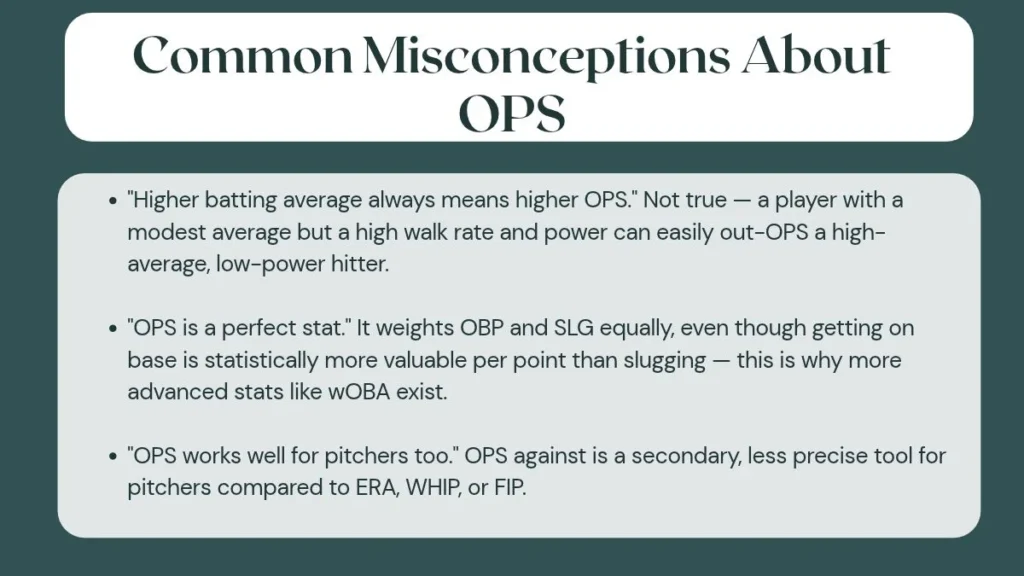
- “Higher batting average always means higher OPS.” Not true — a player with a modest average but a high walk rate and power can easily out-OPS a high-average, low-power hitter.
- “OPS is a perfect stat.” It weights OBP and SLG equally, even though getting on base is statistically more valuable per point than slugging — this is why more advanced stats like wOBA exist.
- “OPS works well for pitchers too.” OPS against is a secondary, less precise tool for pitchers compared to ERA, WHIP, or FIP.
Frequently Asked Questions
Who has the highest career OPS in MLB history?
Babe Ruth ranks first all-time with a career 1.164 OPS, while Ted Williams is second with a 1.116 lifetime OPS.
What is a good OPS in baseball?
A good on-base plus slugging percentage is anything above the league average, which is usually between .700 and .750, and anything above .900 is considered elite.
Is OPS better than batting average?
Most analysts consider OPS more informative because it accounts for walks and extra-base power, while batting average only measures hits per at-bat and ignores both.
What is the difference between OPS and OPS+?
OPS is the raw sum of OBP and SLG. OPS+ takes that number and normalizes it across the league, adjusting for ballpark effects, with 100 set as league average.
How is OPS calculated step by step?
Add a player’s on-base percentage to their slugging percentage: OPS = OBP + SLG. OBP equals (hits + walks + hit-by-pitch) divided by (at-bats + walks + hit-by-pitch + sacrifice flies), while SLG equals total bases divided by at-bats.
Does OPS apply to pitchers?
Yes, in that context it’s referred to as “OPS against,” measuring the combined OBP and SLG of hitters facing that pitcher — a lower number is better for the pitcher.
What does a single-season OPS+ of 140 mean?
A single-season OPS+ of 140 or higher is generally considered a Hall of Fame-caliber offensive season, since it reflects performance 40% better than league average after adjusting for park and league factors.
References
- MLB.com Glossary, “On-base Plus Slugging (OPS)” and “On-base Plus Slugging Plus (OPS+)”
- Baseball-Reference.com Glossary, “On Base Plus Slugging (OPS)”
- Wikipedia, “On-base plus slugging”
- Thorn, John, and Pete Palmer, The Hidden Game of Baseball (1984)
Want this saved as a downloadable file (Word doc or Markdown) instead of just here in chat?
Conclusion
OPS gives baseball fans, coaches, and analysts a fast, reliable way to judge a hitter’s total offensive value by combining on-base skill with power hitting. It’s not a perfect stat — OPS+ and WAR go further by adding context — but for a quick read on who’s producing at the plate, OPS remains one of the most trusted numbers in the sport. Next time you see it on a scoreboard or hear it in a broadcast, you’ll know exactly what it’s telling you: how often a player reaches base, and how much damage they do when they get there.

Daniel Carter is a passionate writer and creative storyteller dedicated to exploring the deeper meanings of life, dreams, and human experiences. With a strong interest in symbolism, spirituality, and personal growth, Daniel brings clarity to complex ideas, making them easy to understand for readers from all walks of life.
As a featured author on meaniings.com, Daniel Carter focuses on delivering insightful, well-researched, and engaging content that helps readers uncover hidden meanings behind dreams, emotions, and everyday situations. His writing style combines thoughtful analysis with a relatable voice, making his work both informative and inspiring.
Daniel’s approach is rooted in curiosity and a desire to guide readers toward self-awareness and understanding. He believes that every dream and experience carries a message—one that can lead to personal transformation when interpreted correctly.
Over time, Daniel has built a reputation for creating meaningful content that resonates with a global audience, especially those interested in dream interpretation and spiritual insight.
Books by Daniel Carter:
- The Hidden Language of Dreams
- Signs, Symbols, and Their Meanings
- Unlocking the Power of Your Subconscious Mind