
If you’re wondering what does dissociation mean, the simple answer is that dissociation is a mental experience where a person feels disconnected from their thoughts, feelings, memories, surroundings, or even their sense of identity. It can happen occasionally to many people, especially during stress, fatigue, or overwhelming situations.
The term is commonly used in psychology, mental health discussions, social media conversations, and everyday life. Understanding the meaning of dissociation can help people recognize why they sometimes feel detached from reality or emotionally distant.
Quick Meaning
What Does Dissociation Mean?
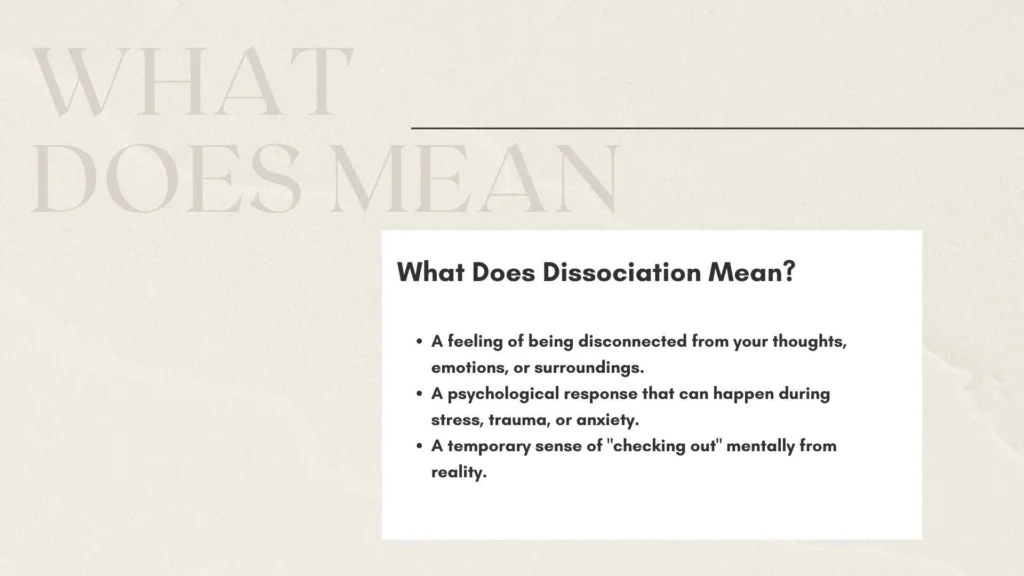
- A feeling of being disconnected from your thoughts, emotions, or surroundings.
- A psychological response that can happen during stress, trauma, or anxiety.
- A temporary sense of “checking out” mentally from reality.
- A mental state where a person feels detached from themselves or the world around them.
These definitions cover the most common meaning of dissociation in everyday conversations and mental health discussions.
What Does Dissociation Mean?
Dissociation is a psychological experience where a person’s awareness becomes separated from certain thoughts, memories, feelings, or surroundings. It can feel like you’re watching yourself from outside your body, feeling unreal, or mentally zoning out.
For many people, mild dissociation happens occasionally and is not necessarily a sign of a serious problem. For example, becoming so absorbed in a movie that you lose track of time can be considered a mild form of dissociation.
Full Meaning in Simple Words
In simple terms, dissociation means your mind temporarily disconnects from what’s happening around you.
People often describe it as:
- Feeling “spaced out”
- Feeling numb emotionally
- Feeling disconnected from reality
- Feeling like a spectator in their own life
- Losing track of time
The experience can last a few seconds, minutes, or longer depending on the situation.
What Does Dissociation Mean in Text?
When people use dissociation in text messages, they are usually referring to feeling mentally disconnected or emotionally detached.
Example
Friend 1: “You okay? You’ve been quiet all day.”
Friend 2: “Honestly, I’ve been dissociating since this morning.”
In this example, the person means they feel disconnected or mentally distant.
What Does Dissociation Mean on Social Media (TikTok, Instagram, etc.)?
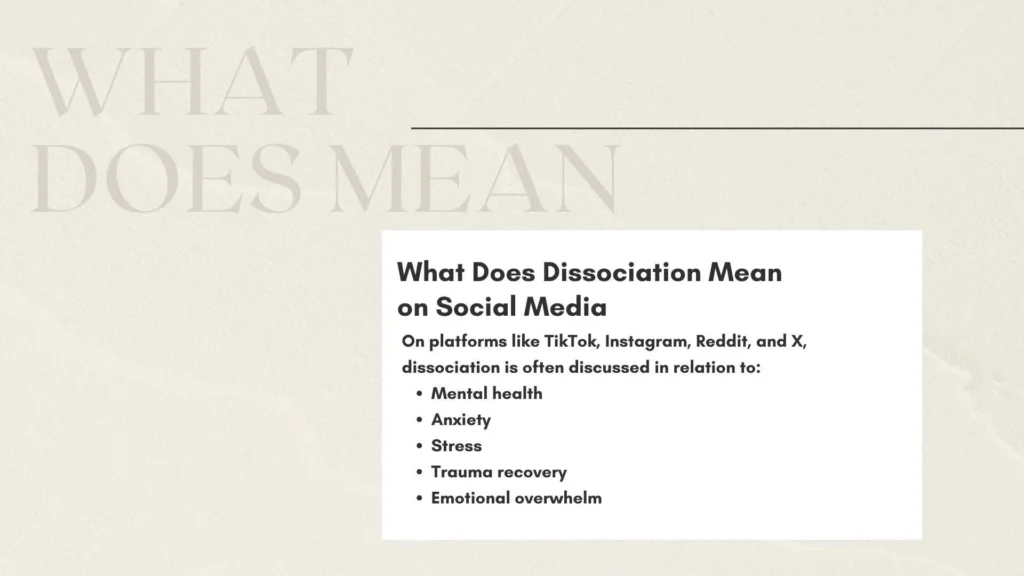
On platforms like TikTok, Instagram, Reddit, and X, dissociation is often discussed in relation to:
- Mental health
- Anxiety
- Stress
- Trauma recovery
- Emotional overwhelm
Many creators share personal experiences about feeling detached from reality, emotionally numb, or mentally checked out.
TikTok Usage
People may post:
“I’ve been dissociating all week after finals.”
This means they feel mentally disconnected due to stress.
Instagram Usage
Someone might write:
“Need a break. My brain keeps dissociating.”
This suggests emotional or mental exhaustion.
WhatsApp Chat Example
Sarah: “Why didn’t you answer my messages?”
Emma: “Sorry, I’ve been dissociating and didn’t realize how much time passed.”
Instagram DM Example
Alex: “You seem distant lately.”
Jordan: “Yeah, I’ve been dissociating a lot because of work stress.”
TikTok Comment Example
Video Creator: “Anyone else feel disconnected after a stressful week?”
Comment: “Yes! I’ve been dissociating nonstop.”
Real-Life Meaning and Usage
In real life, dissociation is often used to describe a feeling of mental separation from reality or emotions.
People may use the word when:
- Experiencing extreme stress
- Feeling emotionally overwhelmed
- Recovering from traumatic events
- Dealing with anxiety
- Feeling mentally exhausted
Not every use of the term refers to a clinical condition. Sometimes people use it casually to describe zoning out.
Real-Life Situations Where This Term Is Used
During Stress
A college student may dissociate during exam week because of pressure.
After a Difficult Event
Someone may experience dissociation after receiving bad news.
During Anxiety
A person experiencing anxiety may feel detached from their surroundings.
While Driving
Many people have experienced “highway hypnosis,” where they arrive somewhere with little memory of the drive. This can resemble mild dissociation.
During Emotional Overload
Some people mentally disconnect when emotions become overwhelming.
Examples of Dissociation in Sentences
- I started dissociating during the stressful meeting.
- She felt disconnected from reality and realized she was dissociating.
- Many people experience mild dissociation when they are exhausted.
- His therapist explained that dissociation can be a response to trauma.
- I was so overwhelmed that I spent the afternoon dissociating.
- Anxiety sometimes causes feelings of dissociation.
- She described the experience as watching life from a distance.
Different Contexts of Dissociation
Casual Context
People may use it informally to mean zoning out.
Example:
“Sorry, I was dissociating during class.”
Academic Context
Researchers study dissociation as a psychological phenomenon linked to trauma, memory, and consciousness.
Clinical Context
Mental health professionals may discuss dissociation as a symptom associated with certain conditions.
Online Context
Social media users often share personal experiences and coping strategies related to dissociation.
Origin and History of the Term
The word dissociation comes from the Latin roots:
- “Dis” meaning apart
- “Sociare” meaning to join together
In psychology, the concept became widely studied during the late 19th century. Researchers and mental health professionals explored how traumatic experiences could affect awareness, memory, and identity.
Over time, dissociation became an important concept in psychology and psychiatry.
Why Do People Use This Word?
People use the word dissociation because it accurately describes a feeling of mental disconnection that many individuals experience.
Common reasons include:
- Explaining unusual mental experiences
- Discussing mental health
- Talking about stress or trauma
- Describing emotional numbness
- Sharing personal experiences online
The word provides a specific way to explain a complex psychological feeling.
Emotional & Psychological Meaning Behind This Word
Psychologically, dissociation is often viewed as a protective mechanism.
When situations become emotionally overwhelming, the brain may temporarily create distance between a person and their emotions, memories, or surroundings.
Possible feelings include:
- Numbness
- Detachment
- Confusion
- Emotional distance
- Feeling unreal
For some people, dissociation helps reduce emotional distress during difficult experiences.
Tone Explanation
Formal
The term is commonly used in medical, psychological, and academic settings.
Informal
People frequently use it in everyday conversations and social media discussions.
Slang
Dissociation is not technically slang, although it is sometimes used casually online.
Offensive?
No. The term itself is not offensive.
Is It Rude to Say This Word?
No, dissociation is not a rude word.
However, because it relates to mental health, it should be used respectfully and accurately.
Avoid making jokes about serious mental health experiences, especially when discussing someone else’s condition.
Is This Word Positive, Negative, or Neutral?
The word itself is neutral.
Its meaning depends on context.
| Context | Tone |
| Psychology | Neutral |
| Medical Discussion | Neutral |
| Personal Struggle | Often Negative |
| Educational Context | Neutral |
| Social Media Discussion | Mixed |
When to Use Dissociation
Use the term when discussing:
- Mental health experiences
- Feelings of detachment
- Psychological topics
- Emotional overwhelm
- Stress responses
When NOT to Use Dissociation
Avoid using the word:
- As a joke about serious mental health issues
- To diagnose someone without expertise
- To exaggerate minor distractions
- In situations where a more accurate term exists
Situations Where You Should Avoid Using This Word
You should avoid using dissociation when:
- Mocking mental health experiences
- Labeling someone else’s behavior without understanding it
- Using it incorrectly to mean simple boredom
- Discussing medical conditions without proper knowledge
Dissociation vs Similar Terms
| Term | Meaning | Usage | Key Difference |
| Dissociation | Feeling disconnected from self or surroundings | Mental health discussions | Involves detachment |
| Daydreaming | Mind wandering | Everyday life | Usually pleasant and intentional |
| Zoning Out | Temporary loss of focus | Casual conversation | Less intense than dissociation |
| Depersonalization | Feeling detached from yourself | Clinical psychology | Specific type of dissociation |
| Derealization | Feeling surroundings are unreal | Clinical psychology | Focuses on external environment |
Variations and Related Meanings
1. Mild Dissociation
Brief mental detachment experienced by many people.
2. Depersonalization
Feeling disconnected from your own body or identity.
3. Derealization
Feeling that the world around you is unreal.
4. Emotional Numbing
Reduced emotional response.
5. Mental Checking Out
Informal description of dissociation.
6. Spacing Out
Common casual expression.
7. Detachment
General feeling of emotional distance.
8. Cognitive Disengagement
Reduced mental involvement.
9. Trauma-Related Dissociation
Dissociation connected to traumatic experiences.
10. Everyday Dissociation
Normal experiences such as becoming absorbed in an activity.
How to Respond When Someone Says They’re Dissociating
Casual Replies
- “I’m here if you need me.”
- “Take your time.”
- “Hope you’re doing okay.”
Funny Replies
Use humor carefully.
- “Your brain took a mini vacation?”
- “Reality buffering again?”
Professional or Mature Replies
- “Thank you for sharing that.”
- “Would you like to talk about what’s going on?”
- “Take care of yourself and let me know if I can help.”
Cultural Usage
USA and Western Usage
In the United States, dissociation is commonly discussed in:
- Therapy
- Mental health awareness campaigns
- Psychology education
- Social media communities
Global Internet Usage
Globally, the term is becoming more widely recognized due to increased conversations about mental health online.
Different cultures may use different words to describe similar experiences, but the concept remains largely the same.
What Does Dissociation Mean in Text?
In texting, dissociation usually means:
- Feeling mentally disconnected
- Being emotionally distant
- Zoning out due to stress or exhaustion
Example:
“Sorry for disappearing. I’ve been dissociating today.”
What Does Dissociation Mean on TikTok and Instagram?
On TikTok and Instagram, dissociation generally refers to experiences involving:
- Stress
- Anxiety
- Trauma
- Mental exhaustion
- Emotional overwhelm
Creators often use the term to explain why they feel detached or disconnected.
Is It Rude to Say Dissociation?
No.
The term is widely accepted in psychology and everyday conversation. The key is to use it respectfully, especially when discussing mental health topics.
Why Do People Use This Word?
People use the word because it describes a specific mental experience that many other words cannot fully explain.
It helps individuals communicate feelings of:
- Detachment
- Emotional numbness
- Mental disconnection
- Stress-related experiences
Frequently Asked Questions
What does dissociation mean in simple words?
It means feeling disconnected from your thoughts, emotions, body, or surroundings.
Is dissociation normal?
Mild dissociation can happen to many people occasionally, especially during stress or fatigue.
What does dissociation feel like?
People often describe it as feeling detached, numb, unreal, or mentally distant.
Is dissociation the same as daydreaming?
No. Daydreaming is usually harmless mind wandering, while dissociation involves a stronger sense of disconnection.
What causes dissociation?
Common causes include stress, anxiety, trauma, emotional overwhelm, and exhaustion.
What does dissociation mean on TikTok?
It usually refers to feeling mentally disconnected, emotionally numb, or detached from reality.
Is dissociation a mental illness?
Dissociation itself is not necessarily a mental illness. It can be an experience or symptom that occurs in various situations and conditions.
Conclusion
Understanding what does dissociation mean can help you better recognize a common psychological experience that involves feeling disconnected from your thoughts, emotions, surroundings, or sense of self. While mild dissociation can happen to almost anyone during periods of stress or fatigue, the term is also important in mental health discussions because it can be associated with anxiety, trauma, and emotional overwhelm.
Whether you encounter the word in therapy, social media posts, text messages, or everyday conversations, knowing the meaning of dissociation allows you to understand the experience more clearly and respond with greater awareness and empathy.

Daniel Carter is a passionate writer and creative storyteller dedicated to exploring the deeper meanings of life, dreams, and human experiences. With a strong interest in symbolism, spirituality, and personal growth, Daniel brings clarity to complex ideas, making them easy to understand for readers from all walks of life.
As a featured author on meaniings.com, Daniel Carter focuses on delivering insightful, well-researched, and engaging content that helps readers uncover hidden meanings behind dreams, emotions, and everyday situations. His writing style combines thoughtful analysis with a relatable voice, making his work both informative and inspiring.
Daniel’s approach is rooted in curiosity and a desire to guide readers toward self-awareness and understanding. He believes that every dream and experience carries a message—one that can lead to personal transformation when interpreted correctly.
Over time, Daniel has built a reputation for creating meaningful content that resonates with a global audience, especially those interested in dream interpretation and spiritual insight.
Books by Daniel Carter:
- The Hidden Language of Dreams
- Signs, Symbols, and Their Meanings
- Unlocking the Power of Your Subconscious Mind