
If you’re searching what does exempt mean, here is the quick answer: to be exempt is to be free from a rule, duty, tax, or requirement that applies to other people. You’ll see the word on pay stubs, tax forms, school notices, and jury summonses, which is why so many people look it up.
This guide explains the plain-English meaning, how the word appears in texts and on social media, and what “exempt employee” and “tax-exempt” mean in real life. You’ll also get sample sentences, a comparison table, a checklist, and a simple decision guide.
Quick Answer: Exempt means “not required to follow a rule or pay a charge that others must.” Example: “Nonprofits are exempt from most federal income tax.”
What Does Exempt Mean?
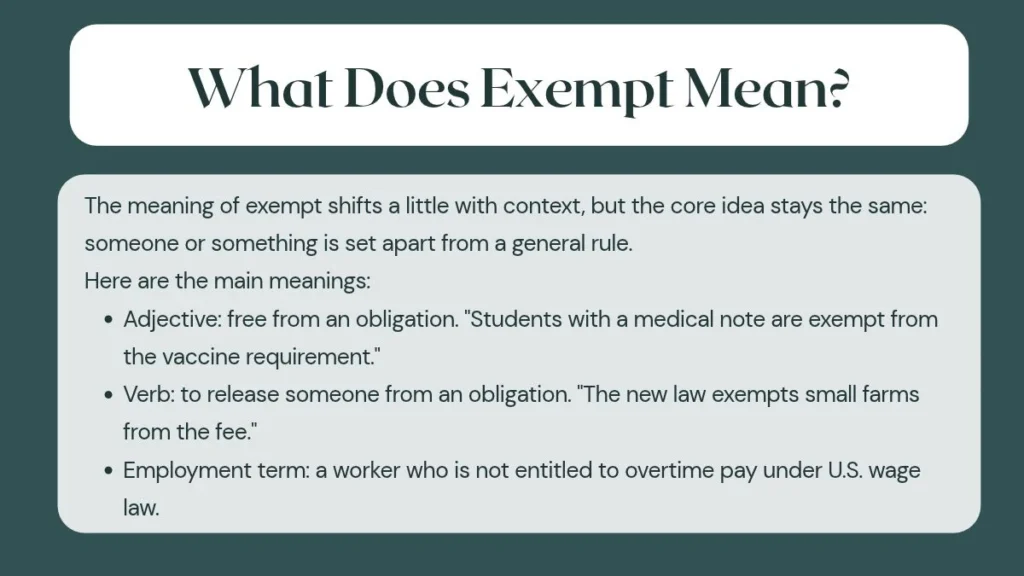
The meaning of exempt shifts a little with context, but the core idea stays the same: someone or something is set apart from a general rule.
Here are the main meanings:
- Adjective: free from an obligation. “Students with a medical note are exempt from the vaccine requirement.”
- Verb: to release someone from an obligation. “The new law exempts small farms from the fee.”
- Employment term: a worker who is not entitled to overtime pay under U.S. wage law.
- Tax term: income, property, purchases, or organizations not subject to certain taxes.
Full Meaning in Simple Words
Picture a rule that says, “Everyone must pay a toll.” An exempt driver gets waved through. The rule is real, but it doesn’t apply to that driver.
Being exempt doesn’t mean the rule is bad or that the person is better than everyone else. It means the rule has a carve-out, and this person or thing falls inside it.
Definition of Exempt at a Glance
| Part of speech | Meaning | Pronunciation |
|---|---|---|
| Adjective | Not subject to a rule, tax, or duty | ig-ZEMPT |
| Verb | To free someone from a rule or duty | ig-ZEMPT |
| Noun (rare) | A person who is exempt | ig-ZEMPT |
What Does Exempt Mean in Text?
Nobody is texting “exempt” as a trendy abbreviation. It’s a standard English word, so the answer to what does exempt mean in slang is simple: it isn’t slang at all.
In text messages, people use it in its normal sense. It usually pops up when the conversation is about rules, work, school, or money. Because it sounds a bit official, people often use it half-jokingly with friends (“I’m exempt from dish duty tonight”).
WhatsApp Chat Example
Sam: Did you pay the parking fee at the new building?
Priya: Nope, we’re exempt. Faculty parking is free.
Sam: Lucky. Students have to pay.
Instagram DM Example
Jordan: Are you doing the group presentation on Friday?
Maya: No, I’m exempt. I already did the solo project instead.
Jordan: Nice, that’s a good deal.
TikTok Comment Example
A creator posts a video about tax season. A commenter writes: “Wait, so my side hustle income isn’t exempt? Nobody told me this.”
Another user replies: “Right, most self-employment income is taxable. Check IRS.gov.”
What Does Exempt Mean on Social Media?
On TikTok, Instagram, YouTube, and X, exempt shows up mostly in personal finance, career advice, and legal explainer videos. You’ll see phrases like “tax-exempt,” “exempt vs. non-exempt,” and “exempt from jury duty.” The tone is informational, not playful.
One caution: short videos often simplify tax and labor rules. Treat them as a starting point, then confirm details with an official source.
Real-Life Meaning and Usage
Real-Life Situations Where People Use This Word
- At work: a manager says, “You’re a salaried exempt employee.”
- At tax time: a church, school, or charity is described as tax-exempt.
- In court: some states excuse certain groups, such as full-time caregivers, from jury duty.
- At school: a student may be exempt from a final exam with a high enough grade.
- In health care: some people are exempt from vaccine requirements for medical or religious reasons, depending on state law.
- In shopping: many states exempt groceries or prescription medicine from sales tax.
- In banking and investing: certain securities are exempt from standard registration rules.
Examples of Exempt in Sentences
- Veterans with a full disability rating may be exempt from property taxes in some states.
- My manager said the role is exempt, so there’s no overtime.
- The city exempted electric cars from the downtown parking fee.
- Straight-A students are exempt from the spring final.
- This purchase is tax-exempt because we’re buying on behalf of a school.
- Farm equipment is often exempt from certain road rules.
- She asked HR whether her new title changed her exempt status.
Different Contexts of Exempt
Casual: “I’m exempt from cleaning duty this week, so I’m off the hook.”
Academic: “Transfer students are exempt from the first-year writing requirement.”
Online: “Are gifts exempt from taxes?” (a very common search-style question)
Legal: “The statute exempts minors from the filing requirement.”
Business: “Exempt vs. non-exempt” is one of the most common HR terms in the U.S.
Exempt Employee vs. Non-Exempt Employee
This is the meaning most Americans are searching for, so it deserves a closer look.
Under the Fair Labor Standards Act (FLSA), most workers must receive at least the federal minimum wage and overtime pay of 1.5 times their regular rate for hours over 40 in a workweek. An exempt employee is one who isn’t entitled to that overtime pay. A non-exempt employee is.
How Someone Qualifies as Exempt
The U.S. Department of Labor generally looks at three things:
- Salary basis: you’re paid a fixed salary, not by the hour.
- Salary level: your pay meets a minimum threshold.
- Job duties: your work fits an exemption category, such as executive, administrative, professional, computer, or outside sales.
All three usually have to be true. The federal salary threshold has changed and been challenged in court in recent years, and some states, such as California, New York, and Washington, set higher thresholds. Check the Department of Labor website and your state labor department for current numbers.
Exempt vs. Non-Exempt at a Glance
| Feature | Exempt | Non-exempt |
|---|---|---|
| Overtime pay | Not required | Required after 40 hours/week |
| Pay type | Salary | Hourly or salary |
| Tracks hours | Usually not | Yes |
| Typical roles | Managers, engineers, accountants | Retail, warehouse, many office support jobs |
A Common Mistake
A fancy job title doesn’t make someone exempt. If your title says “manager” but you spend most of your day on routine tasks and have no real authority to hire, fire, or direct others, you may still be owed overtime. The Department of Labor looks at what you actually do, not what your business card says.
Editorial note: This article explains general meanings and isn’t legal or tax advice. If you think you’ve been misclassified at work, contact your state labor department or an employment attorney.
Checklist: Is My Job Really Exempt?
- Am I paid a set salary, not by the hour?
- Does my pay meet the federal and state minimum for exempt status?
- Do my daily tasks match an exemption category?
- Do I use independent judgment on important matters?
- If I manage people, do I have real say in hiring, firing, or promotions?
If you answered “no” to several of these, ask HR to explain your classification in writing.
Tax-Exempt: What It Means
Tax-exempt means income, property, or an organization isn’t taxed, or is taxed less than usual.
- Nonprofits: organizations recognized under Section 501(c)(3) of the Internal Revenue Code are generally exempt from federal income tax. They still must file certain forms and follow strict rules.
- Purchases: many states waive sales tax on some items, like certain foods or medicines. Schools and government agencies often buy tax-exempt with an exemption certificate.
- Income: some kinds of income, such as interest on many municipal bonds, are exempt from federal income tax.
Misconceptions About Tax-Exempt Status
Many people think “tax-exempt” means “never pays any tax.” That’s not accurate. A charity can still owe payroll taxes for its employees, and it may owe tax on business income unrelated to its mission. Also, exempt from federal tax doesn’t automatically mean exempt from state or local tax.
Origin and History of the Word
Exempt comes from the Latin exemptus, the past participle of eximere, meaning “to take out.” It joins ex- (“out”) with emere (“to take” or “to buy”). The word came into English through Old French in the Middle Ages.
The literal image still works: to exempt someone is to take them out of the group a rule applies to. Early uses were tied to law and church privileges, such as clergy who were excused from certain civil duties.
Why Do People Use This Word?
The word is precise. “Excused” sounds like a one-time favor. “Exempt” tells you the exclusion is built into a rule, law, or category.
People also use it because official language needs clear labels. Tax law, labor law, and school policy all depend on knowing who is covered by a rule and who isn’t.
Emotional and Psychological Meaning
The feeling around this word depends on which side you’re on:
- Being exempt can feel like relief, status, or fairness (“I earned this”).
- Not being exempt can feel like frustration (“Why do they get a pass?”).
- In work settings, “exempt” can feel bittersweet. It often signals higher pay and trust, but also longer hours with no overtime.
Tone: Is It Rude, Positive, or Negative?
Tone Explanation
Exempt is formal to neutral. It’s not slang, not rude, and not offensive. You can safely use it in emails, contracts, school notices, and everyday conversation.
Is It Rude to Say This Word?
No. The word itself is polite. The only risk comes from the situation. Saying “I’m exempt, but you’re not” to a coworker can sound smug, even though the word is fine.
Is It Positive, Negative, or Neutral?
It’s neutral. Whether it feels good or bad depends on what you’re being exempted from. Exempt from a fee? Great. Exempt from overtime pay? Mixed.
When to Use Exempt
- When a rule, tax, or duty officially doesn’t apply to someone
- In legal, HR, school, or tax communication
- When you want to be precise about a formal category
When NOT to Use Exempt
- When it’s a one-time favor. Use “excused” instead.
- When someone is protected from legal action. That’s “immune.”
- When something is simply left out of a list. That’s “excluded.”
Situations to Avoid It
Skip the word when bragging about a special deal, or when you’re unsure of your legal status. Don’t tell a coworker they’re “exempt” unless HR has confirmed it, since the term carries legal weight.
Exempt vs. Similar Terms
| Term | Meaning | Usage | Key Difference |
|---|---|---|---|
| Exempt | Not subject to a rule | Tax, work, school, law | Built-in category or rule |
| Excused | Allowed to skip something once | Absences, chores | Temporary and situational |
| Immune | Protected from harm or prosecution | Law, medicine | Protection, not just exclusion |
| Waived | Right or fee given up on purpose | Contracts, fees | A decision made, not a category |
| Non-exempt | Covered by the rule | Overtime, taxes | Opposite of exempt |
Variations and Related Meanings
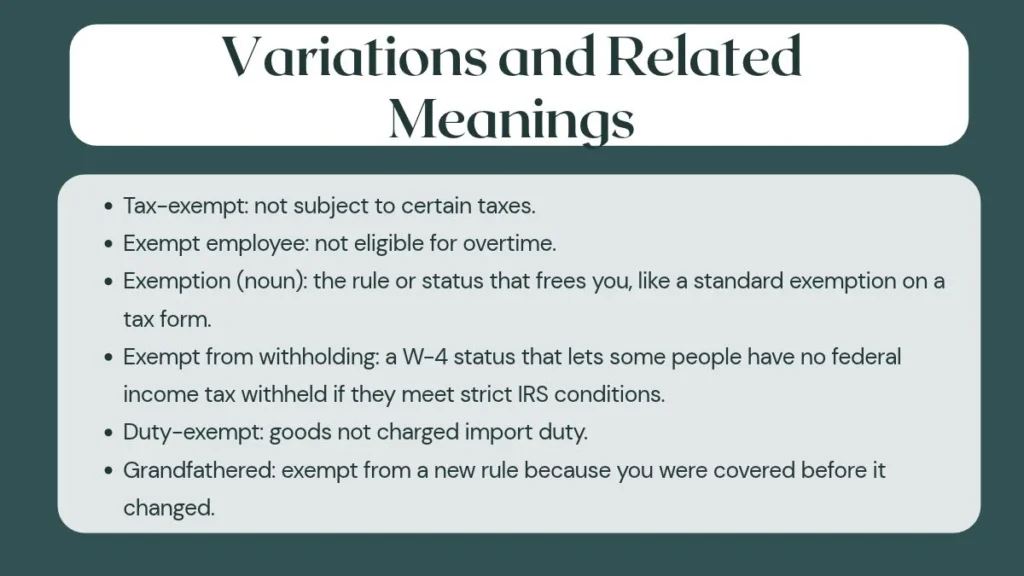
- Tax-exempt: not subject to certain taxes.
- Exempt employee: not eligible for overtime.
- Exemption (noun): the rule or status that frees you, like a standard exemption on a tax form.
- Exempt from withholding: a W-4 status that lets some people have no federal income tax withheld if they meet strict IRS conditions.
- Duty-exempt: goods not charged import duty.
- Grandfathered: exempt from a new rule because you were covered before it changed.
- Exempt securities: certain investments not subject to standard registration rules.
- Exemption certificate: a form a buyer gives a seller to prove a purchase is tax-exempt.
How to Respond When Someone Says “You’re Exempt”
Casual replies
- “Oh nice, thanks for letting me know.”
- “Cool, so I don’t need to do anything?”
Funny replies
- “Exempt? I’ve been waiting my whole life for this word.”
- “Finally, a rule that doesn’t apply to me.”
Professional replies
- “Thank you. Could you confirm that in writing?”
- “Understood. What documentation should I keep on file?”
The professional replies matter most at work and tax time. Getting your status in writing protects you if questions come up later.
Cultural Usage
USA and Western Usage
In the U.S., exempt is most tied to employment law and taxes. Ask an American about “exempt vs. non-exempt” and they’ll almost always think of paychecks.
Global and Internet Differences
In the UK and Commonwealth countries, the word is used similarly but linked to different systems, like VAT-exempt goods rather than U.S. sales tax. Online, it mostly appears in finance and career content. It has no separate slang life the way words like “salty” or “ghosting” do.
Quick Decision Guide
Does a rule or charge normally apply to everyone?
↓
Yes: is this person officially freed from it by law, policy, or category?
↓
Yes → use “exempt.”
No, it’s a one-time favor → use “excused.”
No, it’s protection from prosecution → use “immune.”
Key Takeaways
- Exempt means freed from a rule, tax, or duty that applies to others.
- It’s a standard, neutral word, not slang.
- “Exempt employee” means no overtime pay under federal wage law, and job title alone doesn’t decide it.
- “Tax-exempt” rarely means “never taxed.”
- Choose “excused” for one-time passes and “immune” for legal protection.
FAQs
What does exempt mean in simple words?
It means you don’t have to follow a rule or pay something that others do.
What does exempt mean on a paycheck?
It usually means you’re a salaried worker who isn’t paid overtime. Your duties and salary must meet legal tests.
What does tax-exempt mean?
It means certain income, purchases, or organizations aren’t taxed, or are taxed less. Many rules and exceptions still apply.
What is the difference between exempt and non-exempt?
Non-exempt workers get overtime pay. Exempt workers don’t.
What does “exempt from withholding” mean?
Claiming it tells your employer not to take federal income tax out of your pay. Only people who meet strict IRS conditions can claim it.
Is exempt a good or bad thing?
It depends on context. Being exempt from a fee is good. Being exempt from overtime may or may not be.
Can someone lose exempt status?
Yes. If your job duties or pay change, or the law changes, your status may change too.
Is “exempt” a verb or an adjective?
Both. “She is exempt” uses it as an adjective. “The law exempts her” uses it as a verb.
References
- Merriam-Webster Dictionary, entry for “exempt” (merriam-webster.com)
- Oxford Learner’s Dictionaries, entry for “exempt” (oxfordlearnersdictionaries.com)
- Online Etymology Dictionary, entry for “exempt” (etymonline.com)
- U.S. Department of Labor, Wage and Hour Division, Fair Labor Standards Act and “Fact Sheet #17A: Exemptions for Executive, Administrative, Professional, Computer & Outside Sales Employees” (dol.gov)
- Internal Revenue Service, “Tax-Exempt Organizations” and Publication 557 (irs.gov)
Conclusion
Once you see the pattern, exempt is easy: a rule exists, and someone or something sits outside it. That one idea explains “tax-exempt,” “exempt employee,” and “exempt from jury duty” alike.
Check the context, know what the rule is, and confirm your status through an official source when money or legal rights are at stake.

Daniel Carter is a passionate writer and creative storyteller dedicated to exploring the deeper meanings of life, dreams, and human experiences. With a strong interest in symbolism, spirituality, and personal growth, Daniel brings clarity to complex ideas, making them easy to understand for readers from all walks of life.
As a featured author on meaniings.com, Daniel Carter focuses on delivering insightful, well-researched, and engaging content that helps readers uncover hidden meanings behind dreams, emotions, and everyday situations. His writing style combines thoughtful analysis with a relatable voice, making his work both informative and inspiring.
Daniel’s approach is rooted in curiosity and a desire to guide readers toward self-awareness and understanding. He believes that every dream and experience carries a message—one that can lead to personal transformation when interpreted correctly.
Over time, Daniel has built a reputation for creating meaningful content that resonates with a global audience, especially those interested in dream interpretation and spiritual insight.
Books by Daniel Carter:
- The Hidden Language of Dreams
- Signs, Symbols, and Their Meanings
- Unlocking the Power of Your Subconscious Mind