
If you are wondering what does mhm mean, it usually means “yes,” “yeah,” “I agree,” or “I understand.” It is the informal written form of the spoken expression “mm-hmm,” commonly used to acknowledge what someone has said.
In texting and social media, mhm is usually casual and neutral. However, its tone can change depending on the conversation, punctuation, and relationship between the people communicating.
Quick Answer: What Does MHM Mean?
MHM usually means “yes,” “I agree,” “I understand,” or “I’m listening.” It is most common in casual conversations, text messages, comments, and direct messages.
The most common meanings are:
- Yes — confirming something.
- I agree — showing agreement.
- I understand — acknowledging information.
- I’m listening — showing that you are following the conversation.
The expression comes from the spoken sound “mm-hmm,” rather than being a traditional acronym. Dictionary.com describes mhm as an informal expression used for agreement or acknowledgment.
What Does MHM Mean?
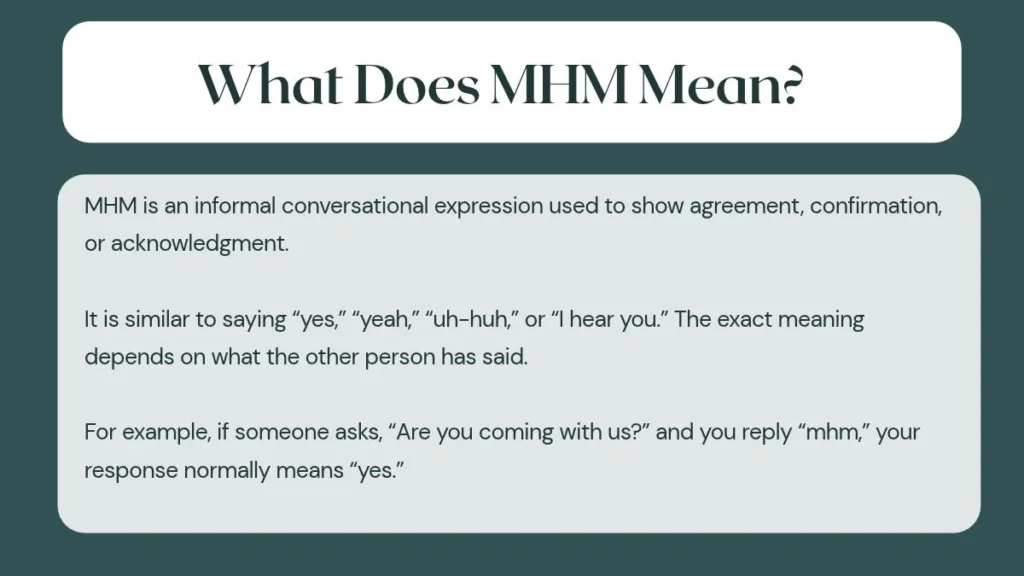
MHM is an informal conversational expression used to show agreement, confirmation, or acknowledgment.
It is similar to saying “yes,” “yeah,” “uh-huh,” or “I hear you.” The exact meaning depends on what the other person has said.
For example, if someone asks, “Are you coming with us?” and you reply “mhm,” your response normally means “yes.”
Unlike abbreviations such as “LOL” or “BRB,” MHM does not normally represent a phrase made from three separate words. It is simply a written representation of a sound people make in conversation.
Full Meaning in Simple Words
In simple English, mhm means “yes” or “I agree.”
Sometimes it can also mean:
- “I understand.”
- “Okay.”
- “I hear you.”
- “Go ahead, I’m listening.”
The context determines which interpretation makes the most sense.
MHM vs. MM-HMM
Mhm and mm-hmm generally communicate the same idea.
The difference is mainly spelling and style:
- Mhm — shorter and common in texting.
- Mm-hmm — closer to the way the spoken expression is written.
- Mhmm — another informal variation found in messages.
What Does MHM Mean in Text?
The mhm meaning in text is usually “yes,” “yeah,” “I agree,” or “I understand.”
Because text messages do not include voice tone or facial expressions, punctuation can affect how the response feels.
For example:
- “Mhm!” can sound enthusiastic.
- “Mhm.” can sound neutral or brief.
- “Mhm…” can suggest hesitation or uncertainty in some contexts.
These interpretations are not fixed rules. You should look at the surrounding messages before deciding what someone means.
WhatsApp Chat Example
Person A: Are you coming to the study group?
Person B: Mhm, I’ll be there at 7.
Here, mhm clearly means “yes.”
Instagram DM Example
Person A: This new design looks better.
Person B: Mhm! I like it too.
Here, the expression shows agreement.
TikTok Comment Example
Comment: Nobody talks about how good this part is.
Reply: Mhm 😭
In this context, the reply most likely means “I agree” or “exactly.”
What Does MHM Mean on TikTok and Instagram?
On TikTok, Instagram, and other social platforms, mhm normally has the same basic meaning as it does in texting.
People may use it to:
- Agree with a comment.
- Confirm someone’s statement.
- Show that they understand.
- Acknowledge a message.
- Respond quickly without writing a full sentence.
The surrounding content matters. A comment such as “mhm!” may feel enthusiastic, while a simple “mhm” may be more neutral.
There is no universal TikTok-specific definition that changes the basic meaning of the expression.
Real-Life Meaning and Usage
Although mhm is common online, the expression comes from ordinary spoken conversation.
Someone listening to a friend might say “mm-hmm” to show that they understand or agree. When people communicate through text, they often write that sound as mhm.
This makes the expression feel more conversational than simply typing “yes.”
Common Situations
You might see or hear it when someone is:
- Answering a simple question.
- Confirming information.
- Agreeing with an opinion.
- Showing that they are listening.
- Acknowledging something without adding another point.
Examples of MHM in Sentences
Here are five natural examples:
- “Did you finish the assignment?” — “Mhm.”
- “So you agree with me?” — “Mhm, definitely.”
- “Are we meeting at six?” — “Mhm.”
- “That was the funniest part.” — “Mhm!”
- “You understand what I mean?” — “Mhm, I got it.”
Each example uses the expression as a short conversational response.
Different Contexts of MHM
The meaning stays fairly consistent, but its suitability changes by context.
Casual Conversations
This is where mhm is most natural. Friends, classmates, and family members may use it in everyday conversations.
Text Messages
It works well when a short confirmation is enough.
Social Media
Comments and DMs often use mhm because it sounds relaxed and conversational.
Academic Communication
It is acceptable in casual conversations between students but generally does not belong in formal academic writing.
Professional Communication
In a formal workplace message, words such as “Yes,” “Understood,” “Confirmed,” or “I agree” are usually clearer.
Origin and History of MHM
Mhm developed from the spoken expression “mm-hmm.”
The expression is much older than modern texting. Dictionary.com notes recorded English use of mm-hmm dating back to at least 1934. The shorter internet spelling mhm became useful as people began representing conversational sounds in written digital communication.
This history explains why mhm feels more like spoken language than a conventional abbreviation.
Why Do People Use MHM?
People use mhm because it is quick, natural, and conversational.
Instead of typing a complete response such as:
“Yes, I understand what you’re saying.”
someone can simply write:
“Mhm.”
It also allows a person to acknowledge a message without interrupting the flow of a conversation.
Emotional Meaning of MHM
The expression itself does not have one fixed emotional meaning.
Its tone can depend on:
- The words around it.
- Punctuation.
- Emojis.
- The relationship between the speakers.
- Whether the conversation is serious or casual.
For instance, “mhm!” can appear enthusiastic, while “mhm…” may suggest uncertainty.
However, it is risky to decide how someone feels based on mhm alone. The rest of the conversation provides better clues.
Is MHM Formal or Informal?
MHM is informal.
| Situation | Appropriate? | Better alternative when formality matters |
|---|---|---|
| Texting a friend | Yes | — |
| Social media comments | Yes | — |
| Casual group chat | Yes | — |
| School discussion | Usually | “Yes” or “I agree” |
| Formal email | Usually not | “Understood” or “Yes” |
| Business document | No | Clear, complete wording |
The expression is best viewed as casual conversational language rather than formal English.
Is It Rude to Say MHM?
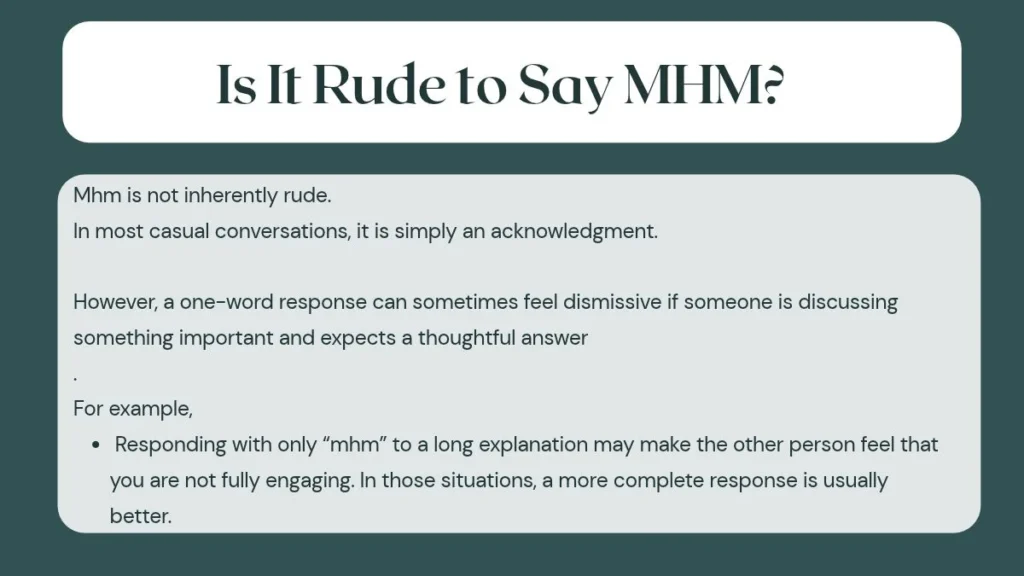
Mhm is not inherently rude.
In most casual conversations, it is simply an acknowledgment.
However, a one-word response can sometimes feel dismissive if someone is discussing something important and expects a thoughtful answer.
For example, responding with only “mhm” to a long explanation may make the other person feel that you are not fully engaging. In those situations, a more complete response is usually better.
Is MHM Positive, Negative, or Neutral?
Mhm is generally neutral.
It can communicate agreement, but it does not automatically express strong happiness, excitement, anger, or sarcasm.
Its emotional effect comes mainly from context.
For example:
- “Mhm!” → potentially warm or enthusiastic.
- “Mhm.” → generally neutral or brief.
- “Mhm…” → potentially hesitant.
These are contextual interpretations, not fixed definitions.
When to Use MHM
Use mhm when you want to:
- Give a quick “yes.”
- Agree with someone.
- Show understanding.
- Acknowledge what someone said.
- Keep a casual conversation moving.
It works especially well when the other person already understands the context.
When Not to Use MHM
Avoid using mhm when your response needs to be especially clear, detailed, or professional.
For example, instead of replying “mhm” to a teacher’s important instruction, you could say:
“Yes, I understand. I’ll complete it by Friday.”
Similarly, workplace communication may be clearer with “Confirmed,” “Understood,” or a complete sentence.
Situations Where You Should Avoid It
A longer response is usually better when:
- Someone is asking an important question.
- You need to provide official confirmation.
- You are communicating with a customer.
- The subject is serious or sensitive.
- Your response could easily be misunderstood.
- You are writing an academic or professional document.
The issue is not that mhm is wrong. It is that a short informal expression may not communicate enough information.
MHM vs. Similar Terms
| Term | Meaning | Usage | Key Difference |
|---|---|---|---|
| MHM | Yes, I agree, I understand | Casual text and speech | Conversational acknowledgment |
| Hmm | I’m thinking, unsure, or considering | Casual conversations | Usually signals thought or uncertainty |
| Uh-huh | Yes, I agree, I’m listening | Spoken and casual text | Very close to “mhm” |
| Yeah | Yes or agreement | Everyday conversation | More direct and explicit |
MHM vs. HMM
This is one of the most important differences to remember.
Mhm generally confirms something.
Hmm generally shows that someone is thinking, uncertain, or considering something.
So:
“Do you want pizza?” — “Mhm.”
usually means yes.
But:
“Do you want pizza?” — “Hmm…”
may suggest “I’m not sure.”
Variations of MHM
You may encounter several spellings online:
- Mhm — common short form.
- Mm-hmm — traditional written representation of the spoken sound.
- Mhmm — extended informal spelling.
- Mhm! — can emphasize enthusiasm.
- Mhm… — may suggest hesitation.
- MHM — capitalized version, often used simply for emphasis.
The spelling alone does not create a completely different definition.
How to Respond to MHM
Your response depends on what you were discussing.
Casual Replies
If someone says “mhm” after a normal question, you can simply continue the conversation:
- “Okay, cool.”
- “Sounds good.”
- “Perfect.”
- “Got it.”
Funny Replies
With friends, a playful response can work:
- “I’ll take that as a yes 😂”
- “That was a very confident mhm.”
Professional or Mature Replies
In a serious conversation, use a clear response:
- “Thanks for confirming.”
- “Understood.”
- “Thanks for letting me know.”
- “Okay, I’ll take care of it.”
USA and Western Usage
In American English and other English-speaking online communities, mhm is widely understood as an informal conversational acknowledgment.
Its meaning is closely connected to the spoken “mm-hmm.” The basic idea is usually agreement, confirmation, or active listening.
The expression is especially natural in casual digital communication.
Global and Internet Usage
English-language internet culture has spread conversational expressions far beyond the United States.
As a result, mhm may appear in messages between people from many different countries. Its basic meaning usually remains understandable, although individual texting habits can vary.
When interpreting it, context is more reliable than assuming a special regional meaning.
Common Misconceptions About MHM
MHM Is Not Usually an Acronym
Although it is written with three letters, mhm normally does not mean that each letter represents a different word.
It is a written version of a conversational sound.
MHM Does Not Automatically Mean Someone Is Annoyed
A short response can sometimes sound distant, but that does not mean the person is necessarily annoyed.
Look at the entire conversation before interpreting the tone.
MHM Does Not Have a Secret Meaning on TikTok
TikTok users may use the expression in playful or sarcastic contexts, but mhm does not automatically acquire a completely different meaning just because it appears on TikTok.
Quick Decision Guide: How to Interpret MHM
Use the surrounding message to understand it:
Was it an answer to a yes/no question?
→ It probably means yes.
Was it responding to an opinion or statement?
→ It probably means I agree.
Was someone explaining something?
→ It may mean I understand or I’m listening.
Does it contain “…” or other unusual punctuation?
→ The person may be expressing hesitation or another tone, so read the surrounding conversation.
FAQs About MHM
What does MHM mean in text?
MHM usually means “yes,” “yeah,” “I agree,” or “I understand.” It is an informal written form of “mm-hmm.”
What does MHM mean in slang?
In casual internet language, mhm is used as a conversational response to show agreement or acknowledgment. It is not normally an acronym.
Does MHM mean yes?
Yes. When used as a response to a yes-or-no question, mhm commonly means “yes.”
Is MHM rude?
No. It is normally neutral and casual. However, a very short “mhm” may seem dismissive in certain serious conversations.
What is the difference between MHM and HMM?
Mhm generally means agreement or acknowledgment, while hmm usually indicates thinking, hesitation, uncertainty, or doubt.
What does MHM mean on TikTok?
On TikTok, mhm generally means “yes,” “I agree,” or “exactly.” The surrounding comment determines the specific interpretation.
Is MHM a formal word?
No. Mhm is an informal conversational expression. For formal writing, clearer alternatives such as “yes,” “confirmed,” or “understood” are usually more appropriate.
Key Takeaways
- MHM usually means “yes,” “I agree,” or “I understand.”
- It comes from the spoken expression “mm-hmm.”
- It is common in texting, DMs, comments, and casual conversations.
- Its tone depends on context and punctuation.
- Mhm and hmm usually have different meanings.
- It is not inherently rude or negative.
- Formal communication usually calls for clearer wording.
- References
- Dictionary.com — mhm: information about the expression’s meaning, usage, and relationship to “mm-hmm.”
Conclusion
The simplest answer to “what does mhm mean?” is “yes,” “I agree,” or “I understand.”
It is a casual written form of the spoken expression “mm-hmm.” You will commonly see it in text messages, Instagram DMs, TikTok comments, group chats, and other informal conversations.
The important detail is context. A friendly “mhm!” may show enthusiastic agreement, while a plain “mhm” may simply acknowledge what someone said. When a conversation is serious or professional, a complete response is usually clearer.
Understanding that small difference makes it much easier to interpret mhm, mhmm, and mm-hmm in everyday digital communication.

James Walker is a passionate writer, dream analyst, and content creator who specializes in uncovering the deeper meanings behind everyday experiences, symbols, and dreams. As a featured author on meaniings.com, he is dedicated to helping readers understand hidden messages within their subconscious and guiding them toward clarity, purpose, and self-discovery.
With a strong interest in psychology, spirituality, and real-life storytelling, James blends research with relatable insights to create engaging and easy-to-understand content. His writing focuses on dream meanings, symbolism, emotional awareness, and personal growth—making complex ideas simple for readers from all backgrounds.
James Walker began his writing journey with a desire to share meaningful stories and life lessons inspired by real experiences. Like many inspirational writers, he believes that every dream and life situation carries a message worth exploring. His work aims to educate, inspire, and empower readers to better understand themselves and the world around them.
Over time, his thoughtful approach and engaging style have helped him build a loyal readership. He continues to contribute valuable content that aligns with the mission of meaniings.com—to provide accurate, insightful, and helpful interpretations.
Notable Works by James Walker:
Growing Up with Jessica: A True Story (inspirational real-life journey)
Dream Symbols and Their Hidden Meanings
The Power of Dreams: Understanding Your Inner Mind