
NGL means “not gonna lie.” It is an informal internet abbreviation people use in text messages, comments, and social media when they want to be honest, express an opinion, or introduce something they genuinely feel. For example, “NGL, that movie was really good” means “Not gonna lie, that movie was really good.” Cambridge Dictionary identifies ngl as an informal abbreviation of “not gonna lie” used in texts and on social media.
If you have seen NGL on TikTok, Instagram, WhatsApp, Snapchat, or another online platform, the meaning is usually simple: the person is saying they are being honest or giving their real opinion.
Quick Answer: What Does NGL Mean?
NGL = Not Gonna Lie.
It is commonly used to:
- Introduce an honest opinion.
- Admit something the speaker really thinks or feels.
- Make a compliment sound more casual.
- Soften a criticism or complaint.
- Emphasize that the following statement is sincere.
Example:
“NGL, I was nervous before the exam.”
This means:
“Not gonna lie, I was nervous before the exam.”
NGL is informal, so it is best suited to casual conversations rather than formal emails, academic assignments, or professional documents.
What Does NGL Mean?
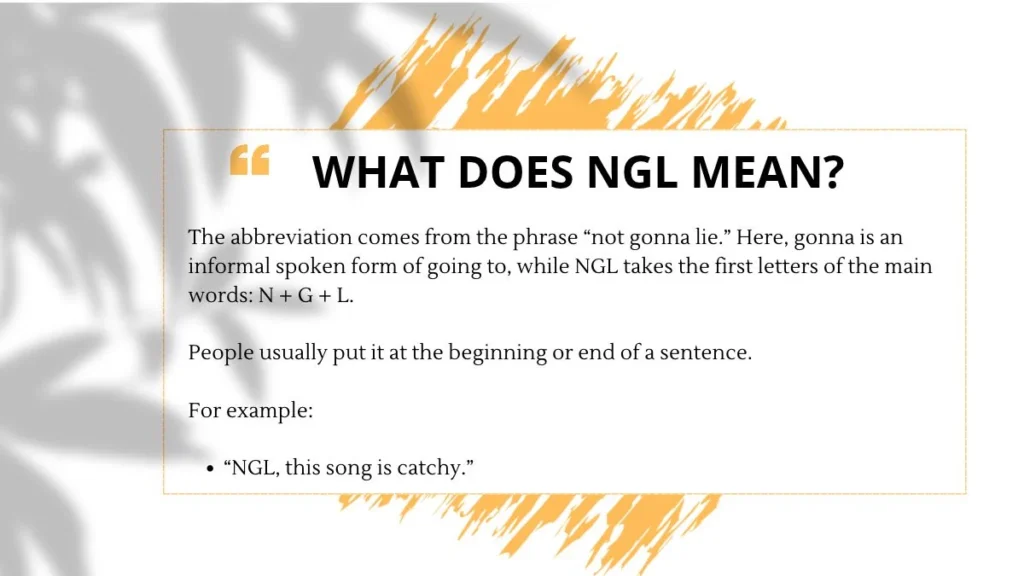
The abbreviation comes from the phrase “not gonna lie.” Here, gonna is an informal spoken form of going to, while NGL takes the first letters of the main words: N + G + L.
People usually put it at the beginning or end of a sentence.
For example:
“NGL, this song is catchy.”
or:
“This game was difficult, NGL.”
Both sentences communicate a personal opinion.
The expression does not necessarily mean that the person was lying before. Instead, it often works as a conversational signal that says, “Here is my honest opinion.”
Full Meaning in Simple Words
In simple English, NGL means “I’m being honest with you.”
Someone might use it before saying something positive:
“NGL, your presentation was really good.”
They might also use it before criticism:
“NGL, the ending was disappointing.”
The abbreviation can therefore introduce either praise or criticism.
Cambridge Dictionary notes that the expression can also be used when someone wants to make a criticism or complaint feel less offensive.
Why Does NGL Sound Casual?
NGL belongs to internet and texting language. Like many online abbreviations, it saves typing and gives a message a relaxed tone.
Compare:
Formal:
“I have to be honest; I did not enjoy the movie.”
Casual:
“NGL, I didn’t really like the movie.”
The second version sounds more like a conversation between friends.
What Does NGL Mean in Text?
In texting, NGL usually means “not gonna lie.”
It is often used before a personal reaction, opinion, or admission.
Text Example 1
A: “Did you like the new game?”
B: “NGL, it was actually pretty fun.”
Meaning:
“Honestly, it was pretty fun.”
Text Example 2
A: “Are you ready for tomorrow’s test?”
B: “NGL, I’m a little nervous.”
Here, NGL signals an honest admission.
Text Example 3
A: “What did you think of the movie?”
B: “It was too long, NGL.”
The abbreviation appears at the end but still means “not gonna lie.”
What Does NGL Mean on Social Media?
On social media, NGL has essentially the same meaning as it does in texting. It is commonly used when someone wants to make a comment sound honest, personal, or conversational.
You may see it in:
- TikTok comments
- Instagram captions
- Instagram comments
- Snapchat messages
- WhatsApp chats
- Online discussions
It can appear in uppercase (NGL) or lowercase (ngl). The meaning normally stays the same.
WhatsApp Chat Example
Ali: “Did you enjoy the trip?”
Sam: “NGL, it was one of the best trips I’ve had.”
Here, the speaker is emphasizing that the statement is sincere.
Instagram DM Example
A: “What do you think of this design?”
B: “NGL, I really like it. The layout looks clean.”
The abbreviation makes the response sound relaxed and conversational.
TikTok Comment Example
“NGL, this ending surprised me.”
The commenter means:
“Not gonna lie, this ending surprised me.”
The comment is simply expressing an honest reaction.
Real-Life Meaning and Usage
Although NGL is strongly associated with the internet, the full phrase “not gonna lie” can also appear in spoken English.
For example:
“Not gonna lie, I was exhausted after that.”
When people type the phrase online, they often shorten it to NGL.
This is a common pattern in digital communication: a longer expression becomes an abbreviation because people want to communicate quickly.
Real-Life Situations Where NGL Is Used
Sharing an Opinion
“NGL, I prefer the older version.”
The speaker is giving a personal preference.
Giving a Compliment
“NGL, that was impressive.”
The abbreviation can make a compliment feel casual and genuine.
Making a Criticism
“NGL, the service was pretty slow.”
Here, it introduces a negative opinion without automatically making the message aggressive.
Admitting a Feeling
“NGL, I was worried about the result.”
This tells the reader that the speaker is openly admitting a feeling.
Examples of NGL in Sentences
Here are natural examples:
- NGL, that was a really good performance.
- I was nervous before the interview, NGL.
- NGL, I prefer the first design.
- That homework was difficult, NGL.
- NGL, I didn’t expect the ending.
- The restaurant looked expensive, NGL.
- NGL, you explained that really clearly.
- I thought the test would be easier, NGL.
These examples show that the abbreviation can introduce positive, negative, or neutral opinions.
Different Contexts of NGL
| Context | Example | Meaning |
|---|---|---|
| Texting | “NGL, I’m tired.” | Honestly, I’m tired. |
| Social media | “NGL, this is funny.” | Honestly, this is funny. |
| Gaming | “That level was hard, NGL.” | Honestly, that level was hard. |
| School chat | “NGL, the assignment was difficult.” | Honestly, it was difficult. |
| Casual conversation | “NGL, I expected more.” | Honestly, I expected more. |
| Professional writing | Usually avoided | Too informal for most formal writing |
The important point is that NGL changes the tone more than the basic meaning. It makes the message feel casual and conversational.
Origin and History of NGL
NGL developed as an abbreviation of the phrase “not gonna lie.” Internet users commonly shorten longer expressions into initialisms to make digital conversations faster.
Unlike a word with a complicated historical origin, NGL is mainly a modern communication abbreviation. Its meaning is closely tied to texting and online communication.
Cambridge Dictionary currently lists ngl as an informal abbreviation and specifically associates it with social media and text messages.
Why Do People Use NGL?
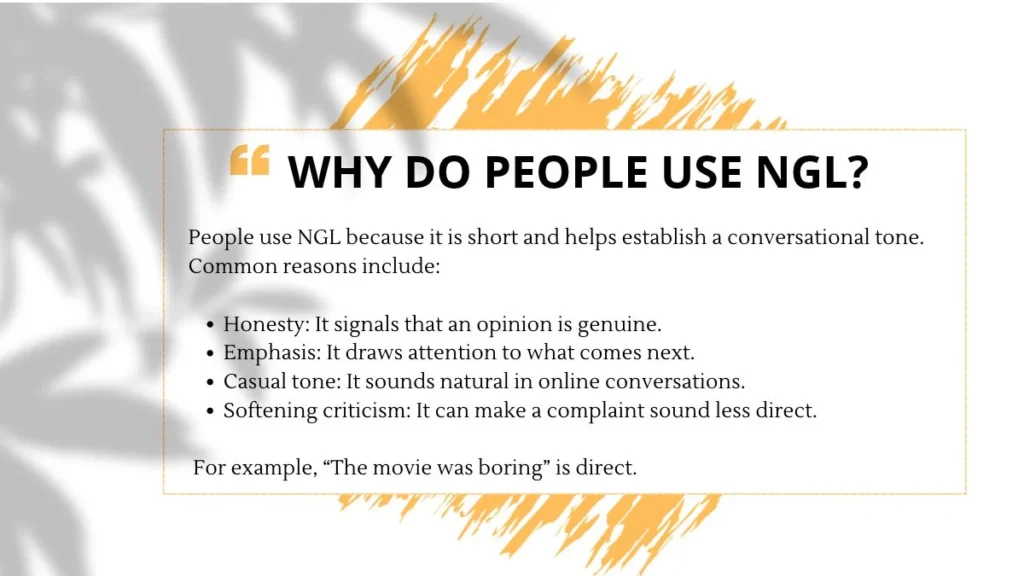
People use NGL because it is short and helps establish a conversational tone.
Common reasons include:
- Honesty: It signals that an opinion is genuine.
- Emphasis: It draws attention to what comes next.
- Casual tone: It sounds natural in online conversations.
- Softening criticism: It can make a complaint sound less direct.
- Personal expression: It shows that the statement reflects the speaker’s own view.
For example, “The movie was boring” is direct.
“NGL, the movie was boring” sounds more like a personal, conversational reaction.
Emotional Meaning Behind NGL
NGL does not describe one specific emotion. Instead, it can introduce many different feelings.
Depending on the sentence, it may come before:
- Excitement
- Surprise
- Nervousness
- Happiness
- Disappointment
- Appreciation
- Frustration
- Agreement
The emotional meaning comes from the words that follow it.
For example:
“NGL, I’m really excited.”
shows excitement.
But:
“NGL, I’m disappointed.”
shows disappointment.
So NGL itself mainly signals honesty, while the rest of the sentence communicates the emotion.
Tone Explanation: Is NGL Formal, Informal, or Slang?
NGL is informal internet language.
It is appropriate for casual digital communication but usually not suitable for formal writing.
Formal
Avoid NGL in:
- Job applications
- Business reports
- Academic essays
- Formal letters
- Professional presentations
Informal
NGL works naturally in:
- Text messages
- Friend-to-friend chats
- Social media comments
- Casual online discussions
It is sometimes described as internet slang, although technically it is more accurate to call it an abbreviation or initialism used in informal online communication.
Is It Rude to Say NGL?
No. NGL is not inherently rude or offensive.
Its tone depends on what comes after it.
For example:
“NGL, you did a great job.”
is positive.
But:
“NGL, your idea makes no sense.”
can sound harsh because the criticism itself is strong.
Therefore, the abbreviation does not automatically make a statement polite. Your choice of words still matters.
Is NGL Positive, Negative, or Neutral?
NGL is neutral by itself.
It can introduce a positive statement:
“NGL, that was amazing.”
A negative statement:
“NGL, that was disappointing.”
Or a neutral observation:
“NGL, I didn’t expect that.”
The surrounding sentence determines the overall tone.
When to Use NGL
NGL works well when:
- Talking casually with friends.
- Writing social media comments.
- Sending informal messages.
- Sharing a personal opinion.
- Making a casual compliment.
- Introducing an honest reaction.
A useful rule is:
If you would comfortably say “not gonna lie” in a casual conversation, NGL may work in a text version of that conversation.
When NOT to Use NGL
Avoid it when the communication needs a formal or professional tone.
Instead of:
“NGL, I disagree with this proposal.”
a professional message could say:
“I have some concerns about this proposal.”
The second version is clearer and more appropriate for a workplace or formal setting.
Situations Where You Should Avoid Using NGL
Be careful with abbreviations when:
- Writing an academic assignment.
- Contacting a teacher formally.
- Applying for a job.
- Writing a business email.
- Communicating with someone who may not understand internet abbreviations.
- You need your message to sound especially professional.
Using simple, complete English is usually the safer choice in formal situations.
NGL vs. Similar Expressions
| Term | Meaning | Usage | Key Difference |
|---|---|---|---|
| NGL | Not gonna lie | Texting and social media | Short internet abbreviation |
| Honestly | Speaking truthfully or sincerely | Casual and formal | More flexible and widely appropriate |
| To be honest | Introducing a sincere opinion | Casual and formal | Full phrase rather than abbreviation |
| TBH | To be honest | Texting and social media | Another common abbreviation with a very similar function |
NGL and TBH can often appear in similar situations, but they are not literally the same abbreviation. NGL expands to “not gonna lie,” while TBH means “to be honest.”
Common Variations and Related Expressions
NGL
The standard abbreviation for “not gonna lie.”
ngl
The lowercase version is extremely common in casual messages.
Not gonna lie
The complete phrase.
To be honest
A similar expression that works in both casual and formal situations.
TBH
An abbreviation for “to be honest.”
Honestly
A simple alternative that does not require internet slang.
These expressions can overlap in meaning, but the exact tone depends on the sentence.
How to Respond to NGL
You do not need a special response just because someone uses NGL.
Casual Reply
“Yeah, I get what you mean.”
Friendly Reply
“Honestly, I agree with you.”
Funny Reply
“Okay, honesty mode activated 😂”
Professional or Mature Reply
“I understand your point. I appreciate your honest feedback.”
The best response depends on the actual statement, not the abbreviation itself.
USA and Western Usage
In American online communication, NGL is generally understood as an informal abbreviation for “not gonna lie.”
It fits naturally into casual digital conversations, especially when someone is sharing an opinion or reaction.
It should not, however, be treated as standard formal writing.
Global and Internet Usage Differences
Because NGL is internet-based, people who regularly communicate in English online may recognize it even when English is not their first language.
However, not every reader will know every internet abbreviation.
If your audience is international or unfamiliar with online slang, writing “not gonna lie” or “to be honest” may make your meaning clearer.
A Simple Decision Guide
Are you writing casually online?
↓
Yes → NGL can work naturally.
Are you writing a formal email, essay, or professional document?
↓
Yes → Write “honestly” or “to be honest” instead.
Are you unsure whether the reader knows internet abbreviations?
↓
Yes → Use the complete phrase.
This simple approach helps you choose the right level of formality.
Common Misunderstandings About NGL
Does NGL mean “not gonna lie”?
Yes. This is the standard meaning in texting and social media.
Does NGL mean someone was lying?
Not necessarily.
When someone says “NGL,” they are usually signaling that what follows is their honest opinion. It does not automatically accuse anyone of lying before.
Is NGL a bad word?
No. NGL is not a swear word or offensive expression.
Is NGL formal English?
No. It is an informal abbreviation used mainly in digital communication.
Can NGL be positive?
Yes. For example:
“NGL, that was amazing.”
The abbreviation can introduce praise just as easily as criticism.
FAQs About NGL
What does NGL stand for?
NGL stands for “not gonna lie.” It is an informal abbreviation commonly used in text messages and social media.
What does NGL mean in texting?
In texting, NGL usually means “not gonna lie” and introduces an honest opinion, reaction, admission, or comment.
What does NGL mean on TikTok?
On TikTok, NGL normally means “not gonna lie.” Someone may use it before giving an honest reaction to a video, creator, trend, song, or situation.
What does NGL mean on Instagram?
On Instagram, NGL has the same basic meaning: “not gonna lie.” It may appear in comments, captions, DMs, or casual conversations.
Is NGL slang?
NGL is best described as an informal internet abbreviation or initialism. It is commonly used in online communication rather than formal writing.
Is NGL rude?
No. NGL is not rude by itself. However, the statement following it can be rude, critical, friendly, or positive depending on the words used.
What is the difference between NGL and TBH?
Both can introduce an honest opinion. NGL means “not gonna lie,” while TBH means “to be honest.” They often serve a similar conversational purpose.
Key Takeaways
- NGL means “not gonna lie.”
- It is mainly used in texting and social media.
- It introduces an honest opinion, reaction, admission, compliment, or criticism.
- NGL is informal and conversational.
- It is not inherently rude or negative.
- TBH, honestly, and to be honest are related expressions.
- Use the full phrase instead of NGL when writing formally.
- Context determines whether the overall message sounds positive, negative, or neutral.
References
Conclusion
NGL means “not gonna lie,” and it is one of the common abbreviations used in casual online communication. People use it to signal that they are about to share an honest opinion, personal reaction, admission, compliment, or criticism.
The meaning is usually straightforward, but the tone depends on the rest of the sentence. “NGL, that’s amazing” sounds positive, while “NGL, I didn’t enjoy it” expresses disappointment.
For texting and social media, NGL is perfectly understandable and natural. For school, business, or other formal writing, however, “honestly” or “to be honest” is usually a better choice.

Daniel Carter is a passionate writer and creative storyteller dedicated to exploring the deeper meanings of life, dreams, and human experiences. With a strong interest in symbolism, spirituality, and personal growth, Daniel brings clarity to complex ideas, making them easy to understand for readers from all walks of life.
As a featured author on meaniings.com, Daniel Carter focuses on delivering insightful, well-researched, and engaging content that helps readers uncover hidden meanings behind dreams, emotions, and everyday situations. His writing style combines thoughtful analysis with a relatable voice, making his work both informative and inspiring.
Daniel’s approach is rooted in curiosity and a desire to guide readers toward self-awareness and understanding. He believes that every dream and experience carries a message—one that can lead to personal transformation when interpreted correctly.
Over time, Daniel has built a reputation for creating meaningful content that resonates with a global audience, especially those interested in dream interpretation and spiritual insight.
Books by Daniel Carter:
- The Hidden Language of Dreams
- Signs, Symbols, and Their Meanings
- Unlocking the Power of Your Subconscious Mind