
YOLO means “You Only Live Once.” The phrase encourages people to enjoy life, take opportunities, and sometimes try something exciting instead of always playing it safe. If you are wondering what does yolo mean, it usually expresses the idea that life is short, so you should make the most of it.
In texting and social media, YOLO can be serious, funny, motivational, or slightly reckless depending on the situation.
Quick meaning of YOLO:
- YOLO = You Only Live Once.
- It means make the most of your life and experiences.
- In slang, it can justify doing something spontaneous or adventurous.
- Online, it is often used humorously to explain an unusual or risky choice.
What Does YOLO Mean?
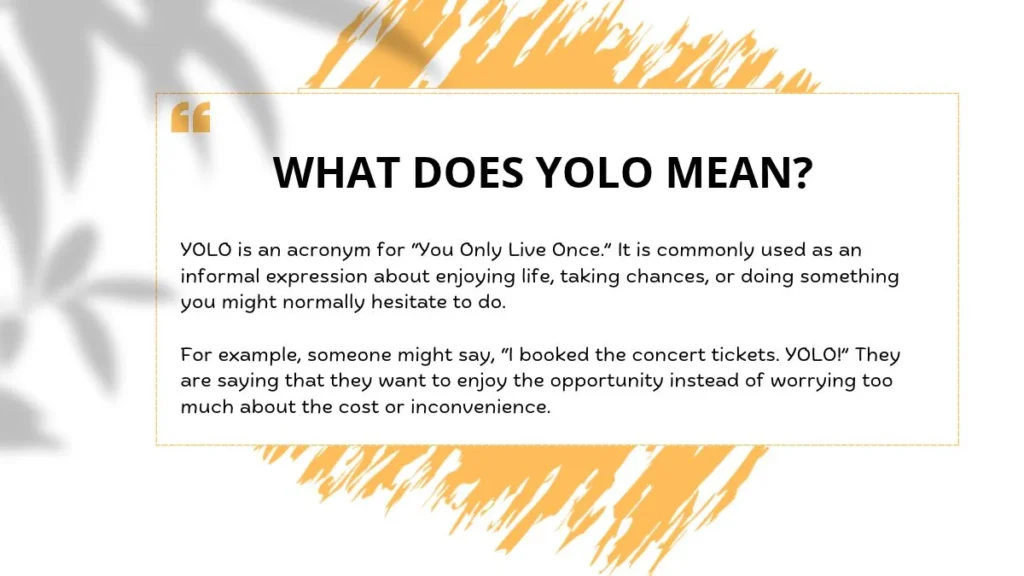
YOLO is an acronym for “You Only Live Once.” It is commonly used as an informal expression about enjoying life, taking chances, or doing something you might normally hesitate to do.
For example, someone might say, “I booked the concert tickets. YOLO!” They are saying that they want to enjoy the opportunity instead of worrying too much about the cost or inconvenience.
The expression does not always mean “do something dangerous.” In everyday conversation, it can simply mean “life is short, so enjoy this moment.”
The meaning of YOLO depends heavily on context. A person might use it sincerely before taking a big opportunity or jokingly after ordering an extra-large dessert.
Full Meaning in Simple Words
In simple words, YOLO means:
You have only one life, so appreciate it, enjoy meaningful experiences, and don’t let unnecessary fear stop you from living.
The idea is similar to older expressions such as “seize the day” or carpe diem. However, YOLO has a much more modern, casual, and internet-friendly tone.
Someone might use YOLO when:
- Trying something new
- Traveling somewhere unexpected
- Taking a personal opportunity
- Spending money on an experience
- Making a spontaneous decision
- Doing something silly for fun
A key point is that YOLO is often about choosing an experience over excessive hesitation. It does not automatically mean ignoring consequences.
What Does YOLO Mean in Text?
When someone writes YOLO in a text, they usually mean “You Only Live Once.” They may be saying that they are going to do something spontaneous, exciting, unusual, or slightly outside their comfort zone.
For example:
Friend: “Are you really going to drive three hours for that concert?”
You: “YOLO 😂”
Here, YOLO means, “Why not? This could be a fun experience.”
The phrase can also be used sarcastically:
“I know I have work tomorrow, but YOLO.”
In this case, the person may be joking about staying out late or making a choice they know is not especially practical.
So, what does YOLO mean in text? Usually, it is a casual way of saying “I’m going to enjoy the moment or take the chance because life is short.”
What Does YOLO Mean on Social Media?
On TikTok, Instagram, Snapchat, Facebook, and other social platforms, YOLO is often used as a short caption, comment, hashtag, or reaction.
Its meaning can range from genuine encouragement to humor.
For example, someone might post a picture from a last-minute road trip and write:
“No plans. Just packed a bag and left. YOLO.”
The person is presenting the trip as a spontaneous adventure.
On TikTok, someone might use YOLO in a funny comment after watching a person make an unexpected decision. On Instagram, it can work as a caption for travel, food, parties, concerts, or memorable experiences.
WhatsApp Chat Example
Alex: “Should I actually come with you guys this weekend?”
Sam: “Yes! Stop overthinking it 😂 YOLO.”
Here, Sam is encouraging Alex to join the trip and enjoy the opportunity.
Instagram DM Example
Friend: “You bought the expensive concert seats?”
You: “Yep 😂 YOLO.”
The message suggests that you decided the experience was worth the money.
TikTok Comment Example
Creator: “I quit my boring weekend plans and drove to the beach instead.”
Comment: “YOLO 😂🌊”
The commenter is playfully supporting the spontaneous choice.
Real-Life Meaning and Usage
In real life, YOLO is generally an informal expression used to encourage enjoyment, spontaneity, and taking opportunities.
It is especially common among friends and in casual conversations.
For example, a person might say YOLO before:
- Going on a spontaneous trip
- Trying an unfamiliar restaurant
- Signing up for an interesting class
- Attending a last-minute event
- Buying something they have wanted for a long time
- Asking someone on a date
- Trying a new hobby
However, responsible use matters. “You Only Live Once” is not a good reason to ignore serious consequences.
There is an important difference between taking a reasonable chance and making a dangerous decision.
Real-Life Situations Where YOLO Is Used
Imagine you have wanted to visit New York City for years. A friend offers you a chance to go this weekend, but you are nervous about making a quick decision.
You might say:
“I’ve always wanted to go. YOLO!”
Here, the expression represents adventure and making a memory.
Another example is a person deciding to try karaoke for the first time:
“I’ve never sung in public before, but YOLO.”
The person is not necessarily being reckless. They are simply allowing themselves to try something outside their comfort zone.
When YOLO Can Be Positive
YOLO can encourage someone to:
- Leave their comfort zone
- Spend time with loved ones
- Try a new experience
- Stop overthinking every small decision
- Appreciate the present
- Pursue a meaningful opportunity
When YOLO Can Be Misused
Using YOLO to excuse dangerous or harmful behavior misses the point.
For example, saying “YOLO” to justify drunk driving is not a harmless interpretation of the phrase. The expression is best understood as a reminder to live fully while still considering consequences.
Examples of YOLO in Sentences
Here are several natural examples:
- “I decided to take the weekend trip because YOLO.”
- “YOLO! Let’s try that new restaurant.”
- “She bought tickets to the concert at the last minute and said, ‘YOLO.’”
- “I was nervous about joining the class, but YOLO.”
- “We had no plans, so we went on a random road trip. YOLO!”
- “He finally asked her out because he figured, YOLO.”
- “I normally wouldn’t order dessert, but YOLO.”
These examples show that YOLO can describe both meaningful decisions and small, humorous choices.
Different Contexts of YOLO
YOLO does not have exactly the same tone in every setting.
| Context | Typical Meaning | Example |
| Casual conversation | Enjoy the moment | “Let’s go to the beach. YOLO!” |
| Texting | Take the chance | “I’m going. YOLO.” |
| Social media | Spontaneous or adventurous choice | “Booked the trip! #YOLO” |
| Humor | Playful excuse | “I ate the whole pizza. YOLO.” |
| Professional setting | Usually too casual | Better to say “Let’s take the opportunity.” |
| Academic writing | Generally inappropriate | Use a formal explanation instead |
YOLO works best when the audience understands casual slang.
Origin and History of YOLO
The phrase “You only live once” existed long before the modern acronym YOLO became popular. The underlying idea has historical connections to older expressions about making the most of life.
The acronym itself became widely associated with modern pop culture in the early 2010s. Drake helped push YOLO into mainstream culture through his 2011 song “The Motto,” which turned the expression into a widely recognized catchphrase. The FADER describes the song as a major force behind YOLO becoming a global phenomenon.
However, Drake did not invent the underlying phrase. Earlier uses of the acronym have been documented, including a 2009 use by entrepreneur Daymond John on Shark Tank. Historical reporting also points to other earlier uses.
The Oxford English Dictionary later added YOLO as an entry in 2016. Reporting on the OED addition noted that the acronym was traced to 1996, while the older “you only live once” idea has much deeper roots.
This history explains why YOLO can feel both like modern internet slang and an updated version of a much older life philosophy.
Why Do People Use YOLO?
People use YOLO because it communicates a fairly big idea with only four letters.
Instead of saying:
“Life is unpredictable, and I don’t want to miss an opportunity just because I’m nervous,”
someone can simply say:
“YOLO.”
The expression can also create a sense of humor and friendship. In group conversations, it often signals that someone is ready to be spontaneous.
Another reason is that YOLO gives people a simple way to frame experiences as valuable. A person may decide that a concert, trip, dinner, hobby, or special event is worth doing because the memory could matter more than minor inconvenience.
Emotional and Psychological Meaning Behind YOLO
YOLO often reflects a desire for freedom, excitement, novelty, and meaningful experiences.
Emotionally, it can appear when someone feels tired of overthinking. Saying YOLO may communicate:
- “I want to enjoy myself.”
- “I don’t want fear to stop me.”
- “This opportunity matters to me.”
- “I want to make a memory.”
- “I’m ready to try something different.”
There is also a humorous side. People frequently use YOLO for small decisions that are not genuinely life-changing.
For example:
“Should I get fries with my burger?”
“YOLO.”
The joke comes from treating an ordinary decision as if it were a major life adventure.
Tone Explanation: Formal, Informal, Slang, or Offensive?
YOLO is primarily informal slang.
It is:
- Informal: Yes
- Casual: Yes
- Common online: Yes
- Professional: Usually not ideal
- Rude: Not inherently
- Offensive: Not inherently
- Vulgar: No
The tone depends on how it is used.
Among friends, YOLO may sound funny and natural. In a formal business report, academic paper, job interview, or professional presentation, it can sound too casual.
Is It Rude to Say YOLO?
No. YOLO is not normally rude or offensive.
However, context matters. Someone could use it in a dismissive way when another person is discussing a serious concern.
For example, responding “YOLO” when a friend is worried about a major personal decision might sound insensitive.
The word itself is harmless, but the attitude behind it can change how it is received.
Is YOLO Positive, Negative, or Neutral?
YOLO is generally positive or playful, but it can be neutral or negative depending on context.
Positive:
“I finally booked my dream vacation. YOLO!”
Playful:
“I ordered the giant milkshake. YOLO.”
Negative or irresponsible:
“I’m going to ignore all the consequences because YOLO.”
The important distinction is between embracing life and using the phrase as an excuse for poor judgment.
When to Use YOLO
Use YOLO when the conversation is casual and you want to express enthusiasm, spontaneity, or a willingness to take a reasonable chance.
Good situations include:
- Casual texts
- Friend-to-friend conversations
- Social media captions
- TikTok comments
- Instagram posts
- Travel conversations
- Jokes about food or shopping
- Celebrating an exciting decision
When NOT to Use YOLO
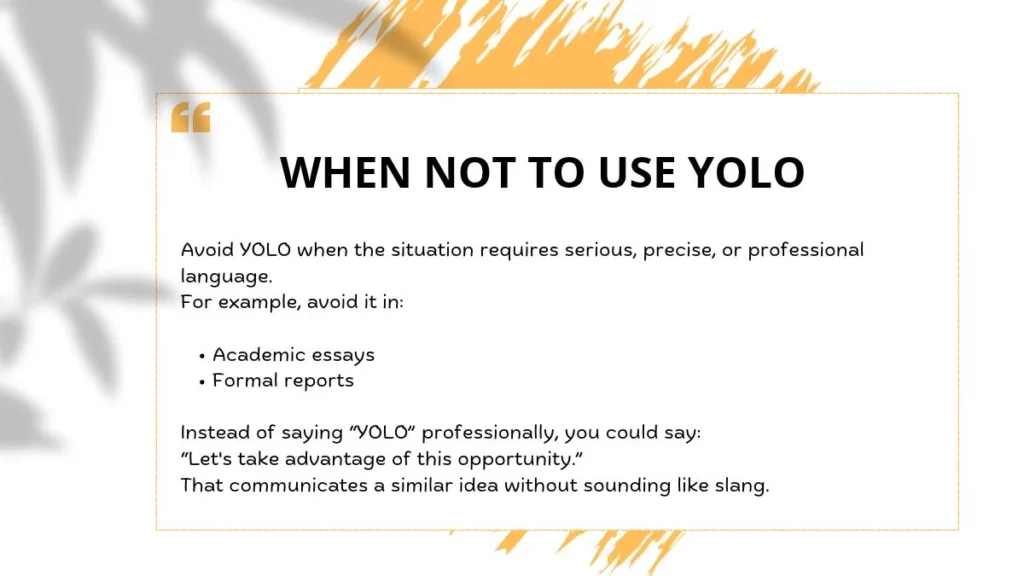
Avoid YOLO when the situation requires serious, precise, or professional language.
For example, avoid it in:
- Academic essays
- Formal reports
- Job interviews
- Legal documents
- Business proposals
- Serious safety discussions
- Sensitive personal conversations
Instead of saying “YOLO” professionally, you could say:
“Let’s take advantage of this opportunity.”
That communicates a similar idea without sounding like slang.
Situations Where You Should Avoid Using YOLO
The biggest mistake is using YOLO to make genuinely dangerous behavior sound harmless.
A useful rule is:
If the decision could seriously harm you or another person, YOLO is not a good justification.
You can embrace adventure without abandoning common sense.
A better version of the YOLO mindset is:
Take meaningful chances, but understand the consequences first.
That interpretation preserves the positive idea behind the phrase while avoiding reckless behavior.
YOLO Compared With Similar Terms
| Term | Meaning | Usage | Key Difference |
| YOLO | You Only Live Once | Casual, online, slang | Focuses on making the most of life |
| Carpe diem | Seize the day | Literary, motivational | More formal and philosophical |
| Live it up | Enjoy yourself fully | Casual | Focuses strongly on having fun |
| Go for it | Take the opportunity | Casual/professional | Encourages action without the “one life” idea |
| Take a chance | Accept some uncertainty | General | Focuses on risk rather than enjoying life |
YOLO and carpe diem are especially similar. Both encourage people to make the most of the present, but YOLO is much more casual and modern.
5–10 Variations and Related Uses of YOLO
YOLO can appear in several forms:
- YOLO — The standard acronym.
- Yolo — A less emphatic capitalization style.
- YOLO moment — A moment when someone chooses to take a chance.
- YOLO mentality — A mindset focused on enjoying life and experiences.
- YOLO lifestyle — A lifestyle associated with spontaneity and adventure.
- YOLO decision — A spontaneous or unusual choice.
- YOLO trip — A last-minute or adventurous trip.
- YOLO purchase — An unnecessary but enjoyable purchase.
- YOLO mode — A joking way to say someone is acting spontaneously.
- #YOLO — A social-media hashtag or caption.
These variations do not create completely different definitions. They expand the original idea into different situations.
How to Respond When Someone Says YOLO
Your response should match the mood.
Casual Replies
- “True!”
- “Let’s do it!”
- “Why not?”
- “I’m in.”
- “Sounds fun.”
Funny Replies
- “YOLO, but my bank account disagrees.”
- “YOLO responsibly 😂”
- “Future me can deal with it.”
- “That’s exactly what a YOLO person would say.”
Professional or Mature Replies
If someone uses YOLO when discussing a real decision, you can respond:
- “Let’s make the most of the opportunity.”
- “I’m open to trying it, as long as we think it through.”
- “Life is short, but let’s make a smart choice.”
- “I’m willing to take the opportunity.”
USA and Western Usage
In the United States, YOLO became strongly associated with casual internet culture, music, memes, social media, and youth slang during the 2010s.
It can still be understood today even when used humorously or ironically. In American English, the acronym is usually pronounced as individual letters: “Y-O-L-O.”
The expression is often connected with travel, entertainment, food, celebrations, dating, shopping, and spontaneous decisions.
Global and Internet Usage Differences
YOLO has spread beyond the United States through social media, music, memes, and online communication.
People in different countries may use it differently. Some use it seriously as a motivational phrase, while others use it almost entirely as a joke.
Internet culture also allows YOLO to cross language boundaries. Even when someone is not a native English speaker, they may recognize YOLO because it functions as a global internet expression.
A Simple Decision Guide: Should You Use YOLO?
Are you talking casually with friends?
↓
Yes → YOLO can fit naturally.
Are you posting a spontaneous experience online?
↓
Yes → YOLO can work as a caption or comment.
Are you writing for school or work?
↓
Yes → Choose more formal wording.
Are you using YOLO to justify something dangerous?
↓
Yes → Stop and reconsider the decision rather than relying on the phrase.
This simple test helps you understand both the meaning and appropriate use of the expression.
Common Misconceptions About YOLO
Does YOLO Mean “Do Anything You Want”?
Not exactly. YOLO means “You Only Live Once,” but it does not literally require reckless behavior.
The expression is often used humorously to encourage people to enjoy experiences and take reasonable chances.
Did Drake Invent YOLO?
No. Drake played a major role in popularizing the acronym through “The Motto,” but evidence of earlier uses exists.
Is YOLO Still Slang?
Yes. YOLO remains an informal expression, although its widespread recognition means many people understand it even outside youth slang.
Key Takeaways
- YOLO stands for “You Only Live Once.”
- It encourages people to enjoy life and make the most of opportunities.
- In texting, YOLO often means “I’m going for it.”
- On TikTok and Instagram, it can describe a spontaneous or funny decision.
- YOLO is informal and usually playful.
- It is not inherently rude or offensive.
- It should not be used as an excuse for dangerous behavior.
- Drake helped make the acronym globally popular, but he did not invent the underlying phrase.
FAQs About YOLO
What does YOLO stand for?
YOLO stands for “You Only Live Once.” It is used to express the idea that people should enjoy life, appreciate opportunities, and sometimes take reasonable chances.
What does YOLO mean in slang?
In slang, YOLO usually means “life is short, so I’m going to do this” or “I’m going to take the chance and enjoy myself.” It is often playful.
What does YOLO mean in text?
In text messages, YOLO is a quick way to say that someone has decided to do something spontaneous or enjoyable. For example, “I’m coming with you—YOLO!”
What does YOLO mean on TikTok?
On TikTok, YOLO can be used in captions and comments to describe spontaneous, funny, adventurous, or unexpected decisions. Its meaning is usually casual rather than literal.
Is YOLO a positive word?
Usually, yes. YOLO often has a positive, enthusiastic, or humorous tone. However, its meaning can become negative if someone uses it to excuse irresponsible behavior.
Is YOLO rude?
No. YOLO is not inherently rude or offensive. Still, saying it during a serious conversation can sometimes sound dismissive if the other person expects a thoughtful response.
Is YOLO still used?
Yes. People still recognize and use YOLO, especially in casual conversations, memes, captions, texts, and online communities. Its tone today is often humorous or nostalgic as well as motivational.
References
- Oxford English Dictionary, historical reporting on the addition of “YOLO” to the OED.
- The FADER, reporting on YOLO’s popularization through Drake’s “The Motto.”
- The FADER, historical discussion of earlier uses of the acronym.
Conclusion
So, what does yolo mean? YOLO means “You Only Live Once.” It is a casual expression used when someone wants to enjoy life, take a reasonable chance, try something new, or stop overthinking a decision.
You may see YOLO in texts, TikTok comments, Instagram captions, conversations, memes, and everyday American slang. While the phrase can encourage spontaneity, its best use is not to ignore consequences. The strongest interpretation is simple: make the most of your life while making smart choices along the way.

Daniel Carter is a passionate writer and creative storyteller dedicated to exploring the deeper meanings of life, dreams, and human experiences. With a strong interest in symbolism, spirituality, and personal growth, Daniel brings clarity to complex ideas, making them easy to understand for readers from all walks of life.
As a featured author on meaniings.com, Daniel Carter focuses on delivering insightful, well-researched, and engaging content that helps readers uncover hidden meanings behind dreams, emotions, and everyday situations. His writing style combines thoughtful analysis with a relatable voice, making his work both informative and inspiring.
Daniel’s approach is rooted in curiosity and a desire to guide readers toward self-awareness and understanding. He believes that every dream and experience carries a message—one that can lead to personal transformation when interpreted correctly.
Over time, Daniel has built a reputation for creating meaningful content that resonates with a global audience, especially those interested in dream interpretation and spiritual insight.
Books by Daniel Carter:
- The Hidden Language of Dreams
- Signs, Symbols, and Their Meanings
- Unlocking the Power of Your Subconscious Mind