
Being emotionally unavailable means a person has difficulty connecting emotionally with others or expressing deep feelings in relationships. Someone who is emotionally unavailable may avoid intimacy, struggle to communicate emotions, or keep people at a distance emotionally.
The phrase “what does emotionally unavailable mean” is commonly searched when people want to understand confusing behavior in dating, friendships, or relationships. It often describes someone who seems distant, detached, or unwilling to open up emotionally.
what does emotionally unavailable mean (Quick Meaning)
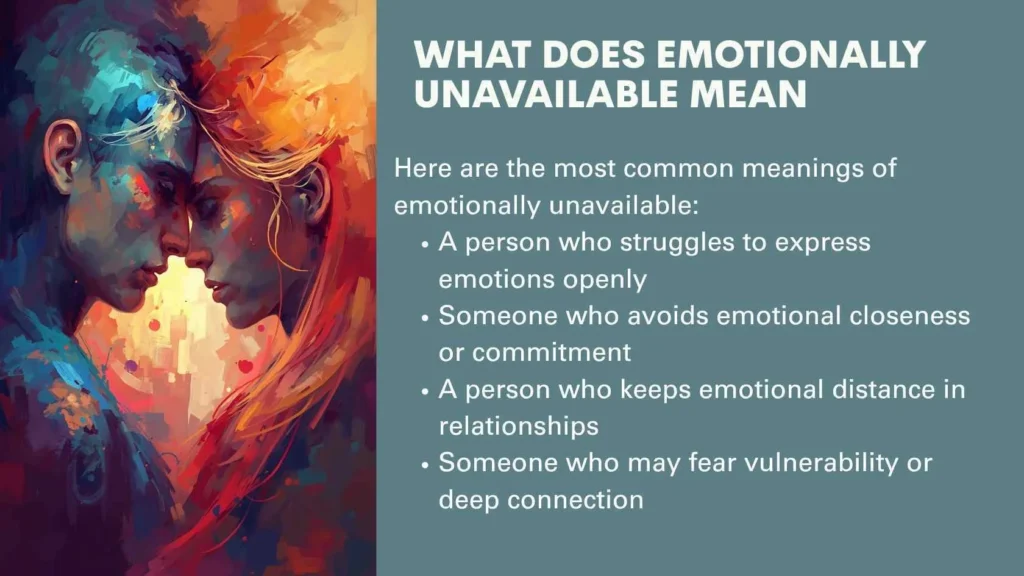
Here are the most common meanings of emotionally unavailable:
- A person who struggles to express emotions openly
- Someone who avoids emotional closeness or commitment
- A person who keeps emotional distance in relationships
- Someone who may fear vulnerability or deep connection
This term is commonly used in dating, psychology, texting, and social media conversations.
What Does Emotionally Unavailable Mean?
The meaning of emotionally unavailable is simple: a person is unable or unwilling to fully connect emotionally with others.
This does not always mean the person is “bad” or uncaring. Sometimes emotional unavailability happens because of:
- Past heartbreak
- Trauma
- Fear of rejection
- Commitment issues
- Stress or mental health struggles
- Difficulty understanding emotions
An emotionally unavailable person may enjoy spending time with someone but still avoid deeper emotional attachment.
Full Meaning in Simple Words
In simple words, an emotionally unavailable person acts distant when emotions become serious.
For example:
- They avoid deep conversations
- They rarely talk about feelings
- They pull away when relationships get close
- They send mixed signals
- They fear commitment
Someone might look loving one day and cold the next. That emotional inconsistency is why many people use this term in dating and relationship discussions.
What Does Emotionally Unavailable Mean in Text?
In texting, the phrase usually describes someone who seems emotionally distant or disconnected.
Example:
“I stopped talking to him because he was emotionally unavailable.”
In this context, it means the person could not give emotional support, commitment, or openness through communication.
People also use it when talking about:
- Dry texting
- Ignoring emotional conversations
- Avoiding relationship labels
- Acting hot and cold
What Does Emotionally Unavailable Mean on Social Media?
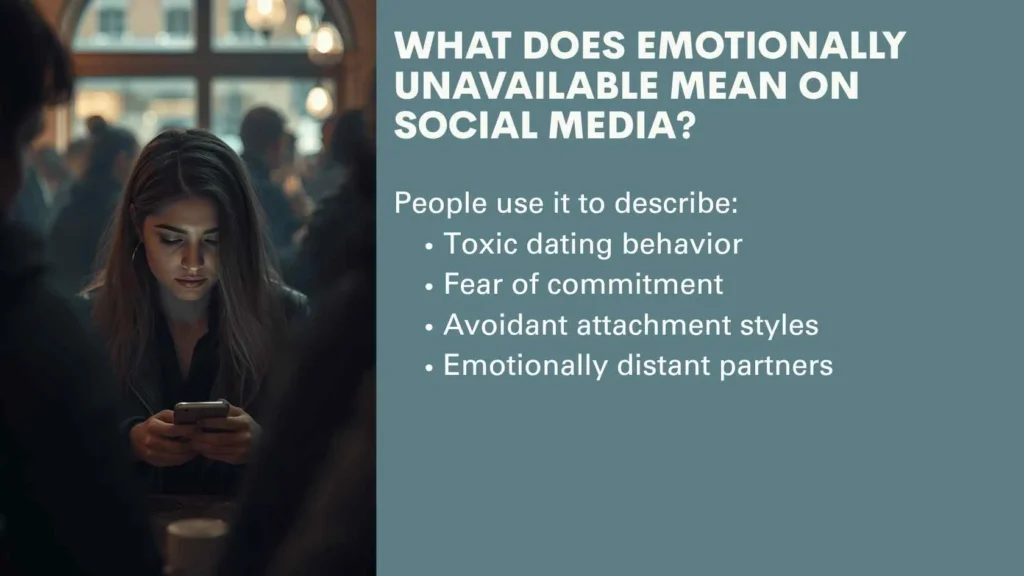
On platforms like TikTok, Instagram, X, and Reddit, the term is extremely popular in relationship content.
People use it to describe:
- Toxic dating behavior
- Fear of commitment
- Avoidant attachment styles
- Emotionally distant partners
You may see posts like:
- “Stop chasing emotionally unavailable people.”
- “He texts every day but avoids real feelings.”
- “Dating emotionally unavailable men is exhausting.”
The term is often connected to self-help, mental health, and dating advice videos.
WhatsApp Chat Example
Person A: “Why does he disappear whenever things get serious?”
Person B: “Honestly, he sounds emotionally unavailable.”
Meaning:
Person B thinks the guy struggles with emotional closeness or commitment.
Instagram DM Example
DM Message:
“I liked her a lot, but she never opened up emotionally. She was emotionally unavailable.”
Meaning:
The speaker feels the other person avoided emotional connection.
TikTok Comment Example
“This video describes every emotionally unavailable guy I’ve dated 😭”
Meaning:
The commenter relates to the behavior shown in the video.
Real-Life Meaning and Usage
In real life, emotionally unavailable people may:
- Avoid discussing feelings
- Change the topic during emotional talks
- Struggle with commitment
- Prefer casual relationships
- Fear vulnerability
- Keep emotional walls up
Not every quiet or independent person is emotionally unavailable. The key difference is emotional avoidance.
For example, someone may care deeply but still struggle to express emotions because of fear or past experiences.
Real-Life Situations Where This Term Is Used
Dating Relationships
This is the most common use.
Example:
“She wanted a serious relationship, but he was emotionally unavailable.”
Friendships
Sometimes friends avoid emotional support or serious conversations.
Example:
“He jokes around all the time but disappears during emotional moments.”
Family Relationships
A parent or sibling may struggle with emotional expression.
Example:
“My dad loves us, but he’s emotionally unavailable.”
Therapy and Psychology
Therapists use the term to discuss emotional patterns and attachment styles.
Examples of Emotionally Unavailable in Sentences
Here are some example sentences:
- “I realized he was emotionally unavailable after months of mixed signals.”
- “Emotionally unavailable people often avoid serious conversations.”
- “She seemed caring but emotionally unavailable.”
- “Dating someone emotionally unavailable can feel confusing.”
- “He struggles to trust others, so he becomes emotionally unavailable.”
- “Her therapist explained that emotional unavailability can come from past trauma.”
Different Contexts of Emotionally Unavailable
| Context | Meaning |
| Casual conversation | Someone distant in relationships |
| Dating apps | A person avoiding commitment |
| Psychology | Emotional avoidance pattern |
| Social media | Relationship advice or red flags |
| Academic discussion | Emotional detachment behavior |
| Online slang | Someone emotionally closed off |
Origin and History of the Term
The term “emotionally unavailable” became more common through psychology and relationship counseling.
It grew in popularity during the late 20th century as therapists discussed:
- Emotional intimacy
- Attachment styles
- Trauma responses
- Relationship communication
Later, social media and dating culture made the phrase mainstream. Today, it is widely used on TikTok, podcasts, YouTube, and dating blogs.
Why Do People Use This Word?
People use the term because it quickly explains emotionally distant behavior.
Instead of saying:
“This person avoids closeness and struggles with emotional communication…”
People simply say:
“They’re emotionally unavailable.”
The phrase helps describe confusing relationship experiences in a short and relatable way.
Emotional & Psychological Meaning Behind This Word
Psychologically, emotional unavailability often connects to fear and protection.
Some people become emotionally unavailable because they:
- Fear getting hurt
- Experienced toxic relationships
- Grew up in emotionally distant homes
- Struggle with trust
- Have avoidant attachment styles
It can also happen during stressful periods like:
- Grief
- Depression
- Burnout
- Divorce
Emotionally unavailable people may still care deeply. They simply struggle to express or manage emotional closeness.
Tone Explanation
The tone of this phrase depends on context.
| Tone Type | Explanation |
| Informal | Common in daily conversation |
| Relationship slang | Popular in dating culture |
| Psychological | Used in therapy discussions |
| Neutral | Can be descriptive, not insulting |
| Negative | Sometimes used critically |
The phrase is usually not considered profanity or offensive language.
Is It Rude to Say This Word?
Not usually, but it can feel hurtful if used carelessly.
Calling someone emotionally unavailable may sound like criticism if:
- Said during arguments
- Used to shame someone
- Used without understanding their situation
It is more respectful to explain behavior calmly instead of labeling someone aggressively.
Example:
Better:
“I feel emotionally disconnected in this relationship.”
Less respectful:
“You’re emotionally unavailable and impossible to love.”
Is This Word Positive, Negative, or Neutral?
The phrase is generally neutral to negative.
- Neutral in therapy or psychology discussions
- Negative when describing relationship struggles
It usually suggests emotional difficulties rather than positive qualities.
When to Use Emotionally Unavailable
You can use this term when describing:
- Difficulty expressing emotions
- Fear of commitment
- Emotional distance
- Avoidance of vulnerability
- Relationship confusion
Example:
“He likes me, but emotionally he seems unavailable.”
When NOT to Use Emotionally Unavailable
Avoid using this term when:
- Someone simply needs personal space
- A person is naturally quiet
- You do not fully understand their situation
- Someone is grieving or emotionally overwhelmed
Not every emotionally reserved person is emotionally unavailable.
Situations Where You Should Avoid Using This Word
You should avoid using the term:
- During heated arguments
- To insult someone
- To diagnose mental health issues
- Without understanding emotional trauma
- In professional settings where sensitivity matters
The phrase should be used thoughtfully, not as a weapon.
Comparison Table: Emotionally Unavailable vs Similar Terms
| Term | Meaning | Usage | Key Difference |
| Emotionally unavailable | Avoids emotional closeness | Relationships | Focuses on emotional distance |
| Cold-hearted | Lacks empathy or warmth | Negative criticism | Stronger and harsher |
| Avoidant | Avoids attachment/intimacy | Psychology | More clinical term |
| Detached | Emotionally disconnected | Casual or formal | Can be temporary |
| Commitment-phobic | Fears commitment | Dating slang | Specifically about commitment |
Variations and Related Meanings
Here are related variations of the term:
- Emotionally distant — avoids closeness
- Emotionally closed off — hides feelings
- Avoidant attachment — psychological attachment style
- Commitment issues — fear of serious relationships
- Detached personality — emotionally disconnected behavior
- Guarded emotionally — protective with feelings
- Unavailable partner — cannot provide emotional support
- Fear of intimacy — anxiety around closeness
- Hot and cold behavior — inconsistent emotions
- Emotionally withdrawn — pulling away emotionally
How to Respond to Someone Who Seems Emotionally Unavailable
Casual Replies
- “I just need honest communication.”
- “Tell me how you really feel.”
- “You seem distant lately.”
Funny Replies
- “Your emotional walls have emotional walls.”
- “Are you emotionally unavailable or just buffering?”
- “Blink twice if feelings scare you.”
Professional or Mature Replies
- “I respect your space, but I need emotional clarity.”
- “Healthy communication matters to me.”
- “I think we want different levels of emotional connection.”
USA / Western Usage
In the United States and Western dating culture, emotionally unavailable is a very common relationship term.
It often appears in:
- Therapy content
- Dating podcasts
- TikTok advice videos
- Relationship memes
- Self-help books
Many Americans use it casually when discussing dating experiences.
Example:
“I keep attracting emotionally unavailable men.”
Global or Internet Usage Differences
Globally, the phrase has spread through social media and online dating culture.
However, meanings may vary slightly:
- In some cultures, emotional reserve is considered normal
- In Western culture, emotional openness is often valued more
- Online, the term is sometimes overused for anyone who struggles with communication
The internet has made the phrase more mainstream and emotionally relatable.
What Does Emotionally Unavailable Mean on TikTok / Instagram?
On TikTok and Instagram, emotionally unavailable usually refers to someone who:
- Avoids commitment
- Gives mixed signals
- Cannot express feelings clearly
- Acts interested but emotionally distant
Relationship creators often discuss signs like:
- Inconsistent texting
- Fear of labels
- Avoiding vulnerability
- Pulling away emotionally
Is It Rude to Say This?
The phrase itself is not rude, but tone matters.
If used respectfully, it can help explain emotional patterns.
If used angrily, it may feel judgmental or insulting.
Why Do People Use This Word?
People use the term because it:
- Explains relationship confusion
- Describes emotional distance clearly
- Helps discuss dating struggles
- Connects with modern relationship experiences
It has become a relatable internet phrase because many people have experienced emotionally distant relationships.
Frequently Asked Questions
Is emotionally unavailable a red flag?
Sometimes. It can be a red flag in relationships if the person refuses emotional connection or healthy communication.
Can emotionally unavailable people fall in love?
Yes. Many emotionally unavailable people still feel love deeply but struggle to express it openly.
Is emotional unavailability toxic?
Not always. Sometimes it comes from trauma, stress, or fear rather than bad intentions.
How do you know if someone is emotionally unavailable?
Common signs include avoiding deep talks, fear of commitment, mixed signals, and emotional distance.
Can emotionally unavailable people change?
Yes, especially through self-awareness, therapy, communication, and emotional healing.
Is emotionally unavailable the same as shy?
No. A shy person may still want emotional closeness, while an emotionally unavailable person often avoids it.
Why are emotionally unavailable people attractive to some people?
Sometimes mystery, emotional distance, or inconsistency can create emotional intensity or attraction.
Conclusion
The phrase “emotionally unavailable” describes someone who struggles with emotional openness, vulnerability, or deep connection in relationships. It is commonly used in dating, texting, social media, and psychology discussions to explain emotionally distant behavior.
Understanding the meaning of emotionally unavailable can help people recognize unhealthy relationship patterns, communicate better, and build healthier emotional connections. While the term often has a negative meaning, it is important to remember that emotional unavailability usually comes from fear, past experiences, or emotional struggles rather than simple lack of care.

James Walker is a passionate writer, dream analyst, and content creator who specializes in uncovering the deeper meanings behind everyday experiences, symbols, and dreams. As a featured author on meaniings.com, he is dedicated to helping readers understand hidden messages within their subconscious and guiding them toward clarity, purpose, and self-discovery.
With a strong interest in psychology, spirituality, and real-life storytelling, James blends research with relatable insights to create engaging and easy-to-understand content. His writing focuses on dream meanings, symbolism, emotional awareness, and personal growth—making complex ideas simple for readers from all backgrounds.
James Walker began his writing journey with a desire to share meaningful stories and life lessons inspired by real experiences. Like many inspirational writers, he believes that every dream and life situation carries a message worth exploring. His work aims to educate, inspire, and empower readers to better understand themselves and the world around them.
Over time, his thoughtful approach and engaging style have helped him build a loyal readership. He continues to contribute valuable content that aligns with the mission of meaniings.com—to provide accurate, insightful, and helpful interpretations.
Notable Works by James Walker:
Growing Up with Jessica: A True Story (inspirational real-life journey)
Dream Symbols and Their Hidden Meanings
The Power of Dreams: Understanding Your Inner Mind