
If you’ve ever wondered what does anxiety spiral mean, it refers to a situation where anxious thoughts build on each other and become increasingly intense, often leading to overwhelming worry, fear, or stress.
An anxiety spiral usually starts with one concern, but that concern triggers additional negative thoughts, creating a cycle that feels difficult to stop.
In simple terms, an anxiety spiral is when your mind keeps jumping from one worry to another until your anxiety feels much bigger than the original problem.
What Does Anxiety Spiral Mean?(Quick Meaning)
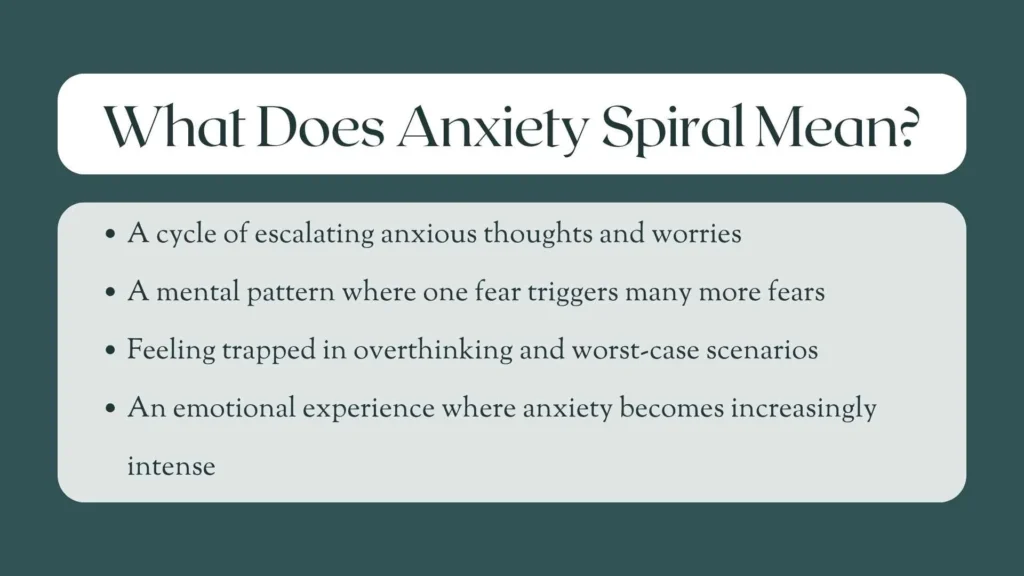
What does anxiety spiral mean?
- A cycle of escalating anxious thoughts and worries
- A mental pattern where one fear triggers many more fears
- Feeling trapped in overthinking and worst-case scenarios
- An emotional experience where anxiety becomes increasingly intense
Featured Snippet Answer:
An anxiety spiral is a pattern of thinking in which anxious thoughts continuously build upon one another, causing increasing stress, fear, and emotional overwhelm. It often begins with a small worry that grows into multiple concerns and worst-case scenarios.
What Does Anxiety Spiral Mean?
An anxiety spiral describes a chain reaction of anxious thinking. Instead of resolving a concern, the mind keeps generating new worries connected to the original issue.
For example:
- You send an important email.
- You don’t receive a reply.
- You start wondering if you said something wrong.
- Then you worry about your job.
- Then you imagine negative outcomes.
Before long, a simple situation feels much more serious than it actually is.
This is the basic definition of anxiety spiral in everyday language.
Full Meaning in Simple Words
The meaning of anxiety spiral can be understood as “worry feeding more worry.”
When someone experiences an anxiety spiral:
- Thoughts become repetitive.
- Concerns seem bigger than they are.
- It becomes difficult to focus on facts.
- Emotions become stronger with each negative thought.
Many people describe it as feeling like they are going down a mental “spiral staircase” of worry that keeps getting deeper.
An anxiety spiral does not mean someone is weak or irrational. It is a common human experience that can happen during stressful situations.
What Does Anxiety Spiral Mean in Text?
In texting, the phrase usually means someone is overthinking or experiencing increasing anxiety.
Text Example 1
Person A: I haven’t heard back from them yet.
Person B: Don’t anxiety spiral. They’re probably just busy.
Text Example 2
Person A: I keep thinking something bad happened.
Person B: Sounds like you’re anxiety spiraling. Try not to assume the worst.
In text conversations, the phrase often acts as a reminder to pause and avoid jumping to negative conclusions.
What Does Anxiety Spiral Mean on Social Media (TikTok, Instagram, etc.)?
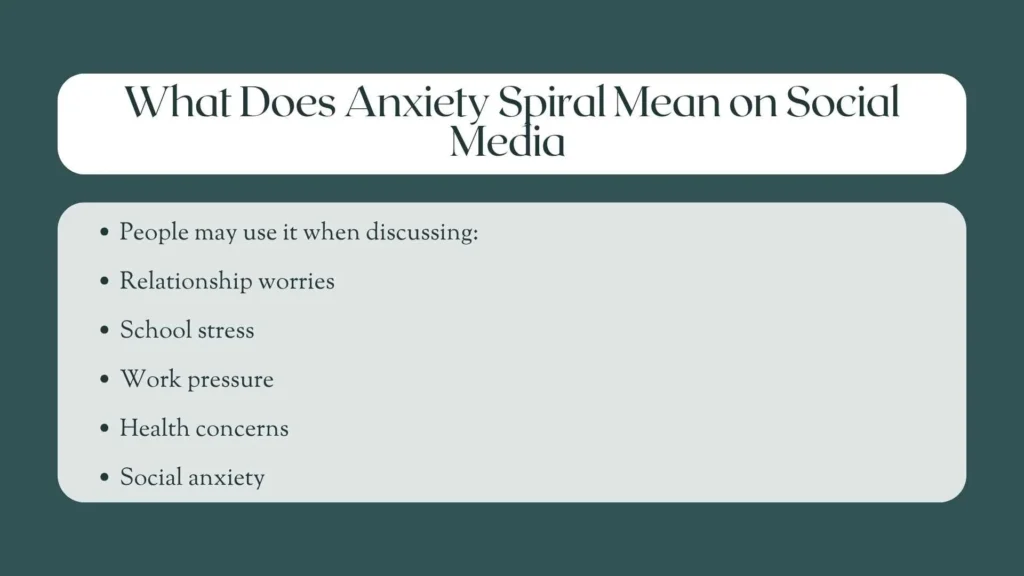
On platforms like TikTok, Instagram, X, and Reddit, “anxiety spiral” is commonly used to describe moments of intense overthinking.
People may use it when discussing:
- Relationship worries
- School stress
- Work pressure
- Health concerns
- Social anxiety
Common Social Media Usage
- “I’m in a full anxiety spiral right now.”
- “Anyone else anxiety spiral before a big presentation?”
- “Trying not to anxiety spiral over this text.”
Social media creators often share tips for recognizing and managing anxiety spirals, making the term widely recognized among younger audiences.
Platform-Based Examples
WhatsApp Chat Example
Sarah: My boss wants to talk tomorrow.
Emma: About what?
Sarah: No idea.
Emma: Don’t anxiety spiral. It could be completely normal.
Instagram DM Example
Friend 1: They viewed my story but didn’t reply.
Friend 2: You’re anxiety spiraling again 😂
Friend 1: Maybe a little.
TikTok Comment Example
Video Caption: Waiting for interview results.
Comment: “The anxiety spiral after every interview is so real.”
Real-Life Meaning and Usage
In real life, anxiety spirals happen when stress causes a person to imagine increasingly negative outcomes.
For example:
- Waiting for medical test results
- Preparing for an exam
- Dealing with financial concerns
- Facing relationship uncertainty
- Starting a new job
The phrase is often used by therapists, mental health advocates, and everyday people because it accurately describes a common emotional experience.
Real-Life Situations Where This Term Is Used
At Work
A worker sends a report and doesn’t hear feedback immediately.
They begin worrying:
- Maybe there was a mistake.
- Maybe the manager is upset.
- Maybe their job is at risk.
This can become an anxiety spiral.
In Relationships
Someone doesn’t receive a text response.
They think:
- Are they upset?
- Did I do something wrong?
- Is the relationship ending?
Again, this can create an anxiety spiral.
In School
A student receives a lower grade than expected.
They may start worrying about:
- Future exams
- College admissions
- Career goals
The original concern grows into many larger fears.
Examples of Anxiety Spiral in Sentences
- I started an anxiety spiral after reading that email.
- She recognized her anxiety spiral and took a break.
- Social media sometimes triggers an anxiety spiral for me.
- Don’t let one small mistake turn into an anxiety spiral.
- He was caught in an anxiety spiral before the presentation.
- Therapy helped her manage anxiety spirals more effectively.
- My anxiety spiral made the situation seem worse than it actually was.
Different Contexts of Anxiety Spiral
Casual Conversations
Friends often use the phrase informally.
Example:
“I’m totally anxiety spiraling about tomorrow.”
Mental Health Discussions
Professionals may discuss anxiety spirals when explaining thought patterns.
Example:
“Recognizing an anxiety spiral is an important step toward managing anxiety.”
Online Communities
The term is frequently used in support groups and social media discussions.
Example:
“This post helped me stop an anxiety spiral.”
Academic Context
Researchers may refer to similar concepts using terms like rumination, catastrophic thinking, or cognitive distortions.
Origin and History of the Term
The phrase “anxiety spiral” is relatively modern and comes from combining two ideas:
- Anxiety = feelings of worry, nervousness, or fear
- Spiral = a pattern that continues moving in one direction, often downward
The metaphor of a spiral became popular because it visually represents how thoughts can build upon each other and feel increasingly difficult to escape.
The term gained significant popularity through:
- Mental health awareness campaigns
- Therapy discussions
- Social media platforms
- Self-help content
Why Do People Use This Word?
People use the phrase because it quickly explains a complex emotional experience.
Instead of saying:
“I started worrying about one thing and then imagined multiple negative outcomes.”
They can simply say:
“I had an anxiety spiral.”
The phrase is:
- Easy to understand
- Emotionally relatable
- Widely recognized online
- Helpful for discussing mental health
Emotional & Psychological Meaning Behind This Word
Psychologically, an anxiety spiral often involves:
Catastrophic Thinking
Assuming the worst possible outcome.
Overthinking
Repeatedly analyzing situations without reaching a solution.
Rumination
Getting stuck on the same thoughts.
Emotional Amplification
Allowing fear and uncertainty to intensify emotions.
An anxiety spiral can make small problems feel much larger because the brain focuses on potential threats rather than evidence-based thinking.
Tone Explanation
Is Anxiety Spiral Formal or Informal?
The phrase is generally:
- Informal
- Conversational
- Mental health-related
- Widely accepted
It is not slang, but it is more common in everyday speech than in highly formal academic writing.
Tone Types
| Tone | Appropriate? |
| Casual | Yes |
| Informal | Yes |
| Professional | Usually |
| Academic | Sometimes |
| Slang | Not exactly |
| Offensive | No |
Is It Rude to Say This Word?
No.
The term “anxiety spiral” is not rude, offensive, or insulting.
However, it should be used thoughtfully.
Respectful Use
“I think I’m having an anxiety spiral.”
Less Helpful Use
“You’re just anxiety spiraling.”
The second example may sound dismissive if used carelessly.
Is This Word Positive, Negative, or Neutral?
The phrase is generally neutral to negative.
Positive Aspect
- Promotes self-awareness
- Encourages discussion of mental health
Negative Aspect
- Describes emotional distress
- Refers to a difficult experience
Overall, it is best classified as neutral because it simply describes a mental state.
When to Use Anxiety Spiral
Use the phrase when:
- Discussing overthinking
- Talking about stress
- Describing escalating worries
- Explaining emotional overwhelm
- Discussing mental health experiences
When NOT to Use Anxiety Spiral
Avoid using it when:
- Someone is experiencing a serious crisis that requires professional help
- You are dismissing another person’s feelings
- You are making fun of someone’s mental health struggles
Situations Where You Should Avoid Using This Word
- Formal legal documents
- Scientific papers without proper context
- Workplace evaluations
- Situations where mental health concerns are being minimized
Always use the term respectfully.
Comparison Table
| Term | Meaning | Usage | Key Difference |
| Anxiety Spiral | Escalating anxious thoughts | Everyday conversations | Focuses on growing anxiety |
| Overthinking | Excessive thinking | Casual and professional | Broader than anxiety |
| Rumination | Repetitive negative thinking | Psychology | Focuses on dwelling on thoughts |
| Panic Attack | Intense physical anxiety episode | Medical and everyday use | Includes physical symptoms |
| Catastrophizing | Assuming worst outcomes | Psychology | Specific thinking pattern |
Variations and Related Meanings
Here are common variations connected to the meaning of anxiety spiral:
- Anxiety spiraling
- Currently experiencing escalating anxiety.
- Mental spiral
- Broader term for worsening thoughts.
- Worry spiral
- Similar focus on excessive worrying.
- Thought spiral
- Chain of repetitive thoughts.
- Negative spiral
- Worsening emotional pattern.
- Stress spiral
- Escalating stress response.
- Overthinking spiral
- Repeated analysis without resolution.
- Emotional spiral
- Increasing emotional distress.
- Downward spiral
- General worsening situation.
- Catastrophic thinking cycle
- Clinical-style description.
How to Respond
Casual Replies
- “Take a deep breath. It might not be as bad as it seems.”
- “Try not to jump to conclusions.”
- “Let’s focus on the facts.”
Funny Replies
- “Your brain is writing a disaster movie again.”
- “Let’s cancel the imaginary apocalypse.”
- “That’s some Olympic-level overthinking.”
Professional or Mature Replies
- “It sounds like you’re feeling overwhelmed.”
- “Let’s look at the evidence before assuming the worst.”
- “Taking a step back may help you evaluate the situation more clearly.”
Cultural Usage
USA and Western Usage
In the United States and other Western countries, the phrase is commonly used in:
- Therapy discussions
- Mental health awareness content
- Workplace wellness conversations
- Social media communities
Mental health openness has helped make the term widely recognized.
Global and Internet Usage
Online communities around the world use the phrase similarly.
However, some cultures may describe the experience differently and use local expressions for excessive worry or overthinking.
What Does Anxiety Spiral Mean on TikTok and Instagram?
On TikTok and Instagram, anxiety spiral usually means:
- Overthinking a situation
- Imagining worst-case scenarios
- Feeling emotionally overwhelmed
- Sharing relatable mental health experiences
Creators often use the hashtag alongside advice, personal stories, or humorous content.
Is It Rude to Say This?
No, it is not rude.
The phrase is generally supportive and descriptive. The key is using it with empathy rather than dismissing someone’s concerns.
Why Do People Use This Word?
People use it because:
- It is easy to understand.
- It describes a common experience.
- It promotes mental health awareness.
- It helps people communicate emotions quickly.
- It feels relatable and validating.
FAQs
What does anxiety spiral mean in slang?
It is not true slang, but informally it means getting stuck in a cycle of worsening worries and negative thoughts.
What causes an anxiety spiral?
Common triggers include stress, uncertainty, relationship concerns, work pressure, health worries, and major life changes.
Is an anxiety spiral the same as a panic attack?
No. An anxiety spiral is primarily a pattern of escalating thoughts, while a panic attack often includes intense physical symptoms.
Can everyone experience an anxiety spiral?
Yes. Even people without an anxiety disorder can experience anxiety spirals during stressful situations.
What does anxiety spiral mean in text messages?
In texting, it usually means someone is overthinking and allowing worries to grow larger than the available evidence supports.
Why is it called a spiral?
The word “spiral” reflects how thoughts seem to keep circling and becoming more intense, often feeling like they are moving downward.
Is anxiety spiraling a mental health condition?
No. It is a description of a thought pattern, not a medical diagnosis.
Conclusion
Understanding what does anxiety spiral mean can help you recognize a common pattern of escalating worry and overthinking. An anxiety spiral typically begins with a small concern that grows into multiple fears, making a situation feel far worse than it may actually be.
Whether you see the term in texts, social media posts, therapy discussions, or everyday conversations, it generally refers to a cycle of anxious thoughts feeding one another. Recognizing an anxiety spiral is often the first step toward breaking the cycle and approaching situations with greater clarity and perspective.

Daniel Carter is a passionate writer and creative storyteller dedicated to exploring the deeper meanings of life, dreams, and human experiences. With a strong interest in symbolism, spirituality, and personal growth, Daniel brings clarity to complex ideas, making them easy to understand for readers from all walks of life.
As a featured author on meaniings.com, Daniel Carter focuses on delivering insightful, well-researched, and engaging content that helps readers uncover hidden meanings behind dreams, emotions, and everyday situations. His writing style combines thoughtful analysis with a relatable voice, making his work both informative and inspiring.
Daniel’s approach is rooted in curiosity and a desire to guide readers toward self-awareness and understanding. He believes that every dream and experience carries a message—one that can lead to personal transformation when interpreted correctly.
Over time, Daniel has built a reputation for creating meaningful content that resonates with a global audience, especially those interested in dream interpretation and spiritual insight.
Books by Daniel Carter:
- The Hidden Language of Dreams
- Signs, Symbols, and Their Meanings
- Unlocking the Power of Your Subconscious Mind